Transform & Preserve
Emulsifying Dressings
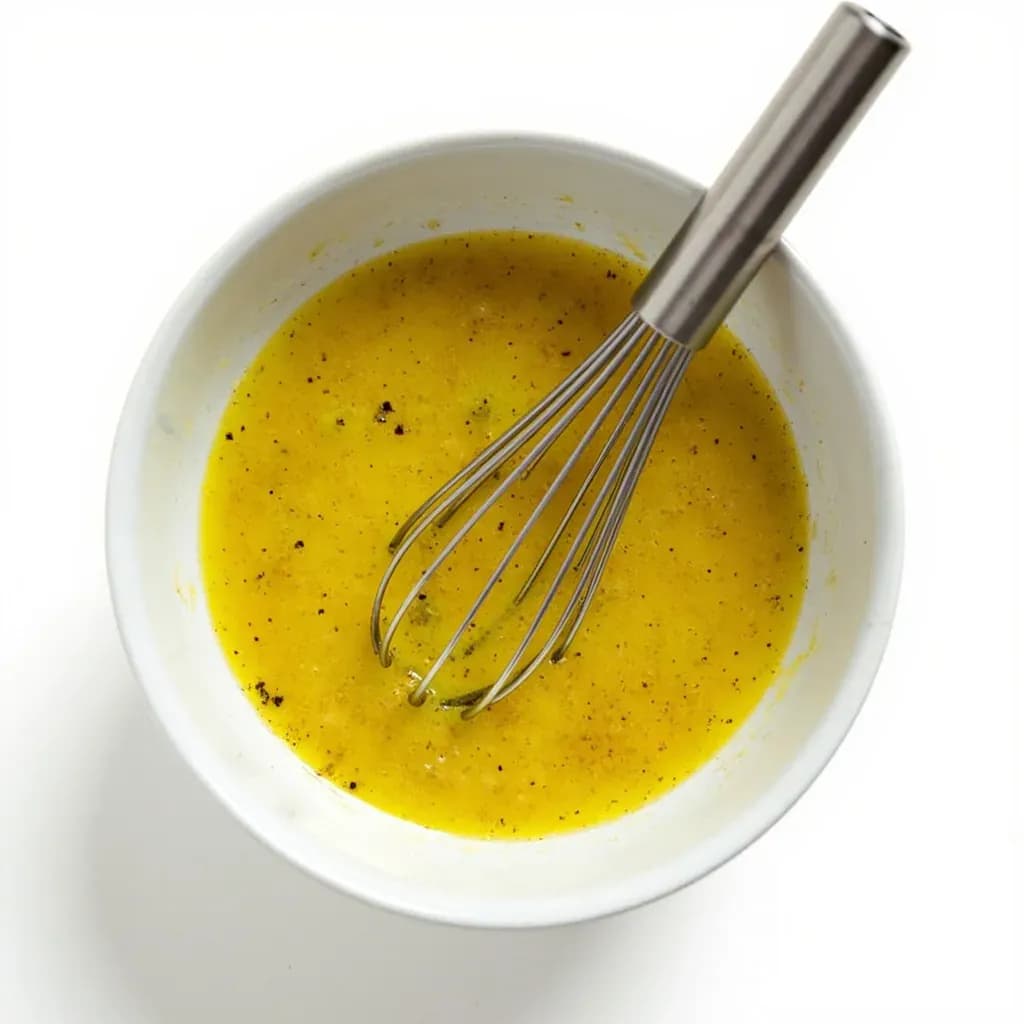
Whisking oil into vinegar or juice with an emulsifier to make a stable, creamy dressing.
Emulsifying dressings forces oil and a water-based liquid like vinegar or citrus into a stable suspension by whisking or blending while slowly streaming in the oil. An emulsifier such as mustard or egg yolk coats the droplets so they don't separate, giving a thick, glossy vinaigrette. The slow oil addition and constant agitation are what keep the emulsion from breaking.
Emulsifying dressings is the technique of forcing oil and a water-based liquid — vinegar, citrus juice, or broth — into a stable, uniform suspension with the help of an emulsifier and vigorous agitation. The work is done at the molecular level by amphiphilic molecules such as lecithin in egg yolk, mucilage in mustard, sesame proteins in tahini, or milk proteins in cream. They wrap each tiny oil droplet in a hydrophilic shell that keeps the droplets from merging back together. Without an emulsifier, oil and vinegar will visibly separate within minutes; with one, the mixture stays creamy for hours, days, or indefinitely.
The technique governs more of the kitchen than most cooks realize: the everyday vinaigrette, the creamy salad dressings built on mayonnaise, the warm butter sauces of classical French cooking, and the sauces built on tahini, yogurt, or mustard. Once a cook understands why an emulsion 'takes' and why it breaks, dozens of sauces become intuitive rather than intimidating.
In practice, emulsifying dressings falls into two camps. The first is the vinaigrette family, classically built at a 3:1 ratio of oil to acid and often stabilized only by mustard; these are temporary emulsions that separate on standing and need to be shaken before use. The second is the mayonnaise family, built on egg yolk or another protein-rich emulsifier; these are permanent, thick, and glossy, and they form the base of aioli, Caesar, rémoulade, Green Goddess, and ranch. Both respond to the same discipline: combine the emulsifier and acid first, then add oil slowly until the mixture thickens, then stream in the rest.
- Difficulty
- Easy
Types & varieties
Temporary emulsion of oil and vinegar or citrus juice; separates within minutes unless stabilized with mustard or another emulsifier.
Permanent cold emulsion of oil, egg yolk, mustard, and acid; the reference point for all egg-yolk emulsions.
Mediterranean garlic emulsion; traditionally made by pounding garlic to a paste and emulsifying with olive oil, with egg yolk optional in modern versions.
Anchovy, garlic, Dijon, egg yolk, lemon, Parmesan, and oil; often bloomed with a raw or coddled egg.
Warm emulsion of clarified butter, egg yolk, and lemon juice — one of the French mother sauces.
Hollandaise derivative flavored with tarragon, shallot, and a wine or vinegar reduction.
Mayo or sour-cream base blended with herbs (chives, tarragon, parsley), anchovy, and garlic.
Emulsified with buttermilk and stabilized by a base of mayo or sour cream; classic on iceberg wedges and alongside fried chicken.
Mayo base with ketchup or chili sauce, sweet pickle relish, and sometimes minced hard-boiled egg.
Ground sesame acts as its own emulsifier; whisked with lemon juice, garlic, and cold water to a pourable consistency.
Buttermilk and mayo base with dried and fresh herbs, garlic, and onion; a contemporary American emulsion.
How to do it
- 1
Set up and temper ingredients
Bring eggs and any dairy to room temperature. In a wide, non-reactive bowl (or the jar of a blender) combine the emulsifier — egg yolk, mustard, or both — with the acid (vinegar, lemon juice, or both), salt, and any aromatics like minced shallot or garlic paste.
- 2
Whisk the base to a uniform mixture
Whisk briefly until the salt dissolves, the yolks lighten slightly in color, and everything is fully combined. This aqueous phase is what the oil will be dispersed into.
- 3
Begin the emulsion drop by drop
Add oil literally a few drops at a time while whisking constantly in a circular motion. After about a tablespoon of oil the mixture should look glossy and have visibly thickened — the emulsion has 'taken.' Do not rush this stage; pour too fast and the sauce will split.
- 4
Stream in the remaining oil
Once thickened, continue adding oil in a thin, steady stream while whisking. With a blender or food processor, keep the machine running and pour oil through the feed tube. The sauce should end up thick, smooth, and glossy.
- 5
Finish and adjust
Whisk in any finishing acid (a final squeeze of lemon), herbs, cheese, or seasoning. Loosen with a teaspoon of warm water if too thick; tighten with another spoonful of oil if too thin. Taste on a leaf of the intended salad green.
- 6
Store
Transfer to a jar. For vinaigrettes, cap tightly and refrigerate up to 2 weeks; shake before using. For mayo-based dressings, refrigerate up to 1 week. Warm emulsions like hollandaise should be held at 140°F (60°C) in a bain-marie or used within an hour or two.
Why dressings break, and how to save them
An emulsion breaks when oil droplets clump back together faster than the emulsifier can keep them apart — usually because the oil was added too fast, the ingredients were too cold, or the sauce was held at the wrong temperature. A broken vinaigrette simply needs to be re-whisked; a broken mayonnaise or warm sauce can almost always be rescued.
- For vinaigrette: empty into a jar, cap tightly, and shake hard for 30 seconds. If it still splits, add a teaspoon of Dijon to a clean bowl and whisk the broken dressing in slowly.
- For mayonnaise: drop a fresh yolk (plus a teaspoon of Dijon and a pinch of salt) into a clean bowl, then whisk the broken sauce in drop by drop. It almost always re-emulsifies within minutes.
- For hollandaise or béarnaise: remove from heat immediately. Whisk in 1 tablespoon of warm water or a fresh yolk in a clean bowl, then whisk the broken sauce back in slowly. If the eggs have actually scrambled, start over — they cannot be saved.
- Prevent future breaks by tempering cold ingredients to room temperature, acidifying the yolk before adding oil, and pouring oil in a thin steady stream rather than in glugs.
Egg-free and low-egg emulsions
Several everyday ingredients carry enough emulsifying power to stabilize a dressing without raw yolk, which is useful for anyone avoiding undercooked egg, for vegan cooking, or simply for lighter sauces.
- Dijon mustard alone can hold a vinaigrette in suspension for hours; most French home cooks add a teaspoon per 1/2 cup of vinegar as a default.
- Tahini, thinned with lemon juice and cold water, makes a silky sauce with no egg at all.
- A small cooked potato, pushed through a ricer or finely grated, emulsifies much like a yolk — a useful trick in vegan cooking and for anyone avoiding raw egg.
- A handful of strained canned white beans blended with lemon, garlic, and oil produces a creamy vegan dressing indistinguishable from a thin mayo.
- Pasteurized shell eggs are widely available and behave identically to raw eggs in mayo; a soft-boiled yolk passed through a fine sieve is another safe option.
Common uses
Tips & pitfalls
- Bring eggs and dairy to room temperature before emulsifying; cold yolks are the single most common reason mayonnaise breaks.
- Always acid the yolk first: whisk vinegar or lemon juice into the yolk with salt before any oil touches it.
- Add oil a few drops at a time until you see the mixture turn glossy and thicken; only then stream in the rest in a thin, steady pour.
- If the emulsion breaks, don't throw it out. Start fresh with a new yolk and a teaspoon of mustard in a clean bowl, and whisk the broken sauce in drop by drop — it almost always recovers.
- Dijon mustard is the most reliable everyday stabilizer; even without egg, mustard alone can hold a vinaigrette in suspension for hours.
- An immersion blender placed at the bottom of a jar with all ingredients layered (yolk, mustard, acid, then oil poured on top) emulsifies mayonnaise in under a minute with no technique required.
- For warm emulsions, keep the heat low and the butter warm but not hot — butter that's too hot will cook the yolks and break the sauce.
Good to know
- Definition
- Forcing oil and a water-based liquid (vinegar, citrus juice, or broth) into a stable suspension using an emulsifier and vigorous agitation.
- Classic vinaigrette ratio
- 3 parts oil to 1 part acid; a working range of 2:1 to 4:1 depending on the acidity of the dressing and the bitterness of the greens.
- Mayonnaise ratio
- Roughly 1 cup (240 ml) oil per large egg yolk; commercial mayonnaise is typically 70–80% oil by weight.
- Common emulsifiers
- Egg yolk (lecithin), Dijon or whole-grain mustard, honey, garlic paste, tahini, cooked potato, strained white beans, or a splash of cream.
- Best equipment
- A wide non-reactive bowl and whisk for hand work; an immersion blender in a tall jar, countertop blender, or food processor for near-foolproof results.
- Temperature
- Room-temperature ingredients emulsify most reliably. Cold yolks are the most common cause of broken mayonnaise; warm (not hot) yolks are used for warm emulsions like hollandaise.
- Shelf life
- Vinaigrettes keep 1–2 weeks refrigerated; mayo-based dressings up to 1 week; warm butter emulsions should be held above 140°F (60°C) or used within 1–2 hours.
- Active time
- 2–5 minutes once ingredients are measured; longer if building flavor with garlic pastes or wine reductions.
Also called
Vinaigrette Emulsification · Whisking a Dressing
Related

Confit
Cook slowly submerged in fat for silky tenderness and keeping

Cure
Draw out moisture with salt and time to preserve and concentrate

Pickle
Steep in acidic brine for bright, tangy, crunchy preservation

Ferment
Let friendly microbes transform food into tangy, complex flavor

Marinate
Soak in a seasoned mix to flavor and tenderize before cooking

Brine
Soak in salt water so meat stays juicy and seasoned throughout

Dehydrate
Slowly dry out moisture to concentrate flavor and extend shelf life

Cold-Smoke
Perfume cured food with smoke without cooking it through