Heat & Fire
Flat-Top Stir-Fry
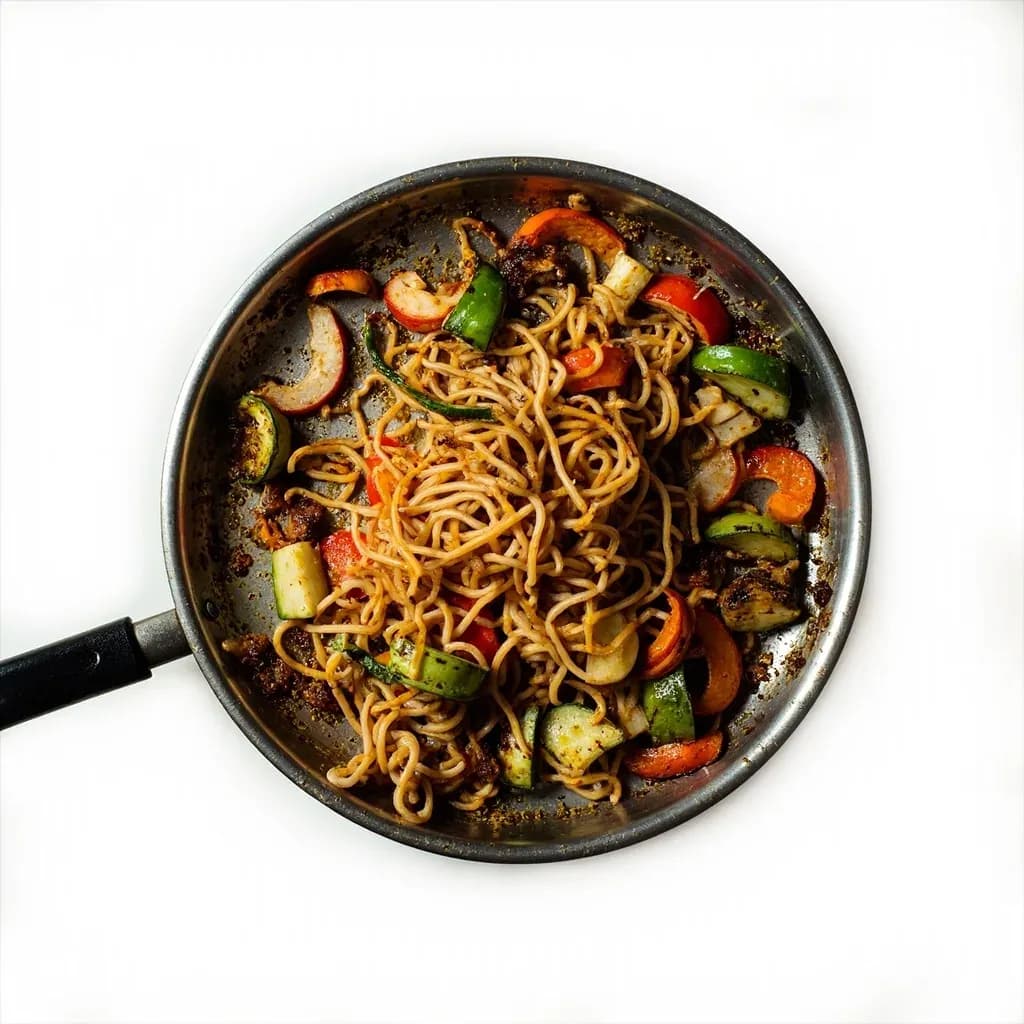
Stir-frying on a flat griddle (teppan/plancha) instead of a wok, spreading food for fast even searing.
Flat-top stir-fry cooks ingredients across a wide, flat heated griddle rather than a curved wok, letting the cook spread food out for maximum contact and quick searing. It is common in teppanyaki, hibachi and diner-style cooking. The large surface handles big batches and sears proteins and vegetables fast, though it lacks the wok's high-walled tossing action.
Flat-top stir-fry is the practice of cooking stir-fry ingredients on a broad, level heated surface — a Japanese teppan, Spanish plancha, commercial flat-top griddle, or a 12–14 inch carbon-steel crepe pan at home — rather than in the curved bowl of a wok. The defining gesture is press-and-sear with a flat-edged metal spatula, not toss-and-flip with a wok ladle. Every piece of food rests against hot metal the entire time it cooks, which produces a more uniform Maillard crust and removes much of the intimidation factor of wok technique.
The technique trades the smoky, convective breath of a properly fired wok — what Cantonese cooks call wok hei — for control, repeatability, and sheer surface area. A 60 cm teppan can sear thirty slices of beef in a single layer; a 14-inch crepe pan over a strong gas burner can do the same for a family dinner. Heat is managed by zone rather than by lifting and tossing: a screaming center for the initial sear, a cooler perimeter for staging and resting, and fond that concentrates fast and is scraped up with the spatula at the end to build the sauce.
The reason it matters is practical. Most home kitchens cannot deliver the 15 kW of focused heat a Cantonese chef uses, and most cooks have not spent a decade learning to toss. A flat, heavy, well-preheated piece of steel will forgive uneven burners, fussy ingredients, and modest knife skills in a way a wok will not. Many Chinese chefs themselves keep a flat carbon-steel pan specifically for seared proteins and switch to a wok only for the final toss — the two are complementary, not interchangeable.
- Difficulty
- Easy
Types & varieties
Japanese style on a solid iron plate, often with soy-mirin-sake sauces and clarified butter; popularized in postwar Kobe and Tokyo steak houses.
Spanish-origin polished steel plate run slightly cooler; oil brushed on with a pad; vegetables take on clean char stripes.
American restaurant interpretation on a flat iron over open gas burners, with garlic-butter-and-sake showmanship; closer to teppanyaki than to charcoal hibachi.
U.S. diner and food-truck approach; salt-and-smoke forward, batch-cooked, often finished with a quick pan sauce scraped from the griddle.
Flat brass or steel pan used for savory pancakes (pajeon, haemul jeon) and quick-seared meats like bulgogi; oil-heavy, lower temperature, built for crisp edges.
How to do it
- 1
Heat the plate
Place a teppan, plancha, flat-top, or 30–35 cm carbon-steel crepe pan over medium-high to high heat. Preheat 5–10 minutes until a drop of water skitters across the surface. Target 200–230 °C / 400–450 °F for general stir-fry work, closer to 180 °C for pancakes and eggs.
- 2
Season and oil the surface
Wipe a thin film of high-smoke-point oil — rice bran, grapeseed, avocado, or beef tallow — across the plate with a folded paper towel or silicone brush. The film should glisten, not pool; pooled oil fries unevenly and smokes.
- 3
Sear aromatics
Lay down smashed garlic, sliced shallot, ginger, or scallion whites. Press flat with the spatula for 10–20 seconds until fragrant and lightly browned, then push to the cooler perimeter to hold.
- 4
Lay proteins in a single layer
Arrange thinly sliced beef, pork, chicken, or seafood in a single layer with space between each piece. Press each piece flat with the spatula. Sear 60–90 seconds per side without moving them; flip once, when a deep brown crust has formed.
- 5
Stage proteins to the side
Shovel seared proteins to a cooler zone or onto a holding plate. Do not cover them — trapped steam softens the crust you just built.
- 6
Sear vegetables in stages
Add a little more oil if the plate looks dry. Spread vegetables in a single layer, in order of density: stems and roots first (asparagus, broccoli stems, mushrooms), then quick-cookers (peppers, snap peas, leafy greens). Press and flip rather than stir.
- 7
Sauce and finish
Return proteins to the hot zone. Pour in a small amount of sauce — soy-mirin-sake, oyster-sesame, garlic butter, or gochujang-honey. Chop and toss against the flat surface with the spatula, scraping up the fond. Cook 30–60 seconds until the sauce reduces to a glaze.
- 8
Rest and serve
Slide everything to a warmer edge for 30 seconds to let carryover heat settle, then plate directly off the teppan or transfer with the spatula. Garnish with scallion greens, toasted sesame, or a squeeze of citrus.
Flat-Top vs. Wok: What You Gain, What You Lose
A wok and a flat top are not substitutes; they are two different tools aimed at two different textures. The wok's curved sides and fierce, focused flame give you convective heat and evaporation — the surface tosses food through hot gases, and the small amount of liquid in the sauce flashes into steam that the food reabsorbs. That is what produces wok hei, the smoky breath of a well-fired Cantonese chao. A flat top cannot replicate this; there is no place for the food to fly through flame, and the sauce reduces against metal rather than evaporating in the air.
What the flat top does, and does better than almost anything else, is produce a uniform, glassy Maillard crust across many pieces at once. Every square centimeter of food touches hot steel, so browning is consistent. A 60 cm teppan will lay down thirty slices of beef in a single layer, sear them, and stage them in under three minutes — something a single wok cannot match. It is also far more forgiving on a home stove, where 15 kW burners are fantasy. A heavy carbon-steel crepe pan over a strong gas flame will behave like a small teppan; the same pan on a weak electric coil will simply steam.
The honest summary: choose a wok for smoky, sauce-light dishes where wok hei is the point — Cantonese chow, dry-fried green beans, yangzhou fried rice finished with extreme heat. Choose a flat top for crust, scale, and repeatability — teppanyaki-style beef and vegetables, Korean pancakes, smashed proteins, anything that reads as 'seared' rather than 'tossed.' Many restaurant lines use both, swapping pans mid-dish.
Equipment at Home
The best home analog to a 60 cm teppan is a 12–14 inch (30–35 cm) carbon-steel crepe pan or a flat cast-iron plancha set over the largest gas burner you own. Carbon steel is preferred because it heats fast, holds even temperature, and seasons like a wok. A cast-iron griddle or a thick carbon-steel disk works for induction, where a thin crepe pan may run hot in the center and cool at the rim. A ridged grill pan will give you attractive marks but acts like a series of small skillets, so it is not the right tool for this technique — you want uninterrupted flat metal.
Two spatulas are useful: a stiff, flat-edged metal scraper (the kind sold for commercial griddles) for pressing and chopping, and a thinner fish spatula for flipping delicate items like fish fillets or scallops. A squeeze bottle or small ladle for oil keeps the surface evenly filmed without pooling. An infrared thermometer is the single best $20 you can spend for this technique, because zone control on a home burner is largely guesswork without one.
Common uses
Tips & pitfalls
- Preheat the plate for 5–10 minutes before oiling; an under-heated flat top steams instead of sears, and this is the single most common home mistake.
- Oil the surface with a folded paper towel or silicone pad rather than pouring — pooled oil fries unevenly and smokes.
- Cook each component in its own layer and combine only at the end; mixing early sacrifices the crust you spent heat building.
- Use a flat-edged metal spatula and press, slice, and flip — do not try to toss. This is a press-and-sear technique, not a wok technique.
- Manage a hot center and a cooler perimeter; sear in the middle, push to the edge to rest or finish. Zone control replaces tossing.
- Choose fats with both smoke point and flavor: clarified butter, beef tallow, or rice-bran oil beat olive oil or untoasted sesame for crust and taste.
- Cut proteins thin and uniform (3–5 mm) so they cook through during the short sear without drying out at the edges.
- Deglaze with sake, mirin, or stock at the very end and scrape hard with the spatula — fond on a flat top concentrates quickly and finishes a sauce in seconds.
- Respect the batch size: a 30 cm teppan handles roughly 400 g of protein in a single layer; more than that and the surface steams instead of sears.
- For noodles or rice, drop aromatics and oil first, then the starch, and break up clumps by pressing the spatula flat rather than lifting.
Good to know
- Also known as
- Teppan stir-fry, plancha stir-fry, griddle stir-fry, hibachi-style stir-fry
- Core surfaces
- Japanese teppan (iron plate), Spanish plancha, commercial flat-top griddle, 12–14 in (30–35 cm) carbon-steel crepe pan
- Primary heat source
- Gas or electric flat metal plate heated from below; thermal mass is the critical spec
- Surface temperature
- 200–230 °C / 400–450 °F for general stir-fry work; lower for pancakes and eggs
- Spatula style
- Flat-edged metal scraper (griddle spatula) rather than a wok ladle (chuan)
- Key difference from wok
- Wider, level contact area; browning comes from contact, not from tossing into a flame
- Ideal batch size
- Single layer per pass, roughly 300–500 g of protein on a 30 cm pan (about 4–6 kg per m² of surface)
- Difficulty
- Moderate — easier than wok tossing, harder than deep sauté because of zone management
Also called
griddle stir-fry · teppan stir-fry
Related

Sear
Blast the surface hot for a deep-browned, savory crust

Sauté
Cook quickly in a little fat over lively heat, tossing as you go

Stir-Fry
Toss bite-sized pieces over roaring heat for fast, smoky cooking

Pan-Fry
Crisp food in a shallow layer of hot fat, turning once or twice

Deep-Fry
Submerge in hot oil for an all-over crackling crust

Roast
Cook uncovered in dry oven heat for browned edges and tender centers

Bake
Cook with steady, surrounding oven heat — the soul of bread and pastry

Broil
Hit food from directly above with fierce overhead heat