Heat & Fire
Fried Rice Tossing
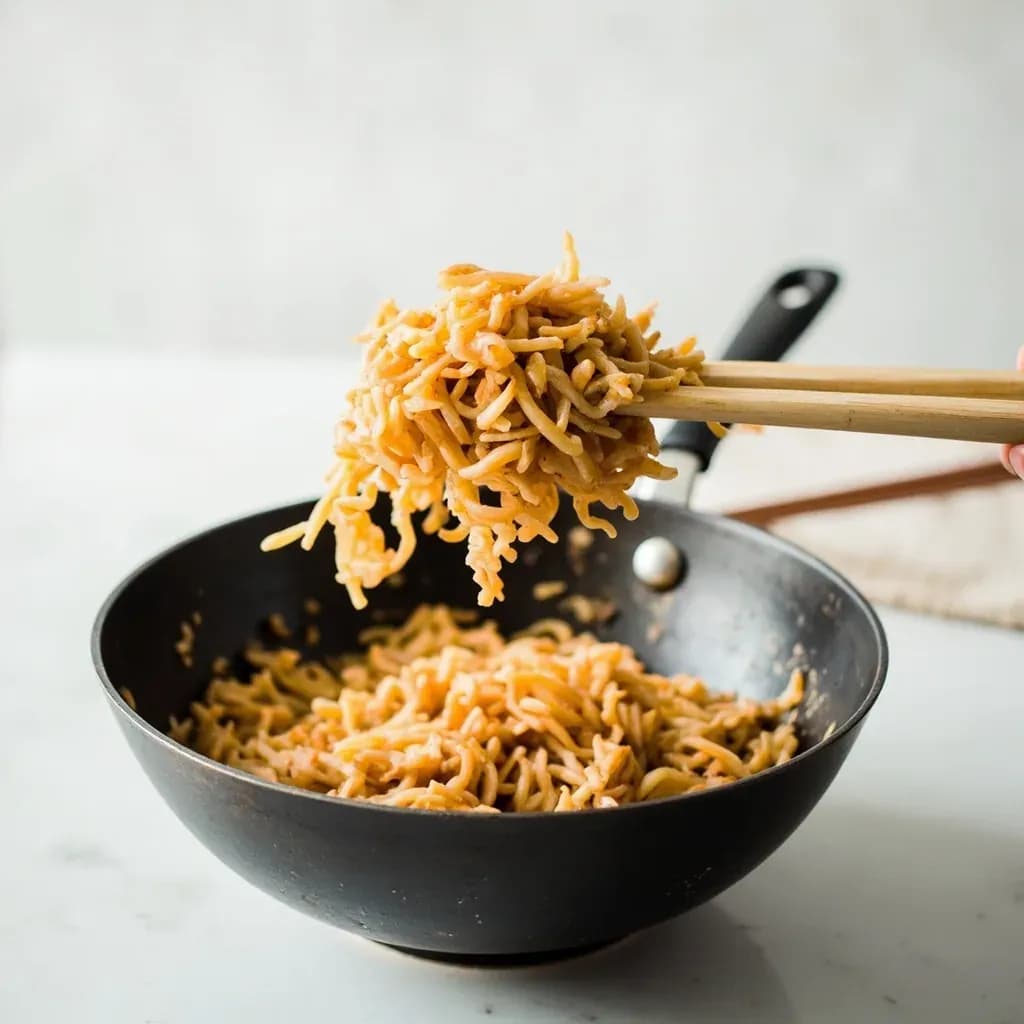
Tossing rice in a screaming-hot wok so every grain separates, sears and picks up smoky wok hei.
Fried rice tossing flings day-old rice repeatedly through the air in a very hot wok so grains separate, dry slightly and sear without clumping or steaming. The constant motion exposes rice to the wok's heat for the smoky flavor known as wok hei. Cold, dry rice and high heat are essential to keep the texture light rather than mushy.
Few techniques in a Chinese kitchen are as much a performance as they are a craft. Fried rice tossing is the high-heat, continuous-agitation method that sends cold, dry rice grains through a wok so hot it is smoking, separating them into distinct pearls, searing them in a thin film of oil, and building the smoky aroma known as wok hei. It is not the same as stirring rice with a spatula: the wok is lifted and snapped, the rice flies up the curved wall, and a ladle catches and turns it back into the heat. The motion is fast, rhythmic, and unforgiving of cold equipment, wet rice, or timid hands.
The technique matters because it produces three things a spoon or a spatula cannot. First, individual grains that stay loose and dry rather than gummy. Second, a slight crust or char on the outside of each grain, the surface Maillard browning that gives fried rice its savory backbone. Third, wok hei — the breath of the wok — which forms when oil, fat, and tiny flecks of food vaporize against steel at temperatures above 250 °C and redeposit on the rice as a complex, almost charred perfume. Lose any of these and the dish is still tasty, but it is no longer fried rice in the restaurant sense.
In practice the tossing is a 60 to 90 second choreography inside a wok that has been heated until it smokes, and it assumes a particular set of conditions: day-old rice that has lost its surface moisture, a carbon steel wok seasoned to a deep bronze, a burner that can output far more heat than a typical home stove, and pre-cooked proteins and vegetables that go in and out in seconds so the wok never cools. Most home failures are not really technique failures — they are equipment and ingredient failures. Halve the batch, accept a softer version of wok hei, and the dish still rewards the cook who can master the rhythm.
- Difficulty
- Medium
Types & varieties
Restaurant benchmark: thin soy seasoning, pronounced wok hei, eggs scrambled directly into the rice, finished with scallions
From Yangzhou, Jiangsu; includes shrimp, char siu pork, peas and egg, with a slightly softer texture and less smoke than Cantonese versions
Seasoned with fish sauce, lime, garlic and Thai chilies; often served with cucumber, lime and prik nam pla
Built on kecap manis (sweet soy sauce), shallots and sambal, traditionally topped with a fried egg and krupuk
Richer seasoning base, often butter- or ketchup-tinted; less wok hei, more uniform soft texture
Garlic-forward breakfast rice, typically tossed gently with toasted garlic rather than at high heat
Rustic home style with anchovies, sambal belacan and long beans
Heavier on sambal, lap cheong and seafood, with a smoky, deep char
How to do it
- 1
Prepare the rice
Use day-old long- or medium-grain rice that is fully chilled and dry. Tumble it through your fingers to break clumps into individual grains. If the rice feels tacky, spread it on a sheet pan and air-dry 20 minutes.
- 2
Heat the wok to smoking point
Place a clean carbon steel wok over the highest flame or jet burner. Hold for 2–3 minutes until a faint haze of smoke lifts from the steel. This is the only way to get real wok hei.
- 3
Season the wok with oil
Add 2 tablespoons neutral oil (peanut, canola, or rice bran). Swirl so a thin film coats the entire inner surface, including the walls. Oil should ripple instantly.
- 4
Aromatics and proteins first
Toss in minced garlic, ginger, or shallots for 10 seconds. Add pre-blanched or pre-cooked proteins (shrimp, char siu, chicken) and sear just to heat through, then scoop them out to a plate so they do not overcook while the rice is tossed.
- 5
Scramble the egg into the wok
Crack 2–3 eggs directly into the hot zone, let them puff for 5 seconds, then break the yolks with the spatula and toss once. Add the rice immediately on top so grains coat with the setting egg.
- 6
Toss the rice to separate grains
Begin the rhythm: push the wok forward with one hand, snap the wrist back, and use the ladle in the other hand to scoop and turn the rice up the side. Keep rice in constant motion for 60–90 seconds until every grain is coated and individual.
- 7
Season in thin streams
Drizzle light soy sauce around the wok's rim and a smaller amount of dark soy sauce for color, plus a pinch of white pepper. Toss to distribute. Avoid pouring sauce directly onto rice or it will steam and clump.
- 8
Return vegetables and proteins and finish
Toss back in the reserved proteins along with scallion whites, peas, or other quick vegetables. Two or three hard tosses to integrate, then kill the heat.
- 9
Off-heat garnish and serve
Taste, then salt only if needed (soy sauce has already seasoned the dish). Add scallion greens and a whisper of toasted sesame oil off the burner. Toss once, plate immediately, and serve while the rice still smells of smoke.
Wok Hei and the Home Heat Gap
Wok hei is not an ingredient you can fake and not really a flavor you can add at the end. It is a state of the wok — a layer of vaporized oil, moisture and amino acids that lands back on the food as the rice is tossed. In a Cantonese restaurant, the burner alone can hit 150,000 BTU; a home gas burner on its highest setting runs closer to 12,000 to 15,000 BTU, and an electric coil cannot reach either. The gap shows up directly in the rice: pale grains, soft texture, no char, and a missing perfume. The honest move is to acknowledge the gap and design around it rather than pretend it is not there.
- Cut the batch in half so the wok can recover between tosses; a 1 kg restaurant load in a 2 kg home wok will never sear.
- Preheat the carbon steel wok a full 3 minutes over the highest flame, then add oil only when a faint haze lifts from the steel.
- Use a flat-bottomed wok on an electric stove to maximize contact with the coil, or move the cooking outdoors to a propane jet burner.
- Build wok hei with fat, not just oil: a tablespoon of lard or schmaltz alongside neutral oil helps the rice pick up more vaporized flavor.
- Toss in a final splash of hot oil around the rim of the wok at the end — the sizzle against the steel is where the last layer of aroma is born.
Common uses
Tips & pitfalls
- Use rice that has been refrigerated uncovered or loosely covered for at least 12 hours — surface dryness is non-negotiable, and freshly cooked rice is the most common reason for mushy fried rice.
- Heat the wok until it just starts to smoke, then add oil and let the oil shimmer before any ingredient goes in; a tepid wok sears nothing and only steams the rice.
- Pre-cook proteins, vegetables and aromatics in small batches and set them aside on a plate, then toss them back in at the end so the wok never cools during the rice stage.
- Add egg to the wok first, scramble lightly, then pile the rice directly onto the curds — adding rice first leaves you with rubbery egg ribbons rather than the egg-coated grains that give good fried rice its color.
- Seasonings go in a thin stream around the perimeter of the wok, not pooled in the center, so they vaporize against the hot steel instead of soaking into the rice and turning it soggy.
- Salt the dish at the very end — soy sauce is already salty, and over-salting masks the wok hei you worked to build. Taste before reaching for the salt.
- Never press or mash the rice — every downward force compacts grains, releases starch and ruins the dry, distinct texture; the wok and ladle should turn the rice, never crush it.
- If rice sticks, the wok has cooled or you are using too little oil; add another small splash of oil, scrape clean, reheat until smoking, and resume tossing.
- Home stoves rarely match restaurant heat, so cook half-batches or split the rice across two pans rather than overcrowding — a single overloaded wok will turn the dish into a soft, pale pilaf.
Good to know
- Origin
- China; rooted in Cantonese restaurant wok cookery, with fried rice itself documented as early as the Sui Dynasty (589–618 CE)
- Core Principle
- Constant high-heat agitation in a curved wok so rice grains stay in motion, sear individually, and absorb wok hei
- Wok Hei
- The 'breath of the wok' — a smoky, charred aroma created when oil, fat and food vaporize against superheated steel at 250 °C and above
- Equipment
- Carbon steel wok (35–40 cm typical), wok ladle (hoak), wok spatula (chuan), long-handled tools, high-output burner (15,000+ BTU / jet burner ideal)
- Rice Spec
- Day-old, fully cooled long-grain or medium-grain rice; each grain should feel dry and distinct before hitting the wok
- Typical Batch Size
- Home wok: 2–3 cups cooked rice per batch; restaurant wok: 4–6 cups maximum to preserve heat
- Cook Time
- 60–120 seconds of active tossing once rice is in the wok; total dish assembly 3–5 minutes
- Difficulty
- Intermediate; requires wrist strength, rhythm, and confidence with very hot equipment
Also called
wok tossing rice · fried rice flip
Related

Sear
Blast the surface hot for a deep-browned, savory crust

Sauté
Cook quickly in a little fat over lively heat, tossing as you go

Stir-Fry
Toss bite-sized pieces over roaring heat for fast, smoky cooking

Pan-Fry
Crisp food in a shallow layer of hot fat, turning once or twice

Deep-Fry
Submerge in hot oil for an all-over crackling crust

Roast
Cook uncovered in dry oven heat for browned edges and tender centers

Bake
Cook with steady, surrounding oven heat — the soul of bread and pastry

Broil
Hit food from directly above with fierce overhead heat