Transform & Preserve
Gelification
Setting a liquid into a gel using agents like agar, gelatin, or pectin.
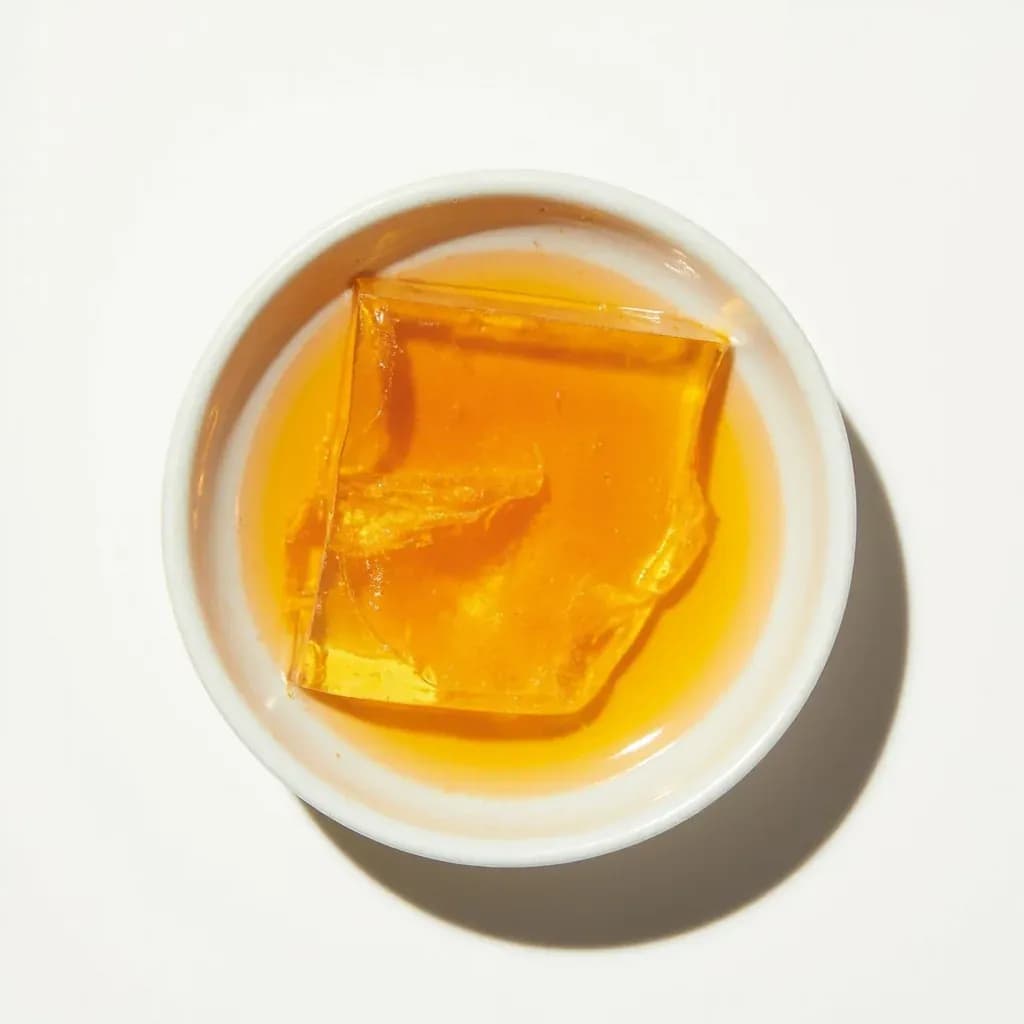
Gelification turns a flavored liquid into a solid or semi-solid gel by dispersing a hydrocolloid such as agar-agar, gelatin, or pectin and then cooling it. It is used to make jellies, panna cotta, terrines, and modernist fluid gels, and to give sauces sliceable structure. Agar sets firm at room temperature and stays stable when warm, while gelatin melts near body temperature for a softer, melt-in-the-mouth texture.
Gelification is the transformation of a liquid into a coherent semi-solid through the action of a hydrocolloid — a long-chain molecule that traps water in a three-dimensional network. It is one of the foundational techniques of modern cuisine, sitting alongside emulsification and foaming as a way to manipulate texture. The principle is simple in concept but unforgiving in practice: each gelling agent has its own dispersion method, activation temperature, ion requirement, and pH window, and treating them interchangeably is the fastest way to produce a puddle instead of a plate.
The gel you choose shapes the dish. Agar and gellan give a clean, vegan, slightly brittle set that holds at room temperature; gelatin yields an elastic, melt-in-the-mouth texture that warms on the tongue; pectin is the workhorse of sweet preserves, demanding sugar and acid; carrageenan and konjac produce savory slices with body. Beyond the classic set, the technique extends to fluid gels (sheared gels that pour like a sauce but briefly hold their mark on the plate), hot foams set with methylcellulose, and thin films of alginate. A small working library — agar, gelatin, HM pectin, kappa carrageenan, low-acyl gellan, and methylcellulose — covers the great majority of gel work in both sweet and savory kitchens.
- Difficulty
- Medium
Types & varieties
Polysaccharide from red algae; firm, clean, slightly brittle; vegan; sets at room temperature; irreversible melt.
Animal collagen protein; smooth, elastic, melt-in-the-mouth; thermally reversible; not vegetarian.
High-methoxyl pectin; sets with sugar (≥60% soluble solids) and acid (pH 3.0–3.4); the classic jam texture.
Low-methoxyl pectin; calcium-set; works at low sugar and broad pH range; good for reduced-sugar preserves and savory gels.
Firm, short, brittle gel with potassium; vegan.
Soft, elastic, thixotropic gel set with calcium; good for spoonable savory gels.
Non-gelling thickener only; increases viscosity without setting.
Soft, elastic, fluid-gel-friendly; heat-stable; vegan.
Firm, brittle, very clear gel; requires ions (calcium or magnesium) to set; vegan.
Thermally inverted — sets when hot (above ~50 °C), melts when cooled; used for hot foams, froths, and edible coatings.
Non-gelling on its own; used with agar, xanthan, or carrageenan to modify texture; synergistic with xanthan.
Non-gelling thickener; gives pseudoplastic flow; commonly combined with gelling agents to prevent syneresis.
Sets on contact with calcium; used for basic spherification and thin-film gels.
Konjac glucomannan with calcium; strong, elastic, heat-stable vegan gel with a gummy or jelly texture.
How to do it
- 1
1. Choose the gelling agent and target texture
Match the agent to the result: agar or gellan for a vegan, clean, slightly brittle gel; gelatin for an elastic, melt-in-the-mouth mouthfeel; HM pectin for sweet preserves; carrageenan or konjac for firmer savory slices; methylcellulose for hot gels or foams.
- 2
2. Calculate and weigh
Use a 0.01 g digital scale. Typical starting points: agar 1%, gelatin 1.2%, HM pectin 1% (with 60% sugar and pH 3.2), kappa carrageenan 0.3%, low-acyl gellan 0.3%, methylcellulose 1%. Adjust on the second batch.
- 3
3. Hydrate or disperse
Bloom gelatin in cold liquid for 5–10 minutes. Sprinkle agar, gellan, or methylcellulose into cold or room-temperature liquid while whisking vigorously — never add as a dry lump. Premix pectin with five times its weight in sugar before whisking in, to prevent clumping.
- 4
4. Heat and activate
Bring the dispersion to the temperature the agent requires: agar and gellan to a full rolling boil for 1–2 minutes; methylcellulose above 80 °C; gelatin just to 60–70 °C (do not boil); HM pectin to a vigorous boil with sugar. Skim foam or vacuum-degas for a clear gel.
- 5
5. Combine with the flavor base and adjust
Stir in fruit purée, stock, herb infusion, alcohol, or other flavorings off the heat. Check pH for agar (keep above 3.5) and pectin (3.0–3.4 for HM); for ion-dependent agents (gellan, kappa carrageenan), add calcium or potassium at this stage if required.
- 6
6. Pour, mold, or sheet
Pour into silicone molds, ring molds, a shallow tray for slicing, or directly onto a plate for a flat disc. Tap gently to release trapped air bubbles; mist the surface with cooking spray if a glossy top is desired.
- 7
7. Set under correct conditions
Agar and gellan set at room temperature in 30–60 minutes. Gelatin must chill below 15 °C for 2–4 hours. Pectin jams set as they cool and reach gel point near 105 °C. Methylcellulose must cool below about 40 °C to liquefy again.
- 8
8. Unmold, portion, and serve
Unmold onto chilled plates for clean shapes; agar releases easily from silicone. Cut with a hot, wiped knife for clean slices. Serve gelatin gels chilled; agar and gellan can be served at room temperature. Store covered and refrigerated for 2–5 days (agar lasts longest, gelatin shortest).
Choosing the right hydrocolloid
Match the agent to the dish before you measure a single gram. The decision is driven by three things: dietary need, the mouthfeel you want on the plate, and what else is in the pot.
- Vegan or vegetarian menu: agar, gellan, kappa or iota carrageenan, konjac, methylcellulose, LM pectin.
- Smooth, elastic, melt-in-the-mouth: gelatin — silver sheet at 250 bloom is the kitchen workhorse.
- Clean, brittle, holds at room temperature: agar or low-acyl gellan; both unmold cleanly from silicone.
- Sweet preserve at high sugar: HM pectin, premixed with sugar and added at a full boil.
- Reduced-sugar or savory preserve: LM pectin or kappa carrageenan with added calcium.
- Spoonable savory gel that gives on the spoon: iota carrageenan or high-acyl gellan.
- Hot foam or coating that sets above 50 °C: methylcellulose — the only common gellant that sets when heated.
- Caviar-like pearls or thin films: sodium alginate combined with a calcium bath (basic spherification).
Common uses
Tips & pitfalls
- Weigh the hydrocolloid to 0.01 g — a few extra milligrams of agar can turn a delicate gel into rubber.
- Bloom gelatin in cold liquid for 5–10 minutes; sprinkle agar and gellan into cold liquid while whisking. Adding them as a dry heap is the most common cause of grainy, lumpy gels.
- Always bring agar or gellan to a full rolling boil for at least one minute; under-heated agar will never set, no matter how long you wait.
- Never combine fresh pineapple, kiwi, papaya, ginger, or fresh figs with gelatin unless they have been cooked first — their proteases destroy the gel.
- Add acid (vinegar, citrus juice) to agar gels after cooking, off the heat, or the acid will hydrolyze the agar and the gel will refuse to set.
- Do not boil gelatin past 80 °C or hold it for hours; extended heat breaks down its setting power. Temper it into warm, never boiling, bases.
- For HM pectin, premix the powder with five times its weight in sugar before whisking into the boiling liquid — direct addition creates stubborn fish-eyes.
- Add 0.1–0.2% xanthan to agar or carrageenan gels to suppress syneresis, the weeping that shows up after a day in the fridge.
Good to know
- Category
- Modernist texture technique; transforms a liquid into a semi-solid gel using a hydrocolloid
- Origin of agar
- Discovered in Japan around 1658 by Minoya Tarazaemon, who reportedly discarded seaweed jelly and found it had gelled overnight
- Pectin isolated
- By French chemist Henri Braconnot in 1825; named from the Greek 'pektos' (congealed)
- Modernist popularization
- Central to the cuisine developed at elBulli (1994–2011) under Ferran Adrià, building on work by Hervé This and Nicholas Kurti
- Typical concentrations
- Agar 0.2–2%; gelatin 0.5–3%; HM pectin 0.5–1.5% with 60–65% sugar; kappa carrageenan 0.1–0.5%; gellan 0.1–0.5%
- Setting and melting
- Agar sets at 32–40 °C and remelts only above 85 °C (irreversible once melted); gelatin sets near 15 °C and melts at body temperature (~32–35 °C, fully reversible)
- pH sensitivity
- Agar hydrolyzes below pH 3.5 (add acid after cooking); gelatin loses strength below pH 3 and is broken down by proteases in fresh pineapple, kiwi, papaya, ginger, and fresh figs
- Storage
- Most gels hold 2–5 days refrigerated; agar tolerates ambient temperature; gelatin must stay below 20 °C
Also called
setting-with-agar · gelling · jellying
Related

Confit
Cook slowly submerged in fat for silky tenderness and keeping

Cure
Draw out moisture with salt and time to preserve and concentrate

Pickle
Steep in acidic brine for bright, tangy, crunchy preservation

Ferment
Let friendly microbes transform food into tangy, complex flavor

Marinate
Soak in a seasoned mix to flavor and tenderize before cooking

Brine
Soak in salt water so meat stays juicy and seasoned throughout

Dehydrate
Slowly dry out moisture to concentrate flavor and extend shelf life

Cold-Smoke
Perfume cured food with smoke without cooking it through