Prep & Assembly
Grinding Meat
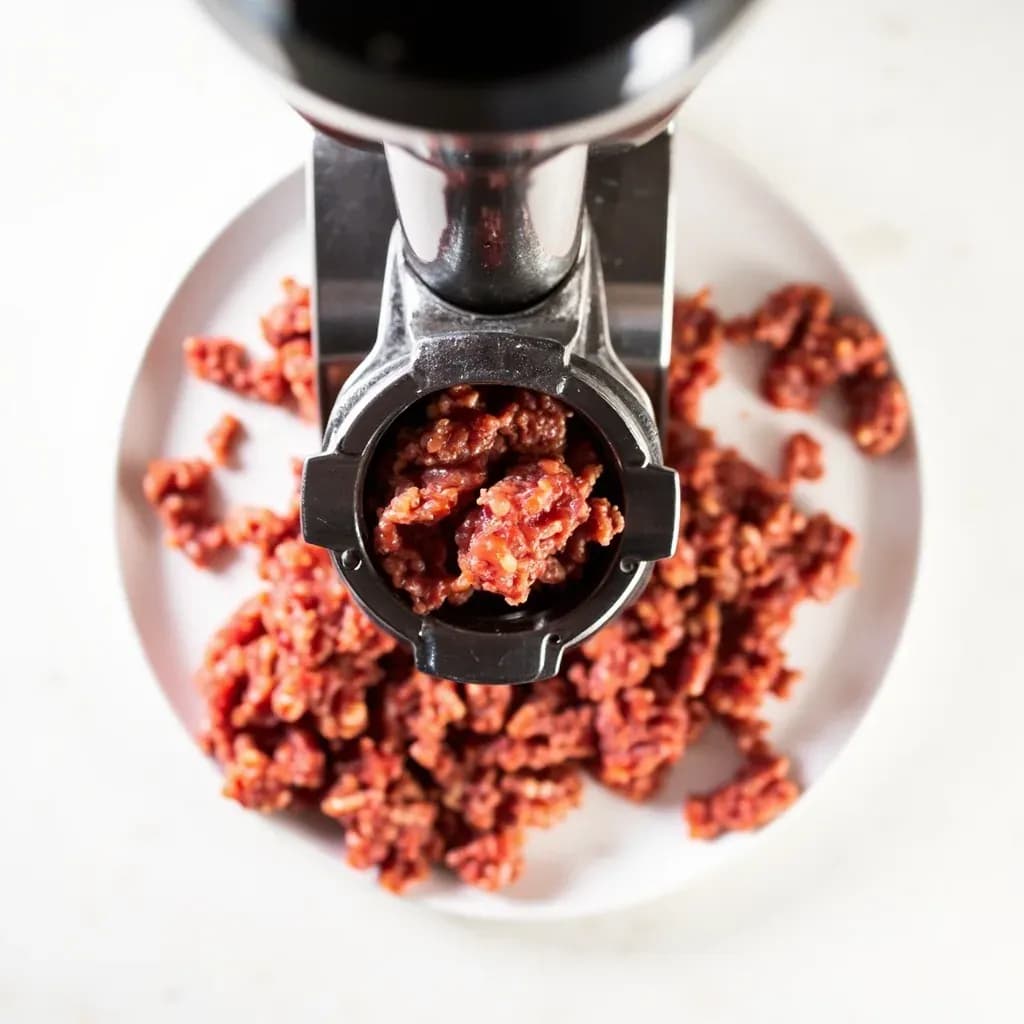
Mincing meat and fat into ground meat for burgers, sausage, or kofta.
Grinding meat passes chilled cubes of meat and fat through a grinder plate to produce ground meat with a controlled fat ratio and texture. It is used for burgers, sausages, meatballs, and pastes like qima. Keeping the meat, fat, and grinder parts very cold is critical so the fat stays in distinct flecks rather than smearing, which gives a juicier, better-textured result.
Grinding meat is the deliberate reduction of solid muscle and fat into small, uniform particles by cutting — not tearing, mashing, or blending. It is one of the oldest and most useful techniques in the kitchen: it expands surface area for seasoning, distributes fat evenly through lean tissue, and turns tough but flavorful cuts into tender burgers, sausages, meatballs, and stuffings. The character of the finished dish — coarse and rustic, fine and silky, or somewhere in between — depends almost entirely on the diameter of the grinder plate and the sharpness of the blade, not on how long the meat is worked.
Two physical realities govern the outcome. First, fat smears at room temperature; warm fat coats protein strands and creates a dense, rubbery texture, which is why meat and equipment must be chilled to near freezing (28–34 °F / −2 to 1 °C) before grinding. Second, a sharp blade shears cleanly between cells, while a dull blade tears them, releasing sticky proteins and producing a pasty, sausage-like result even before seasoning. Get the temperature and the edge right, and grinding is one of the easiest techniques in the kitchen; get either wrong, and even expensive cuts turn out dense, gray, and tough.
In modern home cooking, the same principles apply whether you use a stand-mixer attachment, a countertop electric grinder, a food processor, or two heavy knives on a cold marble or wooden block. The machine matters less than the discipline: trim carefully, chill thoroughly, cut into pieces that feed smoothly, grind once (or twice for finer textures), and handle the finished grind as little as possible before cooking.
- Difficulty
- Medium
Types & varieties
10–12 mm kidney plate; used for chili, ragù, fresh sausages like Italian salsiccia, and rustic burgers where texture matters.
4.5–6 mm plate, often run twice; used for hot dogs, bologna, smooth pâtés, meatballs, and kofta.
Meat cut with a sharp knife or mezzaluna on a cold board; yields irregular, distinct pieces prized in steak tartare and charcuterie.
Fine grind combined with liquid, fat, and seasoning in a food processor until sticky and paste-like; basis of mortadella, frankfurters, and liver mousse.
Common for sausages and pâtés to ensure spice and fat are evenly distributed and texture is uniform.
How to do it
- 1
Chill the meat and equipment
Cut the meat and fat into 1-inch pieces, spread on a sheet pan, and freeze 20–40 minutes until firm at the edges (28–34 °F). Place the grinder plate, blade, and auger in the freezer for at least 15 minutes. Cold is non-negotiable for clean cuts.
- 2
Trim and portion
Remove silver skin, large tendons, glands, bone fragments, and hard fat caps. Decide on the meat-to-fat ratio (80/20 chuck for burgers, 70/30 pork shoulder plus back fat for sausage, and so on). Separate lean and fat into two piles for alternating feed.
- 3
Assemble the grinder
Insert the auger, then the blade (sharp edge facing the plate, flat side toward the auger), then the plate. Lock the head ring finger-tight. Position a cold bowl or chilled sheet pan beneath the outlet to catch the grind.
- 4
First grind (coarse)
Turn the grinder on, or crank steadily, and feed meat a piece at a time, alternating lean and fat. Use the pusher — never your fingers. Let the motor run at a steady pace; forcing meat causes heat buildup and jamming.
- 5
Optional second grind (fine)
For sausage, pâté, or any smooth-textured dish, switch to a 4.5–6 mm plate and pass the coarse grind through once more. This distributes fat and seasoning more evenly and produces a finer, more uniform texture.
- 6
Handle minimally and chill
Once ground, do not knead or press. Return the grind to the refrigerator if not cooking immediately. Form patties or stuff sausage within 1–2 hours, or freeze flat in labeled bags for up to 3 months.
- 7
Cook or season
Season with salt only just before cooking for burgers, so myosin doesn't dissolve and over-compact the patty. For sausage, mix seasonings and any cold liquid (wine, stock) gently with a paddle or by hand until just combined, then stuff or form.
The science of clean grinding
Grinding is fundamentally a temperature-and-sharpness technique, not a blending one. The most common failure — smeary, dense, rubbery texture — almost always traces back to warm meat, dull blades, or overworking the grind. Below 34 °F, intramuscular fat is firm enough to be sliced cleanly by the blade, and muscle fibers separate along their natural planes. Above 50 °F, the same fat softens under pressure and smears across protein strands, binding them into a paste that tightens further on cooking.
Sharpness matters just as much. A fresh blade slices through the meat in a single pass; a dull one compresses the meat against the plate, generating frictional heat and pushing soluble proteins (especially myosin) to the surface. That sticky protein layer is what makes over-handled ground meat feel bouncy and turn springy when cooked. In practice, this means replacing grinder blades when they nick or roll, sharpening knives used for hand-chopping, and resisting the urge to feed meat faster than the machine can cut it.
- Cold (28–34 °F) keeps fat solid so it is sliced, not smeared.
- Sharp blades cut between cells; dull ones tear them and release sticky proteins.
- A steady, moderate feed rate prevents friction heating inside the auger.
- Two distinct piles — lean and fat — let you alternate pieces for an even blend.
Choosing and blending cuts
Single-cut ground meat is the exception in good cooking. Most professional grinders, and an increasing number of home cooks, blend two or three cuts to balance flavor, fat, and texture. Chuck alone is fine for burgers, but adding brisket contributes deep beefiness and short rib brings unctuous, well-marbled richness. For pork sausage, shoulder (Boston butt) provides the right 70/30 ratio, but a small amount of back fat pushes the blend into a silkier 60/40 ideal for fresh Italian-style links. Lamb shoulder benefits from a touch of beef or pork fat to mellow its strong flavor; lean turkey or chicken almost always needs added pork fat to stay moist.
Common uses
Tips & pitfalls
- Partially freeze meat for 20–40 minutes and chill all grinder parts; this is the single most important step for clean grinding.
- Cut meat into 1-inch strips or cubes so pieces feed smoothly without jamming the auger.
- Trim silver skin, large tendons, glands, and bone fragments before grinding — they wrap around the blade and dull it fast.
- Feed fat and lean in alternating pieces so the grinder blends them evenly rather than producing one lean, one fatty batch.
- For burgers, season only just before cooking; salt draws out moisture and dissolves myosin, which over-compacts the patty.
- Form patties gently and do not press or compress; loose, just-bound patties stay juicier on the grill.
- If using a food processor, pulse in short bursts with very cold meat and stop before it turns to paste — the texture will be finer than a true grind.
- Sharpen or replace blades regularly; dull blades tear rather than cut, producing smearing and a mushy texture.
Good to know
- Definition
- Mechanical or manual reduction of solid meat (and often fat) into small, uniform particles using a grinder, food processor, or knife.
- Ideal meat temperature
- 28–34 °F (−2 to 1 °C) — near freezing. Cold meat cuts cleanly; warm meat smears fat into protein and becomes pasty.
- Texture control
- Coarse plate (≈10–12 mm) for rustic textures; fine plate (≈4.5–6 mm), often run twice, for smooth emulsified sausages and pâtés.
- Standard fat ratios
- 70/30 to 80/20 meat-to-fat for burgers; 60/40 to 70/30 for fresh Italian-style sausage.
- Common cuts
- Chuck, brisket, short rib, round, pork shoulder (Boston butt), veal shoulder, lamb shoulder, and pork back fat for blending.
- Yield
- Trimming losses of 10–20% are normal when removing sinew, silver skin, glands, and hard fat before grinding.
- Shelf life
- Use raw grind within 1–2 days refrigerated, or freeze up to 3 months; grind just before cooking for best texture and food safety.
- Active time
- 5–15 minutes to grind 2–3 lb through a home grinder, plus 20–40 minutes of pre-chilling.
Also called
Meat Grinding · Mincing Meat · Grinding Meat (Qima) · Cold-Chain Grinding
Dishes that rely on it
Related

Whisk
Beat ingredients smooth and aerated with a looping wire motion

Sift
Pass dry ingredients through mesh to aerate and remove lumps

Strain
Pour through mesh to separate solids from liquid for a smooth result

Filter
Pass liquid through fine material to clarify out the smallest particles

Rice
Press cooked potatoes through small holes for fluffy, lump-free texture

Mash
Crush soft cooked food into a rustic, creamy purée

Grind
Crush food into a coarse to fine texture, from spices to meat

Grate
Shred food into fine bits against a sharp-toothed surface