Knife Skills
Hand-Cutting Pasta
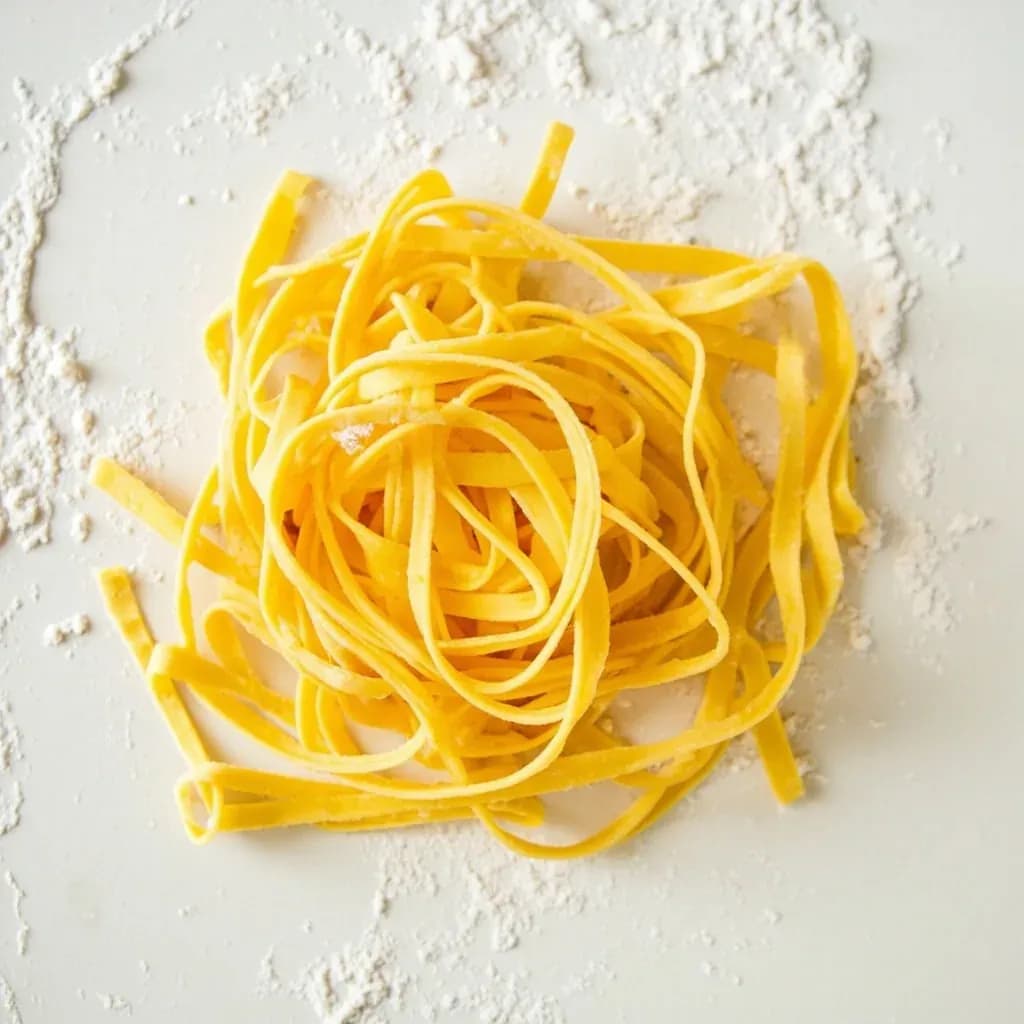
Rolling and slicing a pasta sheet by hand into ribbons like tagliatelle.
Hand-cutting pasta loosely rolls a thin sheet of fresh dough into a flat coil, then slices across it with a knife to make ribbons such as tagliatelle, fettuccine, or pappardelle, which are then unfurled and dusted with flour. The width of the cut defines the pasta's name. Cutting by hand gives slightly irregular edges that hold rustic sauces beautifully.
Hand-cutting pasta is the most elemental way to turn a sheet of fresh dough into ribbons, strips, and irregular shapes — a sheet rolled thin, dusted with semolina, folded loosely, and sliced across with a long knife. The technique predates the pasta machine and remains the standard in Italian homes and in many trattorie, where the irregular, hand-formed edge of each strip is treated as part of the pasta's character rather than a defect.
The hand-cut edge grips sauce in ways an extruded or die-cut edge does not. Ragù catches on the slight tooth; butter pools in the faint waves; pesto clings to the curls. Combined with the egg-rich dough that hand-cutting requires, that texture is why the technique persists even when a pasta machine sits on the counter.
It is also forgiving. Hand-cut ribbons tolerate resting, drying, and short-term storage, and they cook in 1–3 minutes from fresh. The skill is steadiness of hand and even rolling, not strength — one confident stroke across a folded sheet does most of the work.
- Difficulty
- Medium
Types & varieties
Classic 8 mm ribbon from Emilia-Romagna; traditionally served with ragù alla bolognese.
Wide ribbon, roughly 2–3 cm, from Tuscany; pairs with slow-braised game and mushroom ragùs.
Roman-origin ribbon about 5–7 mm wide; classically served with butter and pecorino, or alla Alfredo.
Ligurian ribbon about 3–4 mm wide; the fresh cousin of linguine, served with pesto.
"Badly cut" irregular trapezoids from Emilia; excellent in brodo and with hearty sauces that grip uneven surfaces.
Wide strips layered and baked like lasagna, or boiled and dressed simply.
Small squares about 2–3 cm across, common in brodo and light soups.
Strips whose cut edges curl slightly when the sheet is folded before slicing, creating a ruffled ribbon.
How to do it
- 1
Make and rest the dough
Combine soft wheat flour (tipo 00 or all-purpose) with eggs — typically 1 egg per 100 g flour, plus a pinch of salt and a teaspoon of olive oil if desired. Knead until smooth and elastic, wrap tightly in plastic, and rest at room temperature for at least 30 minutes so the gluten relaxes.
- 2
Roll into thin sheets
Divide the rested dough into 3–4 portions, keeping unused pieces covered. Roll each piece on a lightly floured surface into a rectangular sheet roughly 1 mm thick — you should see the shadow of your hand through it. A long wooden rolling pin (matterello) is traditional; pasta-machine rollers can be used for consistency before the final cut.
- 3
Dust the sheet
Lightly dust the rolled sheet with fine semolina so the folds won't stick together. Shake off any excess before folding.
- 4
Fold or roll the sheet
Fold the sheet loosely into an accordion 3–4 folds wide, or roll it gently from the short side into a loose jelly roll. Keep it slack — any compression here will glue the strips together and make separation difficult later.
- 5
Cut across the fold
Hold the folded or rolled sheet firmly with one hand and slice across it with a long, sharp knife. Width of cut determines the pasta: about 3–4 mm for trenette, 6–8 mm for tagliatelle, 5–7 mm for fettuccine, 2–3 cm for pappardelle, and free-form diagonals for maltagliati. Use a single clean downward stroke; do not saw.
- 6
Unfold and separate
Gently unfurl the cut strips and toss them immediately with semolina rimacinata so they don't stick to one another or to the board. Loosen any strips that cling at the cut edges.
- 7
Cook or dry
Fresh strips cook in generously salted boiling water in 1–3 minutes, depending on thickness. To store, drape over a clean cloth or pasta-drying rack for several hours until leathery, then portion and bag; fully dried hand-cut pasta keeps for several months in a sealed container.
Width, Thickness, and Sauce
The hand-cut edge and the dough's thickness together decide what a ribbon does in the bowl. A clean machine die produces a flat, uniform side that sauce can slide off; a knife slice leaves a faint tooth and an irregular surface that traps and holds. That structural difference, not nostalgia, is why the same dough cut by hand and by machine behaves like two different pastas on the plate. Sheet thickness matters as much as strip width — a sheet rolled to about 1 mm stays tender and cooks in under two minutes, while a thicker sheet becomes chewy and loses the delicate egg-richness that justifies hand-cutting in the first place.
- Tagliatelle, fettuccine, trenette (3–8 mm): butter-and-cheese, cream, pesto, light meat sauces.
- Pappardelle, lasagnette (2–3 cm): slow-braised game, hearty ragùs, mushroom sauces that need surface area to cling to.
- Maltagliati, quadrucci (irregular or small): brodo, bean soups, and brothy dishes where the shapes catch shredded meat and vegetables.
Choosing the Knife
No specialized tool is required. What matters is blade length, sharpness, and the surface beneath. A heavy chef's knife 8–10 inches long handles tagliatelle and fettuccine cleanly; a longer, narrower blade is easier for pappardelle because each stroke crosses the folded sheet in one pass. A mezzaluna rocks through the sheet quickly and produces a slightly more irregular edge, which is part of its appeal in southern Italian kitchens. Wood is the gentlest cutting surface for a fine edge; harder surfaces like glass or marble will dull a knife faster, though marble is still widely used in Italian kitchens for its cool, stable surface and easy cleaning.
Common uses
Tips & pitfalls
- Rest the dough thoroughly — cold, tight dough springs back while cutting and yields uneven, shrunken strips.
- Roll to a consistent thickness — uneven sheets produce ribbons that cook at different rates and look ragged on the plate.
- Dust the sheet and blade lightly with semolina — over-flouring pastes up in the cooking water and dulls the egg flavor.
- Fold the sheet loosely; pressing it flat glues the strips together so they won't separate cleanly.
- Use one confident downward stroke per cut — sawing compresses the dough and roughens the edge beyond the desirable irregularity.
- Cut on a wooden board to protect the knife edge and keep the dough from chilling.
- Toss cut strips with semolina the moment they hit the board, before they have a chance to fuse.
- Cook fresh-cut pasta in 1–3 minutes — it does not need the long boil of dried extruded pasta, and overcooking turns the egg dough gummy.
Good to know
- Origin
- Traditional Italian technique, used widely across Italy long before mechanical pasta machines; especially associated with Emilia-Romagna, Tuscany, and Liguria.
- Type of dough
- Almost always fresh egg pasta (soft wheat flour and eggs, sometimes a little olive oil or water); southern Italy also hand-cuts flour-and-water doughs.
- Sheet thickness
- Approximately 1 mm — thin enough that the shadow of your hand is visible through the sheet.
- Tagliatelle standard
- 8 mm wide, codified by the Accademia Italiana della Cucina and registered at the Bologna Chamber of Commerce in 1972.
- Traditional tool
- A long, sharp knife (coltello) — chef's knife, wide blade, or heavy cleaver-style pasta knife — used on a wooden board.
- Alternative tool
- A mezzaluna (half-moon rocking cutter), particularly common in southern Italy.
- Dough resting
- At least 30 minutes, often up to 1 hour, wrapped in plastic at room temperature, to relax the gluten.
- Dusting flour
- Semola rimacinata (fine semolina) is traditional; it absorbs less moisture than soft flour and prevents clumping without pastiness.
Also called
Cutting Tagliatelle · Hand-Cut Pasta
Related

Chop
Cut into rough, irregular pieces — the everyday workhorse cut

Dice
Cut into uniform cubes for even cooking and a tidy look

Mince
Cut as fine as possible so flavor melts evenly into the dish

Slice
Cut into even, flat pieces for consistent cooking and presentation

Julienne
Cut into thin matchsticks for fast cooking and elegant garnish

Brunoise
Cut into tiny, precise cubes — the finest dice in the kitchen

Chiffonade
Roll and slice leafy greens into delicate ribbons

Batonnet
Cut into tidy sticks, thicker than julienne — think classic fries