Prep & Assembly
Hooping (Molding)
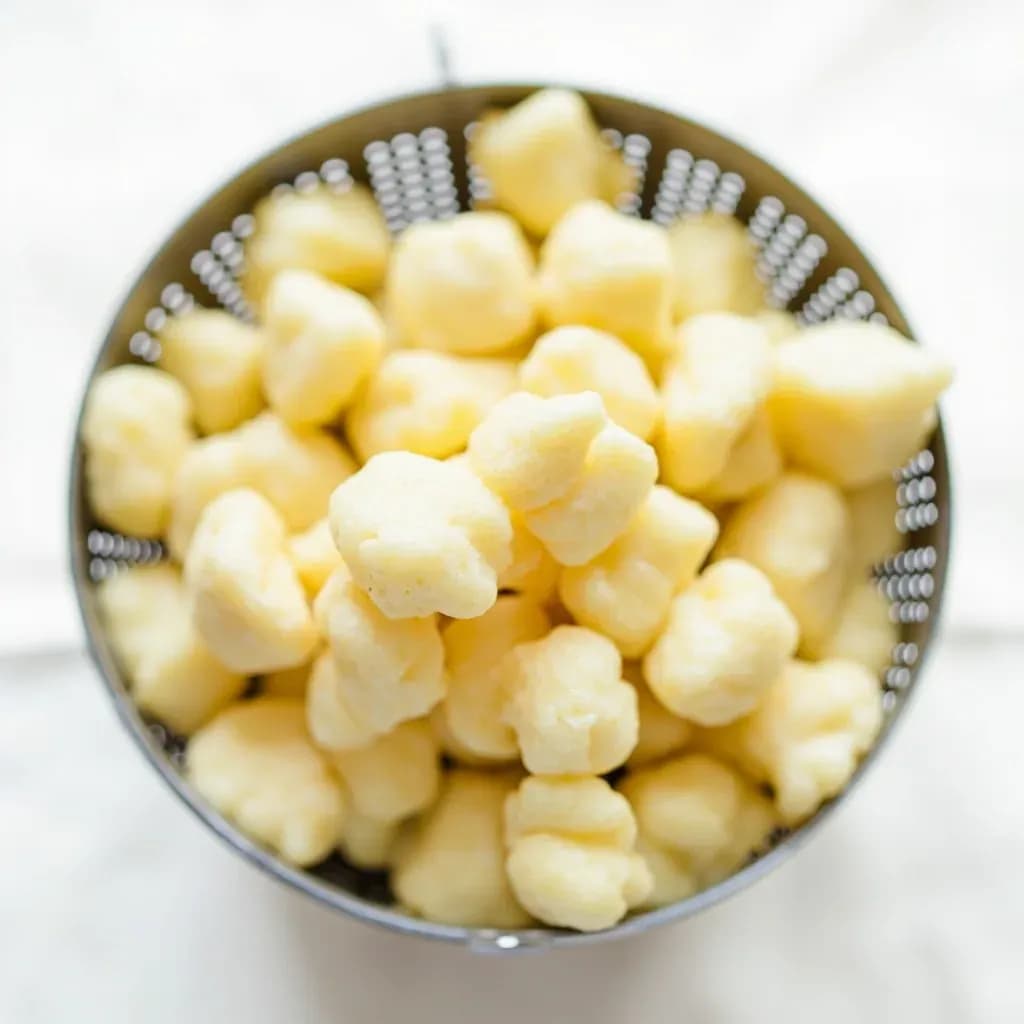
Packing fresh cheese curds into a perforated mold or hoop to shape the wheel and drain whey.
Hooping is the cheesemaking step of transferring drained curds into a mold, or hoop, that gives the cheese its final shape while letting residual whey escape. The mold may be flipped repeatedly so the curds knit evenly and the rind forms uniformly. Pressure and timing during hooping influence the wheel's density, texture, and moisture.
Hooping — also called molding, casting, or 'putting in the hoop' — is the moment in cheesemaking when loose, drained curd is packed into a perforated mold so it can simultaneously take a shape and shed the last of its free whey. The hoop is the gateway between curd and finished cheese: everything that happens inside it, from how the curds knit together to how fast moisture escapes, leaves a permanent signature on the wheel's texture, rind, and aging behavior.
The mold matters as much as the recipe. A wooden Alpine ring with metal peg-holes slows drainage and imprints the rind; a small perforated crottin form drains quickly and produces a dense, low-moisture disc; a pyramid mold lets curd settle into a tall, faceted shape as whey runs off. Perforation size, hoop material, whether the cheese is pressed or self-weighted, and how often the maker flips the wheel all govern the final moisture, rind formation, and even the flavor concentration as the cheese loses water and concentrates its solids.
In practice, hooping is forgiving for fresh cheeses — ricotta, labneh, fresh chèvre, fromage frais — where the goal is simply to drain curds into a tidy shape. It becomes demanding for pressed styles like Cheddar, Gouda, and aged Comté, because the cheesemaker must balance curd temperature, knit time, pressing weight, and flipping cadence to produce a closed, even wheel that will age predictably. Get it right and the cheese goes on to develop a clean rind; get it wrong and you see cracked corners, an open texture, or a rind that slips during affinage.
- Difficulty
- Medium
Types & varieties
The workhorse mold for Cheddar, Gouda, and Tomme-style wheels; available from about 10 cm up to 50+ cm for large farmstead wheels.
Used in industrial dairies for rapid drainage, easy sanitizing, and compatibility with automated pressing.
Used for aged Comté, Beaufort, and other Gruyère-family alpine cheeses; wooden rings bored with metal peg-holes imprint the cheese and slow drainage to encourage rind development.
Used for Valençay and Pouligny-Saint-Pierre; curd settles into a tall pyramid as it drains. Valençay is traditionally finished with a band of chestnut leaf wrapped around its base.
Tiny perforated forms for goat's milk Crottin, Banon-style discs, and Sainte-Maure logs; produce 80–150 g individual portions.
Cylindrical mold with a pierced bottom for shaping log-style cheeses such as Sainte-Maure, traditionally molded around a central straw or rush.
Woven straw, rushes, or plastic reed imprints a characteristic pattern on the rind of Banon, certain Tommes, and other basket-marked cheeses.
Used for cheeses cut into portions — some Cheddar blocks, Pecorino, and Manchego blocks.
Functional hoops with shaped walls used by artisan producers for gift and dessert applications.
Large perforated colander-like form (faisselle) for draining fresh cheeses such as fromage frais, ricotta, labneh, and quark.
How to do it
- 1
Drain the curds and bring them to hooping temperature
Stop the heat, let the curds settle briefly, and remove the free whey by dip, ladle, or pump until the curd mass is exposed. Hold the curds at the recipe's target hooping temperature — typically the cook temperature minus 1–2 °C — so they stay pliable and will knit together under pressure.
- 2
Set up the draining station
Place the perforated hoop on a draining mat, slotted board, or over a sink with a whey bucket beneath. Line the hoop with cheesecloth of the appropriate weave, letting the corners drape over the rim. Lightly wet the cloth and the mold with warm water or whey so nothing snags the curd at demolding.
- 3
Fill the hoop in layers
Scoop or pitch the curds into the hoop in even layers rather than all at once, pressing each layer firmly but not so hard that butterfat is squeezed out. Pack the perimeter especially well to avoid a crumbly edge, and keep the surface level.
- 4
Mound and settle
Fill slightly above the rim — the mass will sink as whey drains. Fold the cheesecloth flaps over the top and place the follower (pressing disc) on the curd. Let it rest 5–15 minutes so the curds knit and the first surge of whey runs out.
- 5
Press in stages (pressed styles only)
For Cheddar, Gouda, alpine, and other pressed cheeses, apply light weight — 1–2× the cheese weight — for 20–30 minutes, then increase in stages to the recipe's target, often 8–20× cheese weight. Press at the recipe's temperature, typically cooling the curd in the hoop after the initial knit for hard cheeses.
- 6
Flip the cheese at regular intervals
Unmold, peel back and re-fold the cloth to expose a dry face, turn the cheese over, and re-hoop. First flip about 15 minutes in, then every 30–60 minutes for the first 3–4 hours, then every few hours for the rest of the press. Even flipping produces a symmetric wheel and uniform moisture.
- 7
Unmold when the cheese holds its shape
When the wheel feels firm, the surface is closed (no cracks or crumbly bits), and the cloth is no longer soaked through, the cheese is ready to demold. Weigh it, record the weight loss to gauge moisture, and proceed to dry salting, brining, or the ripening cave.
How the mold shapes the cheese
Every choice at the hoop leaves a fingerprint on the finished wheel. Perforation size sets the drainage rate: large holes or wide slits in a stainless mold run whey off fast, producing a drier, denser cheese; tight peg-holes in a wooden ring slow drainage and let the curds settle into a tighter knit. Hoop material affects surface character — wood imparts a textured rind and microflora-friendly surface; smooth plastic gives a clean, pale rind that takes well to wax or bandage wrap. Even the shape of the mold has consequences: a tall pyramid has more surface area relative to volume than a low cylinder, so it loses moisture faster and develops a more concentrated flavor during affinage.
Reading the press
Pressure is a seasoning, not a switch. Light weight at the start — often just the weight of the follower plus a kilogram or two — lets the curds knit into a single body and pushes the first surge of whey out cleanly. Heavier weight comes only after that knit has formed; piling on pressure too soon forces butterfat out with the whey (visible as a yellow tint in the runoff) and yields a dry, grainy texture. The progression — 1–2× cheese weight for 20–30 minutes, ramping to 8–20× for hard cheese — is what gives a wheel its closed surface and predictable aging behavior.
Common uses
Tips & pitfalls
- Hoop curds while still warm (generally 32–39 °C depending on style); cold curds lose plasticity and won't knit into a single body.
- Wet the mold and cheesecloth with warm water or whey before packing so curds don't stick in the perforations and tear the surface on demolding.
- Fill the hoop slightly mounded above the rim; curds will settle as whey drains, leaving a flat top.
- Press in stages — light pressure first to knit the curds, then heavier pressure once whey has begun to escape — to avoid forcing butterfat out of the curd.
- Don't skip flips. Asymmetric flipping creates a lopsided, moisture-asymmetric wheel that won't age evenly and may crack on one face.
- Don't press through cheesecloth for soft-ripened styles unless you want a smoother rind; the cloth can trap moisture against the surface and cause rind slip.
- For wooden molds, season new rings by soaking them in brine and whey so the wood is saturated with the dairy environment and won't pull moisture unevenly from the cheese.
- Soak milky, curd-clogged hoops in warm 1–2% citric acid or a food-safe alkaline wash to dissolve milkstone and free the perforations.
- Record the weight of curd going in and the weight of the wheel at demolding; the difference tells you exactly how much whey was expelled and helps predict final moisture.
- If a wheel cracks on demolding, the curd was under-pressed, the knit was incomplete, or the cheese dried out in the hoop; increase pressure or flip sooner next time.
Good to know
- Purpose
- To shape cheese curds into a wheel, block, or other form while simultaneously draining free whey through perforations in the mold wall and base.
- Other names
- Molding, hooping, forming, casting, putting in the hoop (French: moulage, mise en forme; Italian: stampaggio, formatura).
- When performed
- Immediately after curds are cut, stirred, and cooked to 'hooping temperature' (typically the cook temperature or 1–2 °C below it), while curds are still warm and plastic.
- Pressing options
- Self-weight for fresh cheese, weighted lid for soft styles, mechanical screw or hydraulic press for hard cheeses; pressure can exceed 1,000 lb for aged Gouda and Cheddar.
- Flipping cadence
- First flip about 15 minutes after hooping, then every 30–60 minutes for the first several hours, then less often until the cheese holds its shape.
- Drainage time
- Fresh cheese: 30 minutes to 4 hours. Soft-ripened: 8–18 hours. Pressed semi-hard: 12–24 hours under increasing weight. Hard alpine and Cheddar-style: 12–24 hours under weighted press.
- Yields
- A 30 cm Gouda hoop holds roughly 3.5–4.5 kg of curd; a small crottin mold 80–120 g; a Valençay pyramid 150–250 g.
- Difficulty
- Beginner-friendly for fresh cheeses; more demanding for pressed styles because curd temperature, knit, and pressure all directly affect the final texture.
Also called
Flipping in the Mold · Molding Curds · Hoop Filling
Related

Whisk
Beat ingredients smooth and aerated with a looping wire motion

Sift
Pass dry ingredients through mesh to aerate and remove lumps

Strain
Pour through mesh to separate solids from liquid for a smooth result

Filter
Pass liquid through fine material to clarify out the smallest particles

Rice
Press cooked potatoes through small holes for fluffy, lump-free texture

Mash
Crush soft cooked food into a rustic, creamy purée

Grind
Crush food into a coarse to fine texture, from spices to meat

Grate
Shred food into fine bits against a sharp-toothed surface