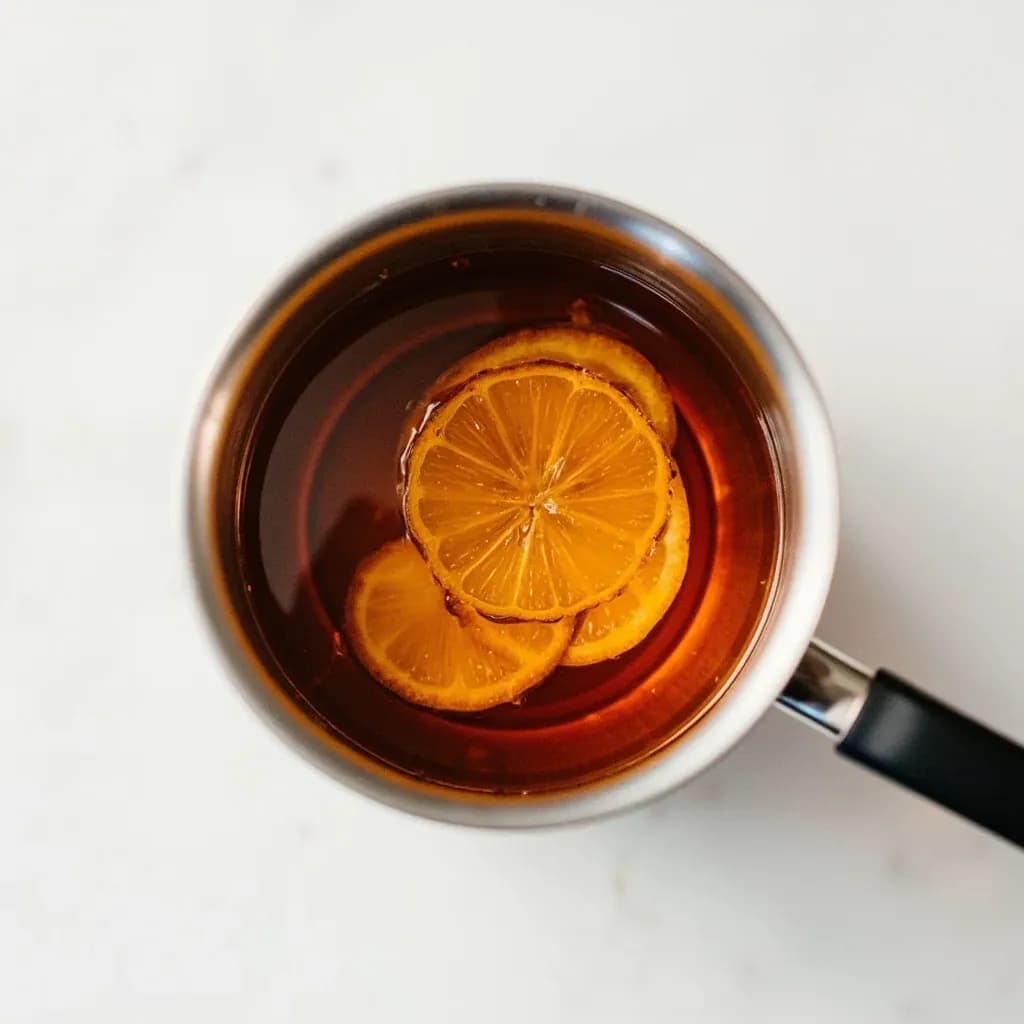
Transform & Preserve
Infusing Tea Syrups
Steeping tea, herbs or spices in hot sugar syrup to make a flavored syrup for drinks and desserts.
Infusing tea syrups steeps tea leaves, herbs or spices in a hot simple syrup so their flavor and color transfer into the sweet liquid, then strains out the solids. The result is a shelf-stable flavored syrup used to sweeten cocktails, lattes, lemonades and desserts. Steep time and temperature control intensity; over-steeping tea can add bitterness or tannin.
An infused tea syrup is a sugar syrup in which tea leaves, herbs, blossoms, or whole spices have been steeped to extract their aromatic compounds into a stable, pourable sweetener. The technique matters because sugar is both solvent and preservative: it dissolves the volatile oils and polyphenols that carry flavor while lowering the syrup's water activity enough to keep spoilage at bay for weeks in the refrigerator. The result is a single ingredient that does the work of two — sweetening and flavoring at once, without the dilution of melting ice or the flatness of plain simple syrup.
The craft lives in the timing and the temperature. Black teas and robust spices tolerate (and reward) a short, hot steep off the burner. Green, white, and oolong teas turn grassy and bitter almost the moment the temperature climbs past 170°F / 77°C, so their syrups are made by cooling the dissolved sugar water before the leaves go in. Delicate florals like lavender and chamomile sit in the middle, best handled covered, off heat, for a measured window. Matcha bypasses steeping entirely and gets whisked into cooled syrup for a vivid, slightly bitter infusion that needs no straining.
The 1:1 syrup (equal parts sugar and water) is the everyday standard — light, clean, and a one-for-one swap for simple syrup anywhere you'd moisten a cake or sweeten a drink. The 2:1 rich syrup, with twice as much sugar, is glossier, sweeter by volume, and the form most bartenders reach for because it adds body to a shaken cocktail without watering it down. Either ratio follows the same five steps; only the dissolve time and final mouthfeel change.
- Difficulty
- Easy
Types & varieties
Earl Grey, English Breakfast, Assam, or smoky Lapsang Souchong. Robust, holds up in coffee and spirit-forward cocktails.
Sencha, jasmine, or genmaicha. Steep at 170°F / 77°C or below to avoid grassy bitterness.
The classic bar syrup; pairs especially well with gin, lemon, and vanilla.
Black tea simmered with cinnamon, cardamom, ginger, clove, and star anise; often a 10–15 minute gentle simmer rather than a steep.
Matcha whisked into cooled syrup rather than steeped; no straining needed, slightly bitter and vegetal.
Deep magenta, tart; common in tropical and mezcal drinks.
Mellow and honeyed; gentle on the stomach and a natural partner for stone fruit.
Floral and intense; use sparingly and pair with lemon or honey to keep it from tasting soapy.
Nutty, caffeine-free, Japanese-inspired; good in cream sodas and coffee.
Lapsang Souchong delivers an instant campfire note for whisky and bourbon drinks.
Cinnamon stick, star anise, fresh ginger, or vanilla bean steeped without any tea for a non-tea spiced syrup.
Double-sugar version; glossier, sweeter, longer shelf life, and the preferred form behind most bars.
How to do it
- 1
Make the simple syrup base
Combine equal parts granulated sugar and water in a small saucepan (1 cup / 200 g sugar to 1 cup / 240 ml water for a standard 1:1 syrup; double the sugar for a rich 2:1 syrup). Heat over medium, stirring, until the sugar fully dissolves and the liquid just reaches a simmer. Do not let it reduce.
- 2
Take off heat and add the infusing ingredients
Remove the pan from the burner. For black tea, robust herbal teas, or whole spices (cinnamon stick, star anise, sliced ginger), add them now while the syrup is near 200°F / 93°C. For green, white, oolong, or delicate floral ingredients, let the syrup cool to about 170°F / 77°C first to avoid scorching and bitterness.
- 3
Steep, covered
Cover the saucepan with a lid. Steep black tea and chai blends 3–5 minutes; green and white tea 2–3 minutes; whole spices 10–15 minutes; dried flowers and herbs 5–10 minutes. Taste at the low end of the range — flavors keep developing as the syrup cools.
- 4
Strain
Pour the syrup through a fine-mesh strainer (lined with cheesecloth for a clearer bar-style finish) into a heatproof measuring cup or directly into a clean glass bottle. Press gently on the solids to extract syrup, then discard them.
- 5
Cool, bottle, and store
Cool to room temperature, then seal in a sterilized glass bottle or jar. Refrigerate for up to 2–4 weeks, or freeze in ice cube trays and transfer to a freezer bag for up to 3 months. Add 1 Tbsp of neutral spirit per cup to extend refrigerated life if desired.
Temperature rules the steep
Tea leaves are not a uniform ingredient. The amino acids and catechins that give green and white teas their sweetness and umami break down quickly above 170°F / 77°C and surrender bitter, astringent compounds into the syrup instead. Black tea, with its oxidized leaf and tougher cell structure, needs that same heat to release its aromatics — pulling it too early gives you colored water. Treat the two camps differently from the moment the sugar dissolves.
- Cool the syrup to 150–170°F / 65–77°C before adding green, white, oolong, or any delicate floral.
- Pour black tea, pu-erh, dark-roasted oolong, and whole spices into syrup at a near-boil.
- Pull a small taste at 2, 4, and 6 minutes; flavor keeps developing as the syrup cools, so err on the early side.
- Cover the pan — steam carries off the very volatiles you're trying to capture.
From bar to bakery
A 1:1 tea syrup swaps cleanly for plain simple syrup in almost any context, which is why the same batch can sweeten a Tom Collins on Friday and moisten a chiffon cake on Saturday. The difference between bar and bakery use is mostly concentration: a 2:1 rich syrup adds gloss and body to a shaken drink without thinning it, while a 1:1 syrup soaks into a sponge layer evenly without making it gummy. Both store the same way, and both freeze well in measured portions.
- Use 1:1 for cake moistening, granitas, sorbets, and anywhere the syrup is absorbed rather than poured.
- Use 2:1 for cocktails, glazes, fruit salads, and drizzles where you want viscosity and shine.
- A single dose per drink is 0.25–0.5 oz / 7–15 ml; taste as you build.
- Freeze in 1-tablespoon ice cubes to dose baking and drinks without thawing the whole bottle.
Common uses
Tips & pitfalls
- Bring the water to a boil, then remove from heat before adding the leaves — pouring boiling water directly over the leaves extracts harshness, especially with green and white teas.
- Taste at 2, 4, and 6 minutes and pull the leaves the moment the flavor reads bright; it dulls as the syrup cools.
- Cover the pan during the steep so volatile aromatics don't escape with the steam.
- Use loose-leaf tea at roughly 1 Tbsp (4–5 g) per cup of finished syrup for a balanced, repeatable strength.
- Strain through a fine-mesh sieve lined with cheesecloth if the syrup is destined for a clear cocktail or a glaze where cloudiness shows.
- Add 1 Tbsp of vodka per cup of syrup to push refrigerated shelf life from 2–4 weeks to 6–8 weeks.
- For citrus infusions, pare only the colored zest (no white pith) — pith turns a syrup sharply bitter in under an hour.
- Cool to room temperature before bottling to prevent condensation inside the cap, which breeds mold fast.
Good to know
- Base ratio
- 1:1 sugar to water by volume (standard); 2:1 for a rich bar-style syrup
- Yield
- About 1.5 cups (350–360 ml) finished syrup per 1 cup sugar + 1 cup water
- Black-tea steep
- 3–5 minutes, covered, off heat, near 200°F / 93°C
- Green/white-tea steep
- 2–3 minutes at 150–170°F / 65–77°C to avoid bitterness
- Herbs & spices
- 5–15 minutes, covered, off heat; whole spices can take longer
- Best tea form
- Loose-leaf gives fuller extraction than bagged at the same weight
- Storage
- Refrigerated in a sealed glass bottle, 2–4 weeks
- Shelf-life extension
- Add 1 Tbsp neutral 40% spirit (vodka, light rum) per cup of syrup for 6–8 weeks
- Freezer storage
- Up to 3 months portioned in ice cube trays, then transferred to a bag
- Cocktail dose
- Most shaken drinks use 0.25–0.5 oz (7–15 ml) per serving
Also called
Syrup Infusing · flavored syrup · tea syrup
Dishes that rely on it
Related

Confit
Cook slowly submerged in fat for silky tenderness and keeping

Cure
Draw out moisture with salt and time to preserve and concentrate

Pickle
Steep in acidic brine for bright, tangy, crunchy preservation

Ferment
Let friendly microbes transform food into tangy, complex flavor

Marinate
Soak in a seasoned mix to flavor and tenderize before cooking

Brine
Soak in salt water so meat stays juicy and seasoned throughout

Dehydrate
Slowly dry out moisture to concentrate flavor and extend shelf life

Cold-Smoke
Perfume cured food with smoke without cooking it through