Knife Skills
Katsuramuki
Rotary-peeling a vegetable into one long continuous paper-thin sheet.
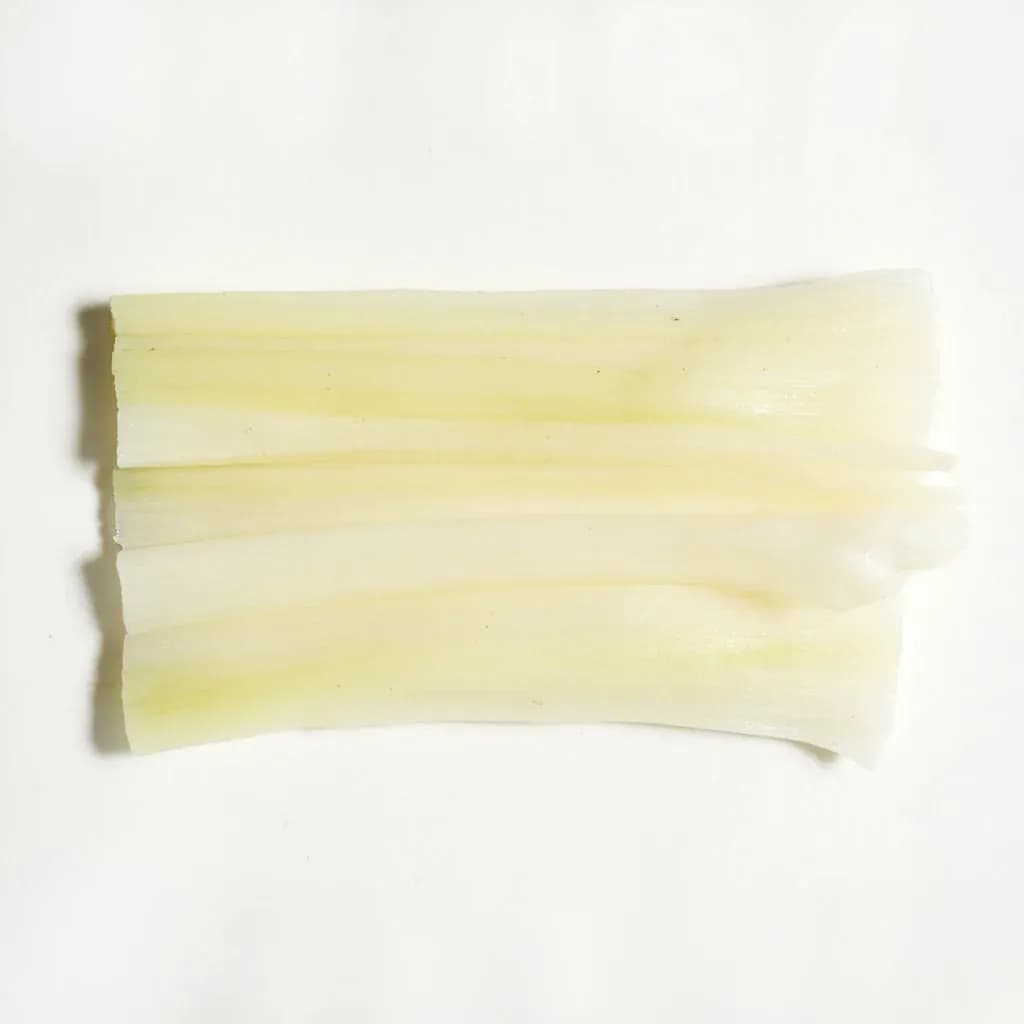
Katsuramuki is the advanced Japanese technique of peeling a cylinder of daikon or cucumber into a single, unbroken, paper-thin sheet by rotating it against a still blade. The long sheet is then stacked and finely shredded into delicate threads (ken) used as a garnish for sashimi. It is a benchmark of knife mastery, demanding even pressure and a razor-sharp usuba over the whole rotation.
Katsuramuki (桂剥き) is the Japanese technique of shaving a cylindrical vegetable — almost always daikon — into one uninterrupted, paper-thin sheet that unwinds from the blade like a continuous ribbon. The name borrows from the katsura tree (Cercidiphyllum japonicum), whose bark famously peels off in long curling strips; the cook is aiming for exactly that quality of unbroken, even sheet. A well-executed run produces a strip roughly 0.2–0.3 mm thick, the full length and width of the vegetable — about 1.5 to 2 metres from a standard 30 cm daikon — translucent enough to read newsprint through.
In a Japanese kitchen the sheet is rarely the final product. It is raw material: stacked and folded, it is julienned into sasagiri (ginkgo-leaf threads), tanzaku (pencil-thin strips), or hanagiri (petal shapes) that form tsuma, the edible garnishes that bed sashimi. The technique matters because no other cut delivers this combination of length, evenness, and delicacy — a rotary peeler's ribbon is brittle, a mandoline's slice is short, and a Y-peeler's strip is uneven. The usuba's flat, single-bevel edge and tall blade are what let the cook hold the knife perfectly still while the vegetable rotates, sliding off in a single plane.
The cut is taught as a benchmark skill in wa-shoku knife training, sitting between basic usuba handling and more elaborate decorative work. It is intermediate to advanced not because it is physically hard but because it punishes every lapse in sharpness, grip, or angle: a torn sheet means the run is lost. Mastery is judged by sheet continuity and evenness rather than speed — a slow, unbroken sheet is the standard benchmark.
- Difficulty
- Hard
Types & varieties
The basic continuous rotary peel — the canonical form, a single unbroken sheet.
Broader category of peel-cuts in Japanese knife work; katsuramuki is the most refined single-sheet variant.
The downstream cut: the katsuramuki sheet stacked and julienned into ginkgo-leaf threads, the most common end product.
How to do it
- 1
Set up the workstation
Place a dampened cutting board or a sheet of damp kitchen paper beneath the work area so the finished sheet does not stick and tear. Have a sharp usuba (or petty knife) ready, and prepare a stable section of daikon — cut both ends flat, and if the root is round, slice a small face from one side so it seats without rolling.
- 2
Establish grip and blade angle
Hold the knife in your dominant hand, index finger and thumb pinching the spine and side of the blade for fine control. Hold the daikon in your other hand with the thumb extended along its length as a guide, the other fingers safely curled back. Set the blade tip against the daikon at a shallow downward angle (roughly 5–10°) so the edge just kisses the surface.
- 3
Begin the stroke
Press the daikon gently into the edge with the blade held still. Draw the knife across the vegetable only enough to start a thin curl, then stop moving the knife entirely. The first 1–2 cm is the hardest part — once a leading edge forms, the rest follows.
- 4
Rotate, do not slice
With the blade stationary, slowly rotate the daikon toward you with your guiding hand, letting the sheet unwind in one continuous ribbon. Keep the thumb of the guiding hand as the rotation pivot. Speed should be slow and even — rushing tears the sheet.
- 5
Control thickness by pressure
Adjust the downward angle or the pressure of the daikon into the blade to control thickness: lighter contact yields a thinner sheet, more pressure a thicker one. Re-establish the original angle every few rotations, since the daikon's diameter shrinks as you work and your hand will naturally rise.
- 6
Stop before the core
Halt when about 1.5–2 cm of daikon remains. The final nub is irregular and will tear the sheet if you push through it. Reserve the inner cylinder for grated daikon (daikon oroshi), quick pickles, or stock.
- 7
Use or store the sheet
Lift the ribbon gently by its edges (never the thin faces) and either lay it flat on damp paper, fold it for sasagiri cuts, or use it immediately as a garnish or wrapper. If not using within minutes, submerge in lightly acidulated cold water to keep it crisp and bright white.
From sheet to garnish: the tsuma lineage
A bare katsuramuki sheet is rarely plated on its own. In professional sashimi service the ribbon is gathered, folded accordion-style, then cross-cut into the threads that sit beneath and beside raw fish. Three named cuts dominate:
- Sasagiri — julienned into thin ginkgo-leaf strips, the most common tsuma for sashimi generally.
- Tanzaku — narrower, pencil-width strips, a denser decorative thread.
- Hanagiri — petal-shaped pieces cut from a folded stack, a more formal decorative cut.
Choosing the vegetable
Daikon is the standard because its straight, cylindrical body, high water content, and crisp cellular structure peel cleanly into long sheets. But the technique transfers to other firm, straight roots and gourds with predictable results:
- Carrot — shorter sheets, vivid colour; good for practising because waste is cheap.
- English cucumber — very forgiving; the skin peels smoothly and the flesh tolerates minor angle errors.
- Naga-imo or yamaimo — works on firm specimens; the sheet takes on the root's characteristically slick texture.
- Avoid tapered or knobbly roots — an irregular diameter disrupts the rhythm of the cut and tears the sheet before a run is established.
Common uses
Tips & pitfalls
- Cut the daikon first so you have a flat, stable face to seat against the board — never try to katsuramuki a whole tapered root, as it will rock and tear the sheet.
- Keep the blade truly stationary; the motion comes from rotating the vegetable with your guiding hand, not from drawing the knife across it.
- Maintain a slight downward angle of the blade (5–10°) — perfectly horizontal cuts lift shavings, vertical cuts shave too thick.
- Wet the daikon with a damp cloth or briefly under water so the surface glides; dry skin grabs and tears the sheet on the first turn.
- Aim for a thickness you can almost read newsprint through — if light does not pass, you are cutting too thick.
- Keep the usuba extremely sharp — even micro-nicks catch and rip the sheet instead of slicing it cleanly.
- Stop before you reach the core or the sheet will tear; reserve the inner cylinder for oroshi or stock.
- If the sheet breaks, do not pause to fuss — continue rotating and the run will resume cleanly once pressure and angle are corrected.
Good to know
- Japanese name
- 桂剥き (katsuramuki / katsura-muki)
- Literal meaning
- 'Peeling [like the bark of a] katsura tree' — Cercidiphyllum japonicum sheds bark in one continuous curling sheet.
- Origin
- Japan, part of the traditional wa-shoku knife-skill repertoire taught alongside usuba work.
- Primary knife
- Usuba (薄刃) — a thin, single-bevel Japanese vegetable knife; a sharp petty knife can substitute.
- Primary vegetable
- Daikon; also carrot, English cucumber, naga-imo, and other firm cylindrical roots.
- Result
- One uninterrupted sheet 0.2–0.3 mm thick, the full length and width of the vegetable.
- Yield
- A standard 30 cm daikon yields roughly 1.5–2 m of continuous sheet when well executed.
- Difficulty
- Intermediate to advanced; considered the benchmark skill for evaluating usuba proficiency.
Also called
Katsuramuki (Rotary Peeling) · Rotary Peeling
Related

Chop
Cut into rough, irregular pieces — the everyday workhorse cut

Dice
Cut into uniform cubes for even cooking and a tidy look

Mince
Cut as fine as possible so flavor melts evenly into the dish

Slice
Cut into even, flat pieces for consistent cooking and presentation

Julienne
Cut into thin matchsticks for fast cooking and elegant garnish

Brunoise
Cut into tiny, precise cubes — the finest dice in the kitchen

Chiffonade
Roll and slice leafy greens into delicate ribbons

Batonnet
Cut into tidy sticks, thicker than julienne — think classic fries