Prep & Assembly
Pounding Meat
Flattening and tenderizing meat with a mallet for even, quick cooking.
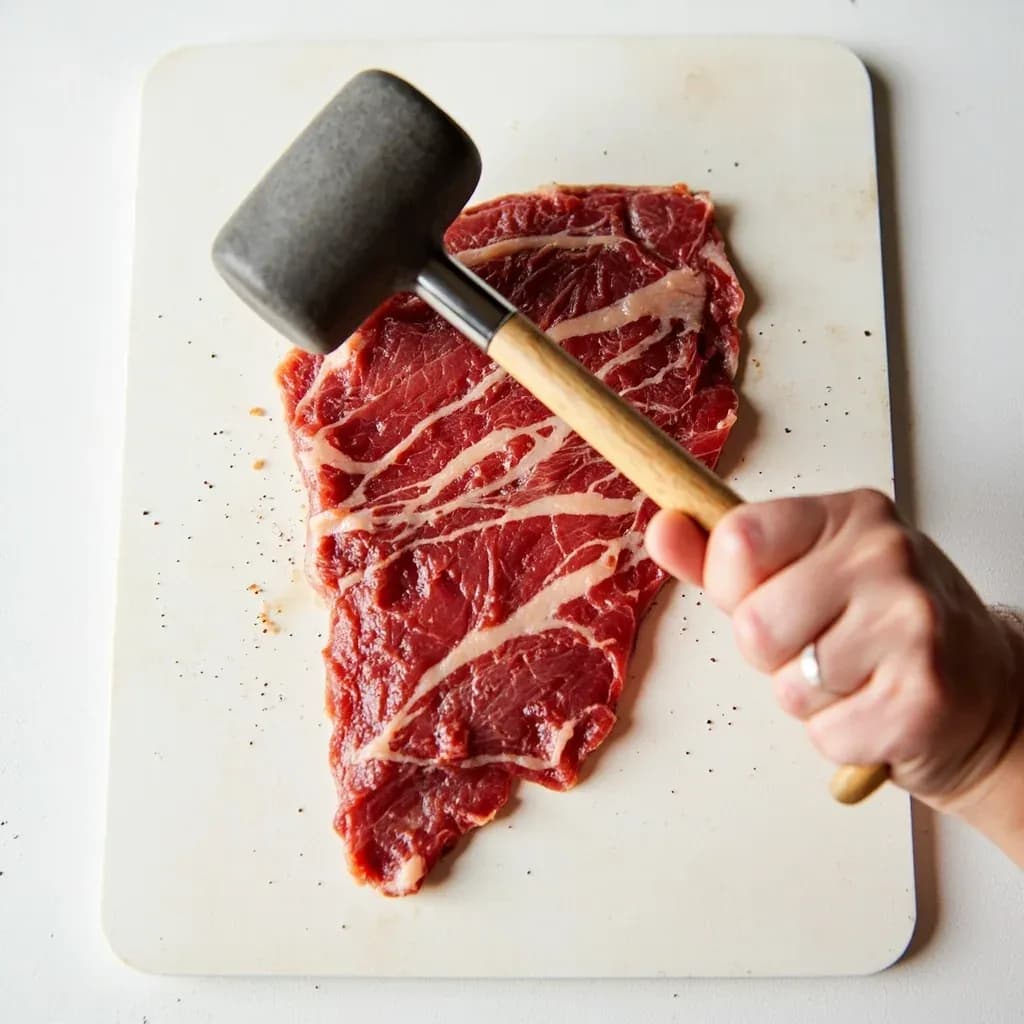
Pounding meat strikes a cutlet with a mallet or heavy pan to flatten it to an even thickness and break down tough fibers. It tenderizes the meat and ensures it cooks quickly and uniformly, the foundation of schnitzel and other breaded cutlets. Pounding between sheets of plastic wrap keeps the meat from tearing and the work surface clean.
Pounding meat is a foundational prep technique in which a heavy mallet, skillet, or rolling pin is used to flatten a cut to a controlled thickness and, in the process, mechanically break down its long muscle fibers. It is the reason a 6-ounce chicken breast cooks in three minutes instead of twelve, and why a breaded veal cutlet crisps through to the center before the crust burns. The goal is twofold: tenderize a tougher or uneven cut, and create a uniform thickness so heat penetrates evenly across the whole piece.
The technique shows up wherever a cuisine has prized a thin, quick-cooking cut — from Austrian wiener schnitzel and Japanese tonkatsu, from Italian piccata to the chicken-fried steak of the American South. Properly executed, pounding roughly doubles the surface area of a cutlet, helps breading or marinade cling to the meat, and turns an awkward thick piece into a tidy, predictable portion. The catch is that it is easy to overdo: an over-pounded cutlet turns translucent at the edges, sheds its juices in the pan, and ends up mealy instead of tender. Cold meat, a barrier of plastic or parchment, and an even hand solve most of the problems beginners run into.
- Difficulty
- Easy
Types & varieties
Smooth face of the mallet drives the cut to a uniform 1/4-inch thickness; emphasis is on even cooking rather than deep tenderizing.
Textured or studded mallet face pierces and shreds fibers, producing the dimpled cube steak used for chicken-fried steak and Swiss steak.
Thick cuts such as whole chicken breasts or pork loins are sliced horizontally almost through, opened like a book, then pounded flat to keep thickness even without tearing.
Pork loin butterflied and pounded to roughly 1 cm thickness, then breaded in panko and deep-fried.
A heavy rolling pin, the bottom of a cast-iron skillet, or a clean brick wrapped in foil used as an improvised pounder — common in home kitchens and traditional rural cooking.
Larger cuts (braciole, stuffed pork loin, chicken Kiev, rouladen) are pounded thin and even so the filling rolls uniformly without gaps or bursting during cooking.
How to do it
- 1
Trim and, if needed, butterfly
Trim silverskin, fat, and ragged edges. For cuts thicker than about 3/4 inch — veal round, whole chicken breast, pork loin — hold the knife parallel to the board and slice horizontally almost all the way through, opening the piece like a book so it flattens without tearing.
- 2
Set up a protected surface
Lay a long sheet of plastic wrap (or parchment) on the cutting board, place the meat on it, and cover with a second sheet. This prevents sticking and tearing and contains splatter from the mallet.
- 3
Start pounding from the center
Using the flat face of a meat mallet — or the bottom of a heavy skillet — strike the thickest central area first with firm, even strokes. Let the weight of the tool do the work; a heavy mallet needs only a guided drop rather than a hard swing.
- 4
Work outward in overlapping strokes
Move the mallet in a slow spiral outward, slightly overlapping each hit. Rotate the meat a quarter-turn every few strokes so it ends up evenly oval rather than lopsided.
- 5
Check thickness and finish
Peel back the top sheet of plastic and feel with your fingertips. Aim for 1/4 inch (6 mm) for schnitzel, milanesa, piccata, and tonkatsu; 1/2 inch (12 mm) for paillard, stuffed rolled cuts, and chicken-fried steak. For cube steak, flip and use the textured face sparingly until the surface is dimpled but not shredded.
- 6
Rest, dry, and season just before cooking
Transfer cutlets to a tray, separate layers with parchment, and refrigerate briefly so the fibers relax. Pat dry and salt and pepper right before cooking — never before pounding, as salt draws moisture and tightens the surface proteins.
Choosing the right mallet face
A meat mallet typically has two sides — a smooth flat face and a studded or textured face. The two are not interchangeable, and choosing wrong is the most common cause of shredded or mushy cutlets. The flat face compresses and spreads the meat; the studded face punctures and tears it. Match the face to the dish you are making, not the tool you happen to pick up first.
- Flat face: use for schnitzel, milanesa, piccata, paillard, tonkatsu, and any rolled or stuffed preparation. The goal is even thickness, not fiber destruction.
- Studded face: reserve for true cube-steak preparations (chicken-fried steak, Swiss steak, smothered steak) where you want the meat to absorb gravy and lose its chew.
- Skip the studded face on veal, poultry, and pork cutlets — the needles will shred the delicate fibers and the cutlet will fall apart in the pan.
- For very tough cuts (shank, brisket, chuck), pounding alone is rarely enough; combine it with brining, marinating, or a low-and-slow braise to break down the connective tissue.
Common uses
Tips & pitfalls
- Always pound between two sheets of plastic wrap, parchment, or inside a zip-top bag — bare meat sticks to the mallet, tears, and splatters juices across the kitchen.
- Work with cold, just-refrigerated meat; warm meat stretches, smears, and tears instead of flattening cleanly.
- Use the flat face of the mallet for even thickness; reserve the textured or studded face for true cube-steak tenderizing — over-using it on a delicate cutlet shreds the fibers.
- Strike from the center outward in overlapping strokes, and rotate the meat 90° every few hits to keep thickness uniform and avoid a lopsided oval.
- Target thickness is set by the thickest spot, not the thinnest — that single thicker area dictates cooking time and will leave the rest overdone.
- Salt and season AFTER pounding; salting before pulls moisture to the surface and tightens the proteins, making the cutlet rubbery once cooked.
- Stop before the meat turns translucent or stringy; over-pounded cutlets lose juices during cooking and turn mushy.
- For thick breasts and loins, slice horizontally almost through to butterfly the cut, then open and pound — this avoids tearing and keeps thickness even.
- A heavy cast-iron skillet, clean wine bottle, or rolling pin all work as makeshift pounders when a dedicated mallet isn't available.
- Pat pounded cutlets dry before breading or searing so flour, egg wash, and crumbs adhere properly and the crust crisps rather than steams.
Good to know
- Primary purpose
- Mechanically tenderize meat and create uniform thickness for fast, even cooking
- Common tools
- Meat mallet (wooden or metal), dedicated meat pounder, handheld pronged tenderizer, heavy skillet, rolling pin, clean wine bottle
- Typical target thickness
- 1/4 inch (6 mm) for schnitzel, milanesa, piccata, tonkatsu; 1/2 inch (12 mm) for paillard and rolled preparations
- Best meat temperature
- Cold, just-chilled meat (about 35–40°F / 2–4°C); not frozen
- Common cuts
- Chicken breast, veal top round, pork loin, beef top round or sirloin, turkey breast cutlet, lamb leg steak
- Skill level
- Beginner; the technique is forgiving
- Effect on texture
- Breaks down long muscle fibers, expands surface area, and helps breading or marinade adhere
- Yield impact
- A 6 oz chicken breast typically flattens to roughly twice its original surface area
- Time required
- 1–3 minutes per piece once set up
- Storage of pounded cutlets
- Stack between parchment, cover, and refrigerate up to 24 hours before cooking
Also called
Pounding Cutlets (Klopfolás) · Pounding Meat (Naklepání) · Tenderizing · Flattening Cutlets
Dishes that rely on it
Related

Whisk
Beat ingredients smooth and aerated with a looping wire motion

Sift
Pass dry ingredients through mesh to aerate and remove lumps

Strain
Pour through mesh to separate solids from liquid for a smooth result

Filter
Pass liquid through fine material to clarify out the smallest particles

Rice
Press cooked potatoes through small holes for fluffy, lump-free texture

Mash
Crush soft cooked food into a rustic, creamy purée

Grind
Crush food into a coarse to fine texture, from spices to meat

Grate
Shred food into fine bits against a sharp-toothed surface