Heat & Fire
Scrambling Eggs
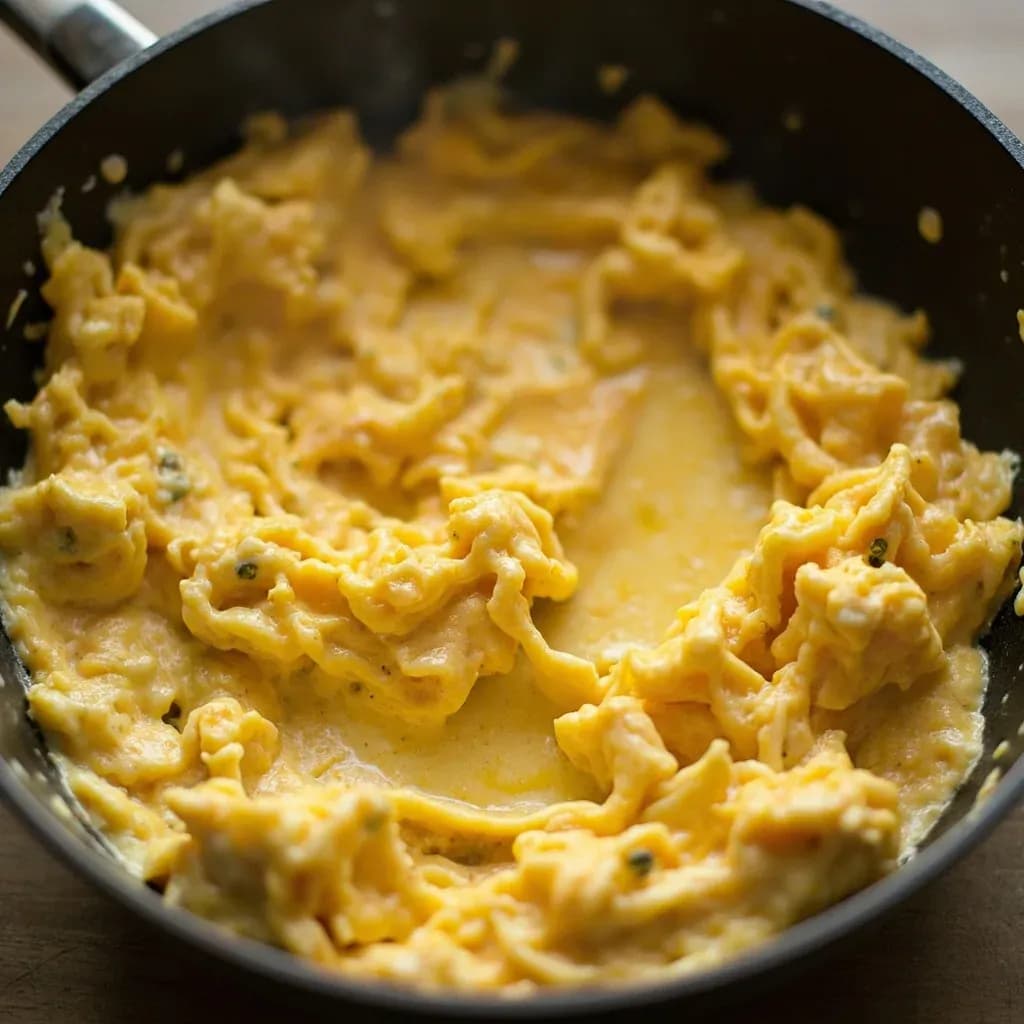
Stirring beaten eggs over heat so they set into soft, creamy curds.
Scrambling beats eggs and cooks them in a buttered pan while stirring or folding so the proteins coagulate into curds rather than a flat sheet. Lower heat and constant motion yield small, soft, creamy curds, while higher heat and less stirring give larger, firmer, drier curds. It is one of the most fundamental egg techniques, and pulling the pan early matters because residual heat keeps cooking the eggs after they leave the burner.
Scrambling is the most forgiving form of egg cookery and, for that reason, often the most misunderstood. Beaten eggs are poured into a heated, lightly fat-coated pan and moved almost constantly so the proteins coagulate into soft curds instead of a single flat sheet. The technique hinges on a simple balance: enough heat to set the eggs in a few minutes, but not so much that the moisture inside the curds boils off before the proteins can finish tightening. When the balance is right, the result is pale, tender, and glossy; when it tips toward high heat, the curds go rubbery, weep liquid, and taste dense.
The reason scrambled eggs demand attention is that they are a living temperature problem. Egg proteins begin to set around 158°F / 70°C, and the FDA safe-holding line sits only 2°F higher, at 160°F / 71°C. The window between perfectly creamy and safely firm is narrow, and the curds keep climbing another 10–15°F / 5–8°C after the pan leaves the heat. Good scramblers learn to read the surface of the eggs as much as the clock: pull the pan when the curds still look slightly wet and glossy, and let residual heat finish them on the plate.
Beyond heat, three small choices shape the final texture: how vigorously the eggs are beaten (just to combine, not to aerate), how much and what kind of dairy is added, and the size of the curds you break them into. Master those variables and the same basic method yields anything from billowy American breakfast curds to silken French-style œufs brouillés to a spiced South Asian bhurji.
- Difficulty
- Easy
Types & varieties
Cooked over very low heat with constant small stirring in a heavy pan, finished with cold butter and sometimes cream off the heat for an almost sauce-like, pale-yellow texture.
Medium-low heat, gentle fold-and-push motion, large billowy curds, pulled while still glossy.
Higher heat, less stirring, fully set curds; common in diners and for chopped-egg fillings.
Cooked in a bowl over simmering water while whisking; gives the silkiest, most controlled texture.
Beaten eggs cooked in a microwave-safe bowl in short bursts with stirring between; quick but prone to rubbery texture if overheated.
South Asian style in which beaten eggs are scrambled with sautéed onions, tomatoes, green chili, ginger, turmeric, and often cumin or garam masala.
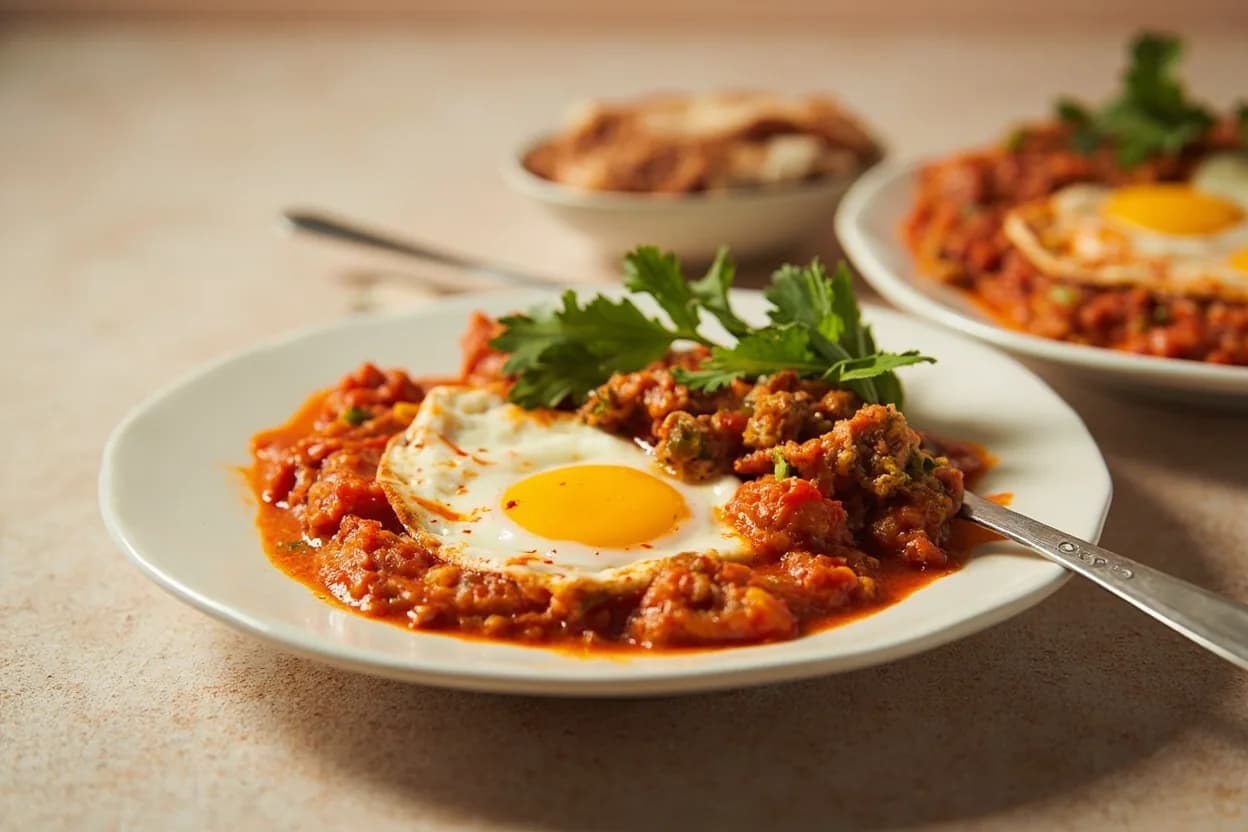
Turkish style: eggs scrambled into a sauce of simmered tomatoes, green peppers, and olive oil until just set.
Mexican style scrambled with diced tomato, onion, jalapeño, and cilantro.
Greek style: eggs scrambled into a rustic tomato-pepper sauce, closely related to menemen.
Classic technique of stirring beaten eggs into a small amount of hot butter over high heat for just a few seconds for tiny, custard-like curds.
How to do it
- 1
Crack and beat
Crack 2–3 large eggs per person into a bowl. Add a pinch of salt and, if you like, about 1 tablespoon of whole milk, cream, or crème fraîche per 2 eggs. Beat with a fork or whisk just until the yolks and whites are evenly combined and the mixture looks uniform—no streaks. Avoid whipping in air; you want a homogeneous liquid, not a foam.
- 2
Heat the pan
Place an 8-inch nonstick skillet (or a well-seasoned carbon-steel or cast-iron pan) over medium-low to medium heat. Add about 1 tablespoon of unsalted butter and swirl to coat the surface. Heat until the butter is fully melted and just starting to foam, but not browned.
- 3
Add the eggs
Pour the beaten eggs into the pan in a steady stream. Let them settle for 15–20 seconds so the very bottom begins to set—this creates the first layer of curds and gives you something to push against.
- 4
Begin stirring
Using a silicone or flat wooden spatula, start pushing the eggs gently from the edges of the pan toward the center, then across the bottom in long strokes. Keep the spatula in contact with the pan to lift set egg before it overcooks and browns.
- 5
Form the curds
Continue stirring almost constantly, breaking large curds into smaller ones only as much as your style calls for: large billowy curds for soft American scrambles, very small uniform curds for French-style. For French-style, work over very low heat and stir in tiny circles while rocking the pan by its handle.
- 6
Off-heat finish
When the eggs still look slightly wet and glossy but are mostly set, remove the pan from the burner. Stir in a small knob of cold butter for a richer, glossier finish and to arrest the cooking. The residual heat will finish the curds in 30–60 seconds.
- 7
Season and serve
Season with freshly ground black pepper and taste for salt. Serve immediately on warm plates or toast. Scrambled eggs do not hold well: they keep cooking and dry out within minutes.
Heat: the single biggest variable
Almost every other choice in scrambling—pan, spatula, dairy, salt timing—is secondary to the intensity of the burner. Lower heat buys you time and moisture; higher heat buys you speed and browning but costs you tenderness. The right setting depends on the style you want: very low for French-style curds that approach a sauce, medium-low for billowy American soft scrambles, and medium to medium-high for diner-style dry scrambles or chopped-egg fillings. A good test is to put a pat of butter in the empty pan over your chosen flame; it should melt and foam gently without darkening. If the butter browns in under a minute, the heat is too high for soft curds.
- Lower the flame, not the pan: removing the skillet mid-cook gives uneven results.
- If your curds are weeping liquid in the pan, the heat is too high or the eggs are overcooking before they can set.
Holding scrambled eggs for a crowd
Scrambled eggs wait poorly because carryover heat and surface evaporation dry them out within minutes. For brunch service, the standard move is to cook in small batches to order, or to hold a finished pan over a barely warm burner (or on a heating pad set low) with a tight-fitting lid. Lay a clean kitchen towel (paper or cloth) over the eggs or between the pan and the lid; it absorbs steam that would otherwise condense and drip back, keeping the curds moist without watering them down. Stir once gently before serving. This works well for roughly 20–30 minutes; beyond that, it's better to start a fresh pan.
- Cook in small batches of 2–4 eggs in an 8-inch pan for the best curds.
- A teaspoon of cream stirred in just before holding helps curb drying.
Common uses
Tips & pitfalls
- Pull the pan from the heat while the curds still look glossy and slightly wet; carryover heat finishes them.
- Use medium-low heat; high heat drives off moisture, tightens proteins, and turns curds rubbery.
- Add a small amount of dairy (about 1 tablespoon per 2 eggs) for a more tender, pale result.
- Beat eggs only until homogeneous—over-beating incorporates air that escapes and leaves a coarse, spongy texture.
- Stir constantly but gently with a silicone spatula, scraping the pan's bottom to prevent sticking and browning.
- Stir in a tablespoon of cold butter at the end to stop cooking and add gloss.
- Don't cover the pan once eggs are in—trapped steam makes curds weep and turn watery.
- For David Eyre-style tiny curds, work fast over high heat with a whisk in a small pan, and stop as soon as the eggs form.
Good to know
- Heat level
- Medium-low to medium for soft, creamy curds; higher heat is used only for dry or hard scrambles.
- Setting temperature
- Egg proteins begin to coagulate around 158°F / 70°C; the FDA safe-holding temperature is 160°F / 71°C.
- Carryover cooking
- Internal temperature climbs 10–15°F / 5–8°C after the pan leaves the heat, so curds should look slightly wet when removed.
- Active time
- 2 to 5 minutes once the pan is hot.
- Yield per egg
- Roughly ¼ to ⅓ cup of finished curds per large egg.
- Standard portion
- 2 to 3 large eggs per person for a main portion.
- Recommended dairy
- Whole milk, half-and-half, heavy cream, or crème fraîche, about 1 tablespoon per 2 large eggs.
- Salt timing
- Add salt during beating; modern tests show early salting does not visibly toughen curds.
- Origin
- Egg cookery is prehistoric; "scramble" in reference to eggs appears in English by the 17th–18th century, and the refined low-heat method is associated with French œufs brouillés.
Also called
scrambled eggs
Dishes that rely on it
Related

Sear
Blast the surface hot for a deep-browned, savory crust

Sauté
Cook quickly in a little fat over lively heat, tossing as you go

Stir-Fry
Toss bite-sized pieces over roaring heat for fast, smoky cooking

Pan-Fry
Crisp food in a shallow layer of hot fat, turning once or twice

Deep-Fry
Submerge in hot oil for an all-over crackling crust

Roast
Cook uncovered in dry oven heat for browned edges and tender centers

Bake
Cook with steady, surrounding oven heat — the soul of bread and pastry

Broil
Hit food from directly above with fierce overhead heat