Prep & Assembly
Shaking Off Water (Yuki)
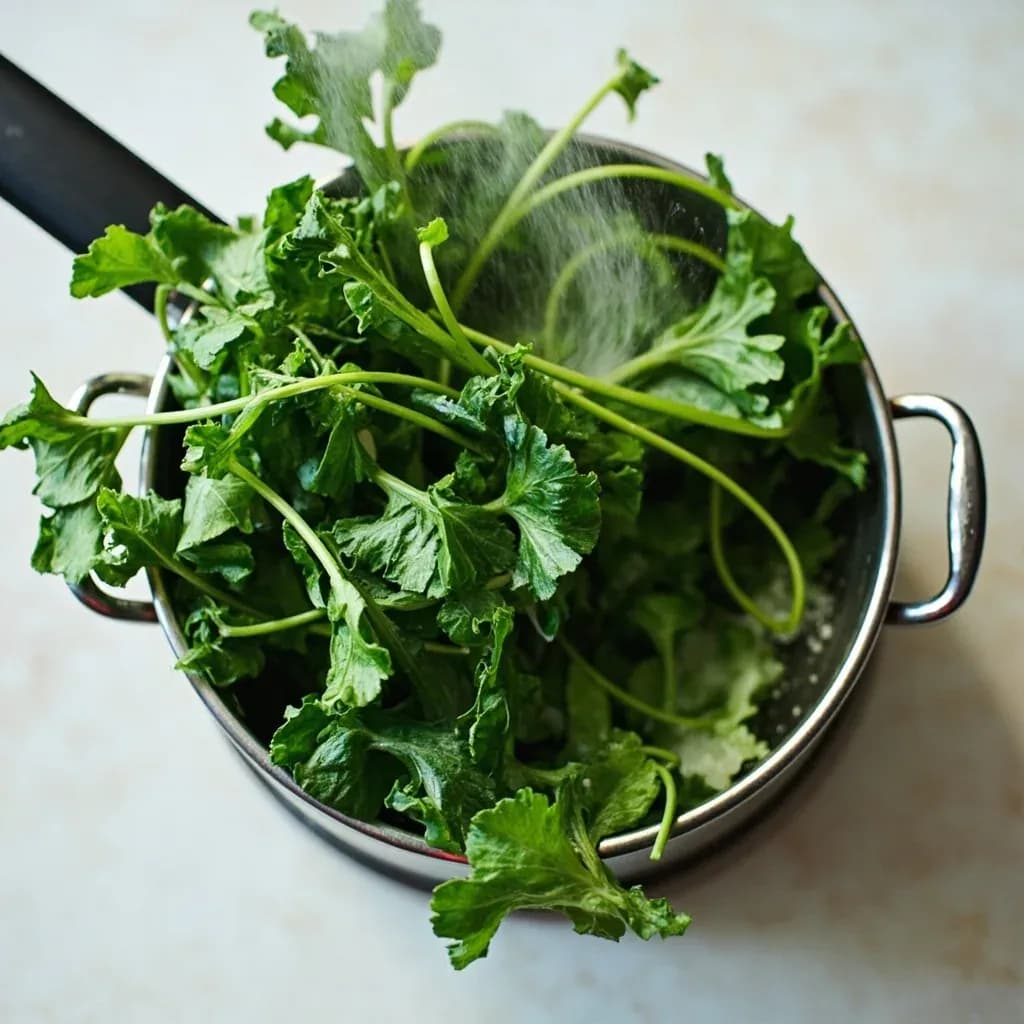
Flicking excess water off washed ingredients so they fry crisp instead of steaming.
This simple prep step shakes or flicks excess moisture off rinsed produce, noodles, or proteins before they go into hot oil or a dry pan. Removing surface water prevents dangerous spattering and stops the food steaming, so it browns and crisps properly. It is an underappreciated but essential habit, especially before deep-frying, where wet ingredients cause violent oil eruptions.
Yuki (雪), literally "snow," is the Japanese cook's name for the quick wrist-driven flick that throws clinging surface water off a just-washed ingredient in a fine spray. The verb form yuki wo kiru (雪を切る, "to cut snow") captures the visual: water flies off in a mist reminiscent of driven snow. In practice it is a single sharp downward snap of the wrists, performed over a sink, that uses centrifugal force to strip the thin film of water left behind after draining or spinning. It is one of the earliest motions taught in Japanese kitchen training and is considered as fundamental as sharpening a knife or seasoning a pan.
The reason yuki matters is moisture physics. A leaf of spinach coming out of a wash basin carries a stubbornly clinging film on its surface; a salad spinner removes the bulk but leaves that film intact. Drop that wet film into oil at 180 °C (350 °F) and the water flashes to steam, splattering fat and dropping pan temperature, or — in a dry pan — it boils against the food and steams it instead of searing it. Vegetables meant to glisten with a quick sear end up watery and limp. Yuki is the small, fast intervention that makes the difference between crisp and soggy, between a clean fry and a dangerous one.
What separates a good yuki from a bad one is the lightness and decisiveness of the snap. Too soft and the surface film stays; too violent and delicate herbs bruise or leaves tear. A trained cook gathers the ingredient into a compact bundle, holds it at chest height, and delivers one clean wrist motion, repeating two or three times until the surface looks matte rather than glossy. Done well it takes five to fifteen seconds per batch and becomes invisible — a motion performed dozens of times a service, usually the moment a vegetable leaves the wash basin.
- Difficulty
- Easy
Types & varieties
The classic wrist-flick motion; water flies off in a fine spray resembling snow.
Performed by hand over the sink, ideal for loose leaves like mizuna, spinach, or shungiku.
Done inside a zaru or metal strainer, used for small items like bean sprouts, chopped cabbage, or herbs.
Broader Japanese term for draining; often used interchangeably with yuki in casual speech, though mizukiri leans on passive draining or spinning rather than the active flick.
How to do it
- 1
Wash thoroughly
Rinse the ingredient under cold running water, rubbing leaves between fingers or swishing them in a basin to dislodge grit and dust. Drain off the bulk water in a colander, shaking it two or three times to dislodge pooled water.
- 2
Gather or position
For loose leafy greens, gather into a compact but uncrowded bundle roughly the size of a fist. For small items like bean sprouts, chopped cabbage, or herbs, transfer them to a zaru or fine-mesh strainer so they cannot escape the snap.
- 3
Position over the sink
Hold the bundle or colander at chest height over a sink or clean countertop, gripping firmly with both hands and elbows slightly bent. Stand clear of other ingredients — water will fly 30 to 60 cm.
- 4
Snap the wrists
In one sharp, decisive downward motion, snap the wrists forward and down. Do not swing the whole arm. The water on the surface flies off in a fine spray, the "snow" that gives the technique its name.
- 5
Repeat and inspect
Repeat the flick two to three times. After each motion, glance at the ingredient: if droplets or a wet sheen still cling to the leaves or stems, flick again until the surface looks matte rather than glossy.
- 6
Cook immediately
Transfer the dried ingredient straight to the pan, pot, or fryer. Yuki is the last prep step before heat is applied — if the ingredient sits, it will reabsorb ambient moisture and undo the work.
Yuki and the Salad Spinner: Why Spinning Isn't Enough
A salad spinner removes the bulk water that sits between and on the surface of leaves after washing, and it is an excellent first step. But it does not — and cannot — strip the thin clinging film that adheres to the cuticle of a leaf or the crease of a stem. That film is what causes oil to splatter and pans to steam. Yuki is the second step that a spinner alone cannot replace. Think of it as a two-stage drying process: spinner for volume, yuki for finish.
- Bulk water removal (spinner, colander shake) gets rid of most of the loose surface moisture.
- Surface film removal (yuki) is what actually protects the oil and the sear.
- Professional kitchens often skip the spinner entirely and rely on yuki alone after a thorough drain.
Common uses
Tips & pitfalls
- Use a sharp wrist snap, not a heavy arm shake; the goal is a quick burst of centrifugal force that throws water off in a fine mist, not brute force.
- For leafy greens, gather into a loose fist-sized bundle first — concentrating the mass makes the flick effective and prevents tearing delicate leaves.
- Repeat the motion two or three times and look closely; even an invisible surface film is enough to prevent a good sear, so flick until the leaves look matte.
- Wet oil is dangerous oil: even small amounts of water flicked into a 180 °C (350 °F) pan can produce explosive splatter, so never skip yuki when going straight from rinse to hot fat.
- Do this over a sink or clean countertop, not over other prep, because water will fly 30–60 cm and can contaminate surrounding ingredients.
- Crisp, fresh greens shed less water than tired ones; the amount that flies off is itself a quick freshness check before cooking.
- For very delicate items like herbs, chervil, or edible flowers, flick more gently or use a gentler shake in a colander to avoid bruising.
- After yuki, move directly to cooking — the ingredient will reabsorb ambient moisture if left to sit, undoing the work.
Good to know
- Japanese name
- Yuki (雪); verb form yuki wo kiru (雪を切る, "to cut snow")
- Category
- Prep & Assembly / moisture control
- Difficulty
- Beginner; one of the first motions taught in washoku and yōshoku training
- Time required
- 5–15 seconds per batch
- Equipment
- None required; a zaru (bamboo colander) or fine-mesh strainer is useful for small items
- Primary purpose
- Strips clinging surface water so ingredients sear rather than steam and so hot oil does not splatter
- Best for
- Leafy greens, blanched vegetables, bean sprouts, herbs, and any washed ingredient headed for high-heat or oil-based cooking
- Origin
- Standard foundational skill across Japanese home and professional kitchens
Also called
shaking off water · draining excess water
Related

Whisk
Beat ingredients smooth and aerated with a looping wire motion

Sift
Pass dry ingredients through mesh to aerate and remove lumps

Strain
Pour through mesh to separate solids from liquid for a smooth result

Filter
Pass liquid through fine material to clarify out the smallest particles

Rice
Press cooked potatoes through small holes for fluffy, lump-free texture

Mash
Crush soft cooked food into a rustic, creamy purée

Grind
Crush food into a coarse to fine texture, from spices to meat

Grate
Shred food into fine bits against a sharp-toothed surface