Heat & Fire
Sheet-Pan Roasting
Roasting proteins and vegetables together on one tray for hands-off meals.
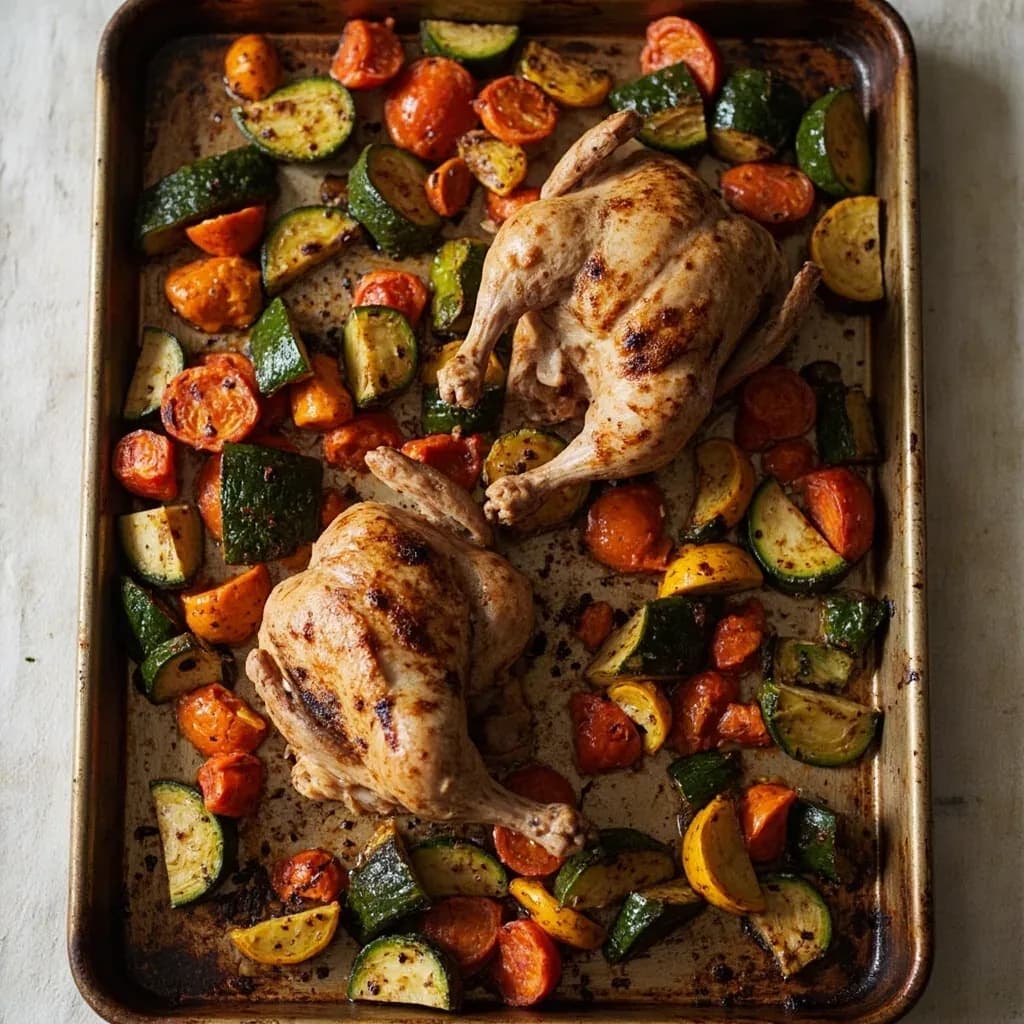
Sheet-pan roasting spreads seasoned vegetables and protein in a single layer on a rimmed baking tray and roasts them in a hot oven. Arranging items so they do not crowd lets edges caramelize rather than steam, and staggering additions accounts for different cook times. It is a popular weeknight technique because one pan delivers a full meal with minimal cleanup.
Sheet-pan roasting is a dry-heat oven technique built around a simple, stubborn idea: arrange food in a single layer on a rimmed tray, blast it with hot air, and let the Maillard reaction do the work. Where a deep roasting pan is designed to hold a whole bird in a moist, self-basting environment, the shallow rimmed sheet pan does the opposite — it spreads food out and exposes as much surface area as possible to radiant heat, producing the deep brown, caramelized edges that roasting is supposed to deliver but often doesn't.
The technique matters because it solves two everyday kitchen problems at once. It makes weeknight cooking almost entirely hands-off — most assemblies take about 10 minutes and the oven does the rest — and it consolidates the entire meal onto one pan, which is genuinely useful on a busy night or when feeding a crowd. It also behaves predictably: anything that can be cut into uniform pieces, oiled, and given space will brown, and the only real failure modes are crowding (which traps steam and turns roasting into something closer to steaming) and putting the wrong things together (a thick pork shoulder will never finish alongside a few minutes of shrimp).
In practice, sheet-pan roasting is less a recipe and more a framework. The cook chooses a hot oven (typically 425 °F / 220 °C), a protein and a vegetable that share a cook time, a fat, and a seasoning, then commits to the single-layer rule. Everything else — the timing, the staggering, the final flourish of acid and herbs — flows from there.
- Difficulty
- Easy
Types & varieties
The signature format: a single protein — chicken thighs, sausages, salmon, shrimp, or tofu — roasted alongside vegetables on one tray.
Vegetables only, served as a side; staggered additions let denser items get a head start.
Two sheet pans used to separate fast- and slow-cooking components, with the slower pan started earlier or placed on a lower rack.
British cousin; ingredients often sit in a shallow pool of stock, wine, or tomatoes, sometimes finished with breadcrumbs or cheese.
Run at 475–500 °F / 245–260 °C for charred, caramelized edges on quick-cooking items like cherry tomatoes, broccolini, or shrimp.
Bacon, sausages, hash, and eggs baked together at a moderate 375–400 °F / 190–200 °C so the eggs set gently.
Fruit crisps, slab cookies, brownies, and roasted stone fruit; the same single-layer, dry-heat logic applied to sweets.
How to do it
- 1
Heat the oven and the pan
Set the oven to 425 °F / 220 °C, or up to 475 °F / 245 °C for blistered, fast-cooking items. Place a rimmed half sheet pan inside while the oven preheats so it's hot when the food goes on — that initial contact sear jump-starts browning.
- 2
Choose compatible ingredients
Pick a protein and vegetables that finish in roughly the same window, or plan to stagger them. Cap the load at 1.5–2 lb / 700–900 g of food per half sheet pan; if there's more, use a second pan.
- 3
Cut for even cooking
Dice or chop vegetables into uniform ¾–1 in / 2–2.5 cm pieces. Cut denser vegetables (carrots, potatoes, squash) on the smaller side and quicker ones (zucchini, peppers, cherry tomatoes) slightly larger so they finish together. Portion proteins to a consistent thickness.
- 4
Dry, oil, and season
Pat everything thoroughly dry — surface moisture is the enemy of browning. Toss vegetables with 1–2 Tbsp high-smoke-point oil per pound, a generous pinch of salt, and pepper. Rub proteins with oil and season just before they go on the hot pan.
- 5
Arrange in a single layer
Spread food cut-side down where possible — more contact with the pan equals more browning — and leave small gaps between pieces. Put the slowest-cooking items in first; reserve quick items (shrimp, cherry tomatoes, delicate greens) to add partway through.
- 6
Roast, checking and turning
Roast on the center rack. At the halfway point, flip pieces with tongs or a thin spatula and rotate the pan front-to-back so the back doesn't char. Add the reserved quick items now.
- 7
Test for doneness
Vegetables should be deeply browned and tender at the tip of a knife; proteins should hit their safe internal temperature — 165 °F / 74 °C for chicken, 145 °F / 63 °C for salmon, 160 °F / 71 °C for pork sausage. If the vegetables finish first, lift them off with a spatula and let the protein keep going.
- 8
Finish and serve
Pull the pan and scatter fresh herbs, a squeeze of lemon, a splash of vinegar, flaky salt, or crumbled cheese. For extra sauce, deglaze the pan with a splash of water or stock, scrape up the browned bits, and spoon them over. Rest proteins 3–5 minutes before plating.
Why Crowding Is the One Mistake That Matters
Sheet-pan roasting lives or dies by the single-layer rule, and the physics are worth understanding. When food is spread out, hot air circulates around each piece and water vapor escapes freely, so the surface temperature climbs well past the boiling point of water and browning begins. When pieces touch or overlap, that water vapor gets trapped between them, evaporative cooling pins the surface close to 212 °F / 100 °C, and the Maillard reaction never gets going. The result is pale, limp, faintly steamed vegetables sitting in a puddle of their own liquid — edible, but not roasted in any meaningful sense.
- A crowded pan effectively roasts at a fraction of the temperature of a spacious one, because the food is cooling itself with its own steam.
- Two sheet pans on two racks is almost always better than one packed pan — but rotate them front-to-back and swap racks at the halfway point, since the lower pan partially blocks heat from reaching the upper one.
- If a recipe's ingredient list has multiplied beyond the pan's capacity, scale the recipe up to a second pan rather than down to a smaller pan.
- Water-heavy vegetables (zucchini, mushrooms, tomatoes) crowd a pan faster than drier, denser ones (carrots, potatoes, cauliflower), because they release so much liquid into a small space.
Choosing What Goes on the Pan Together
The technique's real skill is matching cook times. The simplest version pairs one protein with one or two vegetables that finish in the same window — chicken thighs and broccoli, salmon and green beans, sausages and peppers. The more ambitious version stages additions: carrots and potatoes go in first for a 15-minute head start, then a quicker vegetable is added when those come out for a turn.
- Group A (start first, ~40 min): potatoes, butternut squash, carrots, beets, brussels sprouts, whole shallots.
- Group B (add at the start, ~25 min): cauliflower, broccoli, peppers, fennel, thick asparagus, chicken thighs, sausages, bone-in pork chops.
- Group C (add halfway, ~15 min): zucchini, green beans, cherry tomatoes, shrimp, salmon fillets, tofu cubes.
- Group D (add in the last 5 minutes or after roasting): leafy greens, fresh herbs, lemon zest, a squeeze of citrus, crumbled feta or goat cheese.
Sheet-Pan Roasting vs. Roasting and Broiling
It's worth knowing what the technique is and isn't. Sheet-pan roasting is a subset of roasting defined by the shallow rimmed pan and the single-layer arrangement. A traditional roast in a deep pan — say, a 5-pound chicken on a rack with a cup of liquid below — is a different method, designed to capture drippings for gravy and to let the bird cook from within. Broiling, meanwhile, is top-down radiant heat, and while a sheet pan can go under the broiler to finish a dish with a quick char, broiling itself is a separate technique. The British traybake is the closest cousin: same pan, same oven, but with a small amount of liquid and often a finished topping of cheese, breadcrumbs, or pastry on top.
Common uses
Tips & pitfalls
- Use a rimmed sheet pan. A flat cookie sheet has nowhere for fat and juices to go, and you will spend the evening cleaning the bottom of your oven.
- Do not crowd the pan. Food should sit in a single layer with small gaps; if it doesn't fit, reach for a second pan rather than pile things up. Crowding is the single most common reason sheet-pan meals turn out pale and soggy.
- Cut to a similar size and group ingredients by cook time, or plan to add faster items partway through. Dense roots go in 10–15 minutes before quicker vegetables, and quick seafood or greens go in last.
- Pat proteins and washed vegetables thoroughly dry before oiling. Surface water has to evaporate before browning can begin, and it steals time and color.
- Use a high-smoke-point oil — olive oil, avocado oil, or grapeseed. Butter burns and turns acrid above roughly 400 °F / 200 °C.
- Preheat the sheet pan in the oven while it heats. Placing oiled food on a hot pan jump-starts the sear and dramatically improves browning on the underside.
- Add delicate finishing touches after roasting, not before: fresh herbs, lemon zest, leafy greens, a squeeze of citrus, or a splash of vinegar. They scorch under sustained dry heat and are best scattered on at the end.
- Salt water-heavy vegetables (zucchini, tomatoes, mushrooms) a little less and denser ones (potatoes, carrots, squash) a little more, since the quick-cooking ones release water that dilutes seasoning on the pan.
Good to know
- Also known as
- Traybake (UK/Ireland), sheet-pan dinner, one-pan roast
- Standard pan size
- Half sheet pan, 18 × 13 in (45 × 33 cm) with a 1 in (2.5 cm) rim
- Oven temperature range
- 400–475 °F / 200–245 °C; 425 °F / 220 °C is the common sweet spot
- Core principle
- Hot, dry oven + a single layer of oiled food on a rimmed tray = browning, not steaming
- Best pan material
- Heavy-gauge aluminum — it heats fast, conducts evenly, and resists warping at high temperatures
- Typical time
- 20–40 minutes for most vegetable-and-protein combinations
- Key equipment
- Rimmed aluminum sheet pan, tongs or a thin spatula, and an instant-read thermometer for proteins
- Yield
- One half sheet pan feeds 2–4 as a main, 4–6 as a side
Also called
sheet-pan-roast · sheet-pan-roasting · tray bake
Related

Sear
Blast the surface hot for a deep-browned, savory crust

Sauté
Cook quickly in a little fat over lively heat, tossing as you go

Stir-Fry
Toss bite-sized pieces over roaring heat for fast, smoky cooking

Pan-Fry
Crisp food in a shallow layer of hot fat, turning once or twice

Deep-Fry
Submerge in hot oil for an all-over crackling crust

Roast
Cook uncovered in dry oven heat for browned edges and tender centers

Bake
Cook with steady, surrounding oven heat — the soul of bread and pastry

Broil
Hit food from directly above with fierce overhead heat