Prep & Assembly
Single Fold (Letter Fold / Tour Simple)
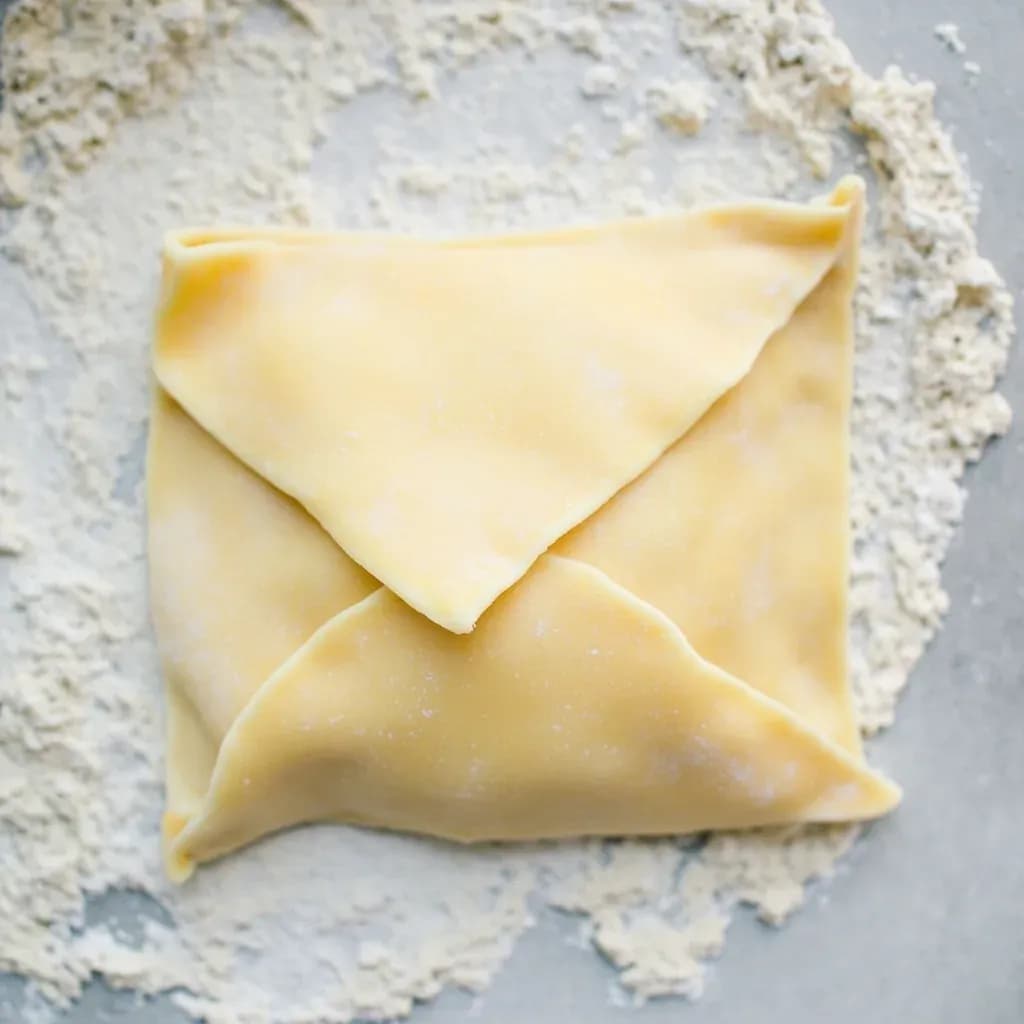
Folding laminated dough in thirds like a letter to build butter layers.
The single fold, or tour simple, folds a sheet of laminated dough into thirds like a business letter, layering butter and dough to create the flaky strata of croissants, puff pastry, and Danish. Each single fold roughly triples the layers, and the dough is chilled between turns so the butter stays firm and distinct. It is gentler than a double fold and gives more controlled, even lamination.
The single fold — tour simple in French pastry — is the foundational turning technique behind nearly every laminated dough. You roll the butter-enclosed dough into a long rectangle, fold the bottom third up, then fold the top third down over it, the same motion used to fold a letter into an envelope. That simple action triples the number of butter layers in the dough with every turn: each fold stacks three thin sheets of butter between four sheets of dough, and repeating the process compounds the count into the hundreds.
The technique works because two materials are kept at carefully matched temperatures. The butter must be cold enough to remain a solid sheet — pliable, never greasy — while the détrempe (the base dough) must be relaxed enough to roll without springing back. Both should sit near 15 °C / 60 °F; at that temperature the butter folds cleanly without shattering and the dough extends without tearing. Every fold is followed by a rest in the refrigerator, which re-chills the butter and lets the gluten relax before the next turn. Skip the rest and the dough fights you; skip the chill and the layers melt into each other and disappear.
The single fold is the most forgiving of the lamination turns, which is why it dominates croissant and Danish schedules (typically three turns after a lock-in for 27 layers) and is the only fold used in inverse puff pastry. In classic puff pastry, single folds are often alternated with double folds to build a high layer count without overworking the dough. For a home baker, mastering the tour simple is the difference between laminated pastry that rises in clean, flaky sheets and one that bakes up dense, greasy, and shrunken.
- Difficulty
- Medium
Types & varieties
Both ends folded to the middle, then folded in half like a book; 4 layers per turn. Often alternated with single folds in classic puff pastry.
Dough simply folded in half; 2 layers per turn. Rarely used in classic lamination.
The very first step: the butter block is wrapped in the détrempe before any folding turns begin.
How to do it
- 1
Start from a rested dough
Take the dough and butter block out of the refrigerator after the previous rest (or after the lock-in). They should both feel pliable and around 15 °C / 60 °F — the butter should give slightly when pressed but leave no greasy film on your finger.
- 2
Orient the dough
Place the dough on a lightly floured cool surface (marble is ideal) with the folded seam closest to you, so the open ends point away. Having the seam on your side means you will roll across the layers, not along them, which keeps them even.
- 3
Roll into a long rectangle
With a rolling pin, roll from the center outward in even strokes, lengthening the dough into a rectangle roughly three times as long as it is wide (for example, 20 × 60 cm / 8 × 24 in). Keep the edges straight with a bench scraper as you go and never roll back and forth, which pushes butter out the sides.
- 4
Square the edges
Trim or square the sides with a bench scraper or large knife so the rectangle has clean, even edges. Tapered or rounded ends will create wedge-shaped layers that distort the final dough and bake unevenly.
- 5
Fold the bottom third up
Take the edge closest to you and fold it up so it covers the middle third of the rectangle. Align the edge precisely with the far side of the middle third.
- 6
Fold the top third down
Take the far edge and fold it down over the first flap, like closing a letter to slip into an envelope. The folded dough should now be a neat rectangle one-third the original length, with three even layers visible from the side.
- 7
Seal and mark the turn
Press the open edges gently with the heel of your hand or a bench scraper to seal them. Press one fingertip dent into the top of the dough to mark this as turn number 1 — two dents next time, three after that, and so on, so you never lose count.
- 8
Wrap and chill
Wrap the dough tightly in plastic wrap, place it on a flat tray, and refrigerate for 30–60 minutes to relax the gluten and re-chill the butter before the next turn. Do not skip this rest; it is what keeps the layers distinct.
- 9
Rotate and repeat
For the next turn, take the dough out, rotate it 90° so the folded edge is once again closest to you, and repeat steps 3–8. Continue for the number of turns your recipe specifies — typically 3 for croissants, up to 6 for classic puff pastry.
Single Fold vs Double Fold
The single fold and the double fold are the two workhorses of French lamination, and they are usually alternated within a single recipe rather than used alone. A single fold triples the layer count in one motion and gives the butter a wider, more forgiving flap — small temperature drifts or uneven rolling rarely ruin the turn. The double fold quadruples the layer count in one motion, which is faster for building a high layer total, but it stacks the dough and butter more tightly, leaving less margin for error and producing more gluten development from the extra handling. A common professional schedule is single, double, single, double, single, single, which reaches 1,296 layers with even handling. For home bakers, a single-fold-only schedule (the standard for croissants) is the safer path: easier to keep cold, easier to roll evenly, and easier to recover from a small butter breakout.
- Single fold: 3 layers per turn, wider flap, more forgiving on temperature and rolling.
- Double fold: 4 layers per turn, tighter stack, builds layer count faster but stresses the dough more.
- Alternating the two in one schedule is standard in professional puff pastry.
- Inverse puff pastry uses only single folds to keep gluten development minimal.
Why Temperature Is Everything
Every aspect of the single fold is governed by a single physical fact: laminated dough is two materials — butter and dough — bonded in thin alternating sheets, and the technique works only while those sheets stay distinct. Butter becomes workable, plastic, and foldable in a narrow window of roughly 13–16 °C / 55–60 °F. Below that window it shatters into hard fragments when the dough is rolled, breaking the sheets and creating holes; above it the butter softens, smears into the dough, and the layers dissolve into a single mass. A cool marble or steel work surface, a chilled rolling pin, and a room at 18–20 °C / 64–68 °F give the baker enough time to roll and fold before the butter warms past the working window. The 30-to-60-minute refrigerator rest between turns is not optional — it re-chills the butter and relaxes the gluten so the next roll does not shrink the dough back.
Common uses
Tips & pitfalls
- Keep everything cold: a marble or steel slab, a chilled rolling pin, and a cool room (18–20 °C / 64–68 °F) make the technique far easier and prevent the butter from smearing into the dough.
- Dust the bench with flour sparingly — excess flour gets folded into the dough and toughens the final pastry. Brush off the loose flour before each fold.
- Roll in single, even strokes from the center outward; never rock the pin back and forth, which pushes butter out the sides and ruins the rectangle's shape.
- If a small patch of butter pokes through the dough, don't panic — dab it with a little scrap of excess dough from the edge to patch it, dust lightly with flour, and continue.
- Mark completed turns on the dough with fingertip dents (1, 2, 3…) so you never lose count mid-schedule, and rotate the dough 90° between turns so you always roll across the layers, not along them.
- If the butter ever shatters and feels like cold gravel when you roll, the dough is too cold — let it sit 5–10 minutes at room temperature until it gives slightly under your thumb.
- Always rest the dough long enough between turns: under-rested dough springs back when rolled, and over-handled dough loses its layer definition and bakes up dense.
- Wrap the dough tightly in plastic between turns to prevent a skin from forming on the surface and to keep the exposed butter from drying out or picking up fridge odors.
Good to know
- French name
- Tour simple
- Also called
- Letter fold, three-fold, single turn
- Layers created per fold
- 3 (the butter layer count multiplies by 3 each turn)
- Working temperature
- Around 15 °C / 60 °F for both dough and butter
- Rest between turns
- 30–60 minutes in the refrigerator, 15–20 in the freezer on a tight schedule
- Standard croissant schedule
- 1 lock-in (enclosure) + 3 single folds = 27 layers
- Standard puff pastry schedule
- 6 turns total in the classic French method, yielding roughly 729 layers
- Difficulty
- Moderate — more forgiving than the double (book) fold for home bakers
Also called
Letter Fold · Tour Simple · Three-Fold
Dishes that rely on it

Related

Whisk
Beat ingredients smooth and aerated with a looping wire motion

Sift
Pass dry ingredients through mesh to aerate and remove lumps

Strain
Pour through mesh to separate solids from liquid for a smooth result

Filter
Pass liquid through fine material to clarify out the smallest particles

Rice
Press cooked potatoes through small holes for fluffy, lump-free texture

Mash
Crush soft cooked food into a rustic, creamy purée

Grind
Crush food into a coarse to fine texture, from spices to meat

Grate
Shred food into fine bits against a sharp-toothed surface