Prep & Assembly
Smashing Aromatics
Crushing garlic, ginger, or lemongrass to bruise the fibers and release their oils.
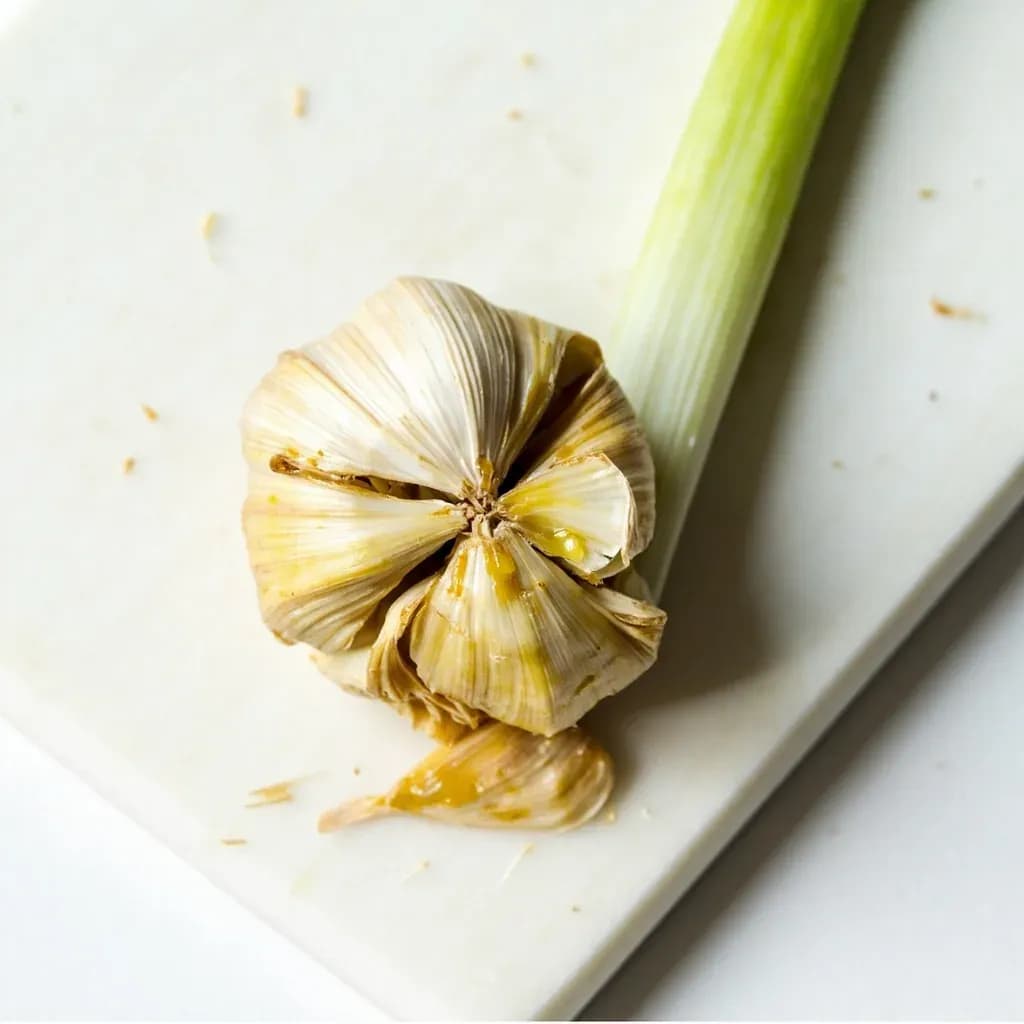
Smashing aromatics uses the flat of a knife, a pestle, or a cleaver to bruise garlic, lemongrass, ginger, or galangal so their cell walls rupture and flavor oils flood out. It releases far more aroma than slicing and lets fibrous stalks like lemongrass perfume a broth without being eaten. Smashed garlic also slips out of its skin easily and infuses oil quickly when fried.
Smashing aromatics is the deliberate bruising of whole garlic cloves, knobs of ginger, lemongrass stalks, shallots, and similar flavor-bearing plant tissue to rupture the cell walls that trap their volatile oils. A single firm press — usually with the flat of a knife or cleaver — splits the fibers without reducing the piece to a paste, so the aromatic holds its shape while its flavor pours out the moment it meets heat, fat, or liquid.
This sits in the middle of the prep spectrum, between leaving the ingredient whole and mincing it. A whole clove releases slowly and politely; a mince or paste integrates immediately but disappears into the dish. A smash gives you the best of both: the oils flood out fast enough to perfume a wok in seconds, yet the bruised piece stays large enough to fish out of a braise, to identify in a finished curry paste, or to steep and discard from an infused syrup.
The underlying mechanism is simple plant anatomy. Aromatic roots, bulbs, and pods store their flavor compounds in tiny compartments; mechanical impact bursts those compartments, and the released oils then dissolve into surrounding fat or water. Bruising, rather than cutting, is the gentlest way to trigger that release without sacrificing structural integrity — which is why the same motion appears in Thai curry work, French stocks, Indian tadka, Vietnamese pho, and the bottom of an Old Fashioned glass.
- Difficulty
- Easy
Types & varieties
Flat of a chef's knife or cleaver pressed or struck down on the cutting board — the standard Western and Chinese method.
Single firm press or short rotation inside a mortar; produces a coarser bruise and is the traditional Southeast Asian and Indian approach.
Aromatic pressed with the flat base of a heavy skillet, useful when a cutting board is not at hand.
A quick sharp strike with the flat of the blade, often used to loosen garlic skins or to crack whole spices like cardamom or cinnamon sticks.
The cocktail variant — a wooden muddler in a mixing glass to bruise herbs, citrus, ginger, or sugar.
How to do it
- 1
Select and prep the aromatic
Choose firm, fresh garlic, ginger, lemongrass, shallot, chili, or whole spice. Trim root ends, peel tough outer layers (especially on lemongrass and fresh turmeric), and leave the item whole — do not pre-slice.
- 2
Position on the board
Place the aromatic flat on a sturdy wooden or composite board. Keep fingers well clear of the strike zone. A damp paper towel under the board keeps it from sliding.
- 3
Set the knife
Lay the broad, flat side of a heavy chef's knife or cleaver directly over the aromatic so the blade is parallel to the board. The heel of the blade should sit over the thickest part of the piece.
- 4
Strike or press
Use the heel of your palm (or a controlled, moderate-force downward strike) to drive the flat of the blade into the aromatic. You should hear and feel the fibers crack; one firm motion is better than a slow crush.
- 5
Inspect and finish
The piece should be visibly split, with broken fibers and a wet, glossy surface where the oils have surfaced, but still recognizably whole. Peel off any loosened skin (garlic, ginger). Coarse-bruised spices can now be dropped into hot oil.
- 6
Use or store briefly
Add the smashed aromatic to the dish immediately for the most aromatic impact. If prepping ahead, hold in a covered container no more than a few hours; cut surfaces oxidize and lose potency quickly.
By the ingredient
Different aromatics respond differently to the smash, and a little tailoring makes a real difference in both flavor yield and waste.
- Garlic: place the flat of the blade over an unpeeled clove and press with the heel of your palm. The skin splits and slips off cleanly afterward; a pinch of coarse salt on the board acts as a gentle abrasive and seasons as you go.
- Fresh ginger: smash unpeeled so fibers split lengthwise, then lift off the papery skin with the edge of a teaspoon. The bruise exposes the oils and the spoon recovers almost every bit of flesh — far less waste than peeling with a knife.
- Lemongrass: strip the tough outer leaves and trim the root end. Bruise only the pale lower 4–6 inches for curries and soups; the green tops can be lightly whacked and steeped in stocks or tea, then discarded.
- Shallots and small onions: a flat press compresses the layers so they weep less in the pan and caramelize more evenly when sliced afterward.
- Whole spices — cardamom, cumin, coriander, peppercorns, cinnamon sticks: a single sideways whack cracks the husk without powdering the seed, which is exactly what you want for tadka, dry rubs, and chai.
Common uses
Tips & pitfalls
- Use one decisive, firm strike rather than a slow grind — you want fibers split, not pulverized into paste.
- For garlic, place the flat of the blade over the clove and press with the heel of your palm; the skin loosens and slips off cleanly afterward.
- Smash fresh ginger before peeling — the bruised flesh separates easily from the papery skin with the edge of a spoon.
- For lemongrass, peel off the tough outer layers, then smash only the pale lower 4–6 inches; reserve the very tops for steeping in tea or stock.
- Smash, don't mince, when the recipe asks you to remove the aromatic later — a whole bruised piece is much easier to fish out of a broth.
- If a recipe calls for both smashed and sliced garlic, smash one clove and slice a separate clove; pressing an already-sliced piece turns it into mush.
- Salt acts as a gentle abrasive: sprinkle a pinch on the board before smashing ginger or garlic to keep it from skating and to season as you go.
- Add smashed aromatics to cold liquid rather than hot when you want maximum extraction — heat them gradually so the oils diffuse evenly.
- Use the side of a heavy cleaver, not the tip, when working in volume (large batches of ginger for stock) to protect the blade edge.
Good to know
- Technique family
- Mechanical prep / bruising
- Primary purpose
- Rupture cell walls to release volatile oils and aromatic compounds
- Common tools
- Flat side of a chef's knife or cleaver, pestle and mortar, meat mallet, bottom of a heavy skillet, rolling pin
- Difficulty
- Easy
- Active time
- 5–15 seconds per piece
- Best for
- Garlic, fresh ginger, lemongrass, shallots, small onions, whole spice pods, fresh chilies, fresh turmeric
- Cuisine prevalence
- Universal; central to Thai, Vietnamese, Chinese, Indian, and Mediterranean cooking
- Distinguished from
- Mincing (fine chopping), grating (shredding), pounding (repeated heavy impact)
Also called
Smashing Garlic & Lemongrass · Smashing Garlic · Smacking Garlic (Thup Kratiam) · Smashing Lemongrass (Titik)
Related

Whisk
Beat ingredients smooth and aerated with a looping wire motion

Sift
Pass dry ingredients through mesh to aerate and remove lumps

Strain
Pour through mesh to separate solids from liquid for a smooth result

Filter
Pass liquid through fine material to clarify out the smallest particles

Rice
Press cooked potatoes through small holes for fluffy, lump-free texture

Mash
Crush soft cooked food into a rustic, creamy purée

Grind
Crush food into a coarse to fine texture, from spices to meat

Grate
Shred food into fine bits against a sharp-toothed surface