Prep & Assembly
Spätzle Scraping
Scraping or pressing soft egg-dough strands directly into boiling water to form rustic German dumplings.
Spätzle scraping forms the irregular little dumplings by spreading a loose egg-and-flour batter on a board and slicing thin ribbons off the edge into boiling water, or pressing it through a perforated spätzle press. The dough is too soft to shape by hand, so the scraping motion creates the characteristic uneven curls. The dumplings are done when they float, then often pan-tossed in butter.
Spätzle scraping is the original Schwäbische method of shaping these egg-dough dumplings: a wet wooden board is loaded with a thin layer of soft, glossy batter, and a long flat scraper is drawn across it so ribbons of dough peel off, snap into short pieces, and tumble directly into a pot of boiling salted water. No press, no grater, no machine — just board, scraper, and a steady hand. The result is a rustic strand with a slightly tapered body and a crinkly, broken end that no other method quite replicates.
The technique rewards cooks who pay attention to dough feel more than to measurements. The batter sits between a pancake batter and a pasta dough: thick enough to cling to the board, viscous enough to release cleanly when scraped, and rich enough with eggs to set the moment it hits boiling water. Because the dough is pushed off the board rather than extruded under pressure, the strands carry tiny irregularities that catch melted cheese, mushroom cream, and pan gravy far better than the smooth cylinders from a Spätzle press.
Scraping is considered one of the oldest shaping methods in the Spätzle family — very likely predating the press and grater — and the one that defines the farmhouse versions found from Swabia across Austria into Alsace and South Tyrol. Once you understand how the dough wants to behave — heavy ribbon, glossy sheen, slow drip — the rest is rhythm.
- Difficulty
- Medium
Types & varieties
The classic scraped form: long, thin, slightly tapered strands with irregular, knobby ends.
Smaller, button-like dumplings produced when a thicker layer of dough is scraped off a wet board.
Umbrella term covering press, grater (Hobel), knife-cut, and scraping methods.
Close cousin with similar soft dough, traditionally shaped with two spoons rather than scraped.
How to do it
- 1
Make the dough
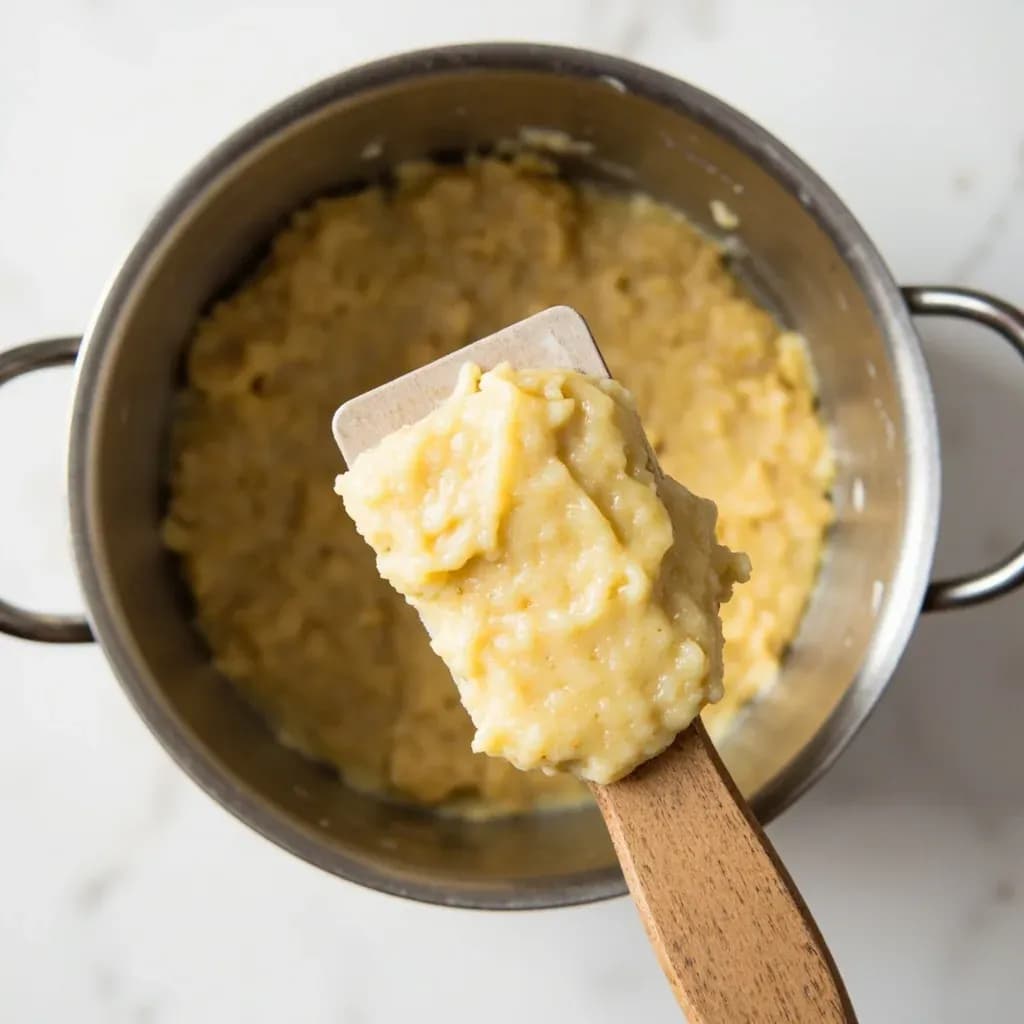
In a large bowl, whisk 4–5 eggs with 1 tsp salt and a splash of milk or water. Gradually beat in about 250 g wheat flour until completely smooth. The finished batter should fall from the spoon in a slow, thick ribbon and hold a brief trail on the surface. Cover and rest 15–30 minutes so the flour fully hydrates.
- 2
Bring the water to a hard boil
Fill a wide, deep pot with plenty of water, salt heavily (about 1 tbsp per liter — it should taste like sea water), and bring to a sustained rolling boil. Keep it at a hard boil while scraping; the Spätzle need to set the instant they hit the water.
- 3
Prepare the board and scraper
Submerge the wooden Spätzlebrett in hot water so it is well-warmed and slick. Keep the long Spätzleschaber (or a flat bench scraper) slightly damp and within easy reach beside the pot.
- 4
Spread the dough on the board
Lift the wet board at a slight angle over the pot. Using the scraper or a ladle, spread a manageable portion of dough (about a third of the batch) in a thin, even layer — roughly 3–5 mm thick — across the upper two-thirds of the board.
- 5
Scrape into the water
Hold the board so the lower edge hovers 10–20 cm above the water. With the long edge of the scraper held flat and at a shallow angle, draw it across the dough in smooth, even strokes. Thin strips of dough peel off, snap into short pieces, and drop into the pot.
- 6
Cook until they float
As soon as the Spätzle rise to the surface, time 1–2 minutes more. They should look slightly swollen, feel springy when bitten, and bounce against each other in the water.
- 7
Drain and finish
Lift the cooked Spätzle with a spider or slotted spoon, drain well, and immediately toss with a knob of butter. Repeat with the remaining dough, rewetting the board between batches. Hold finished Spätzle in a warm bowl with a little butter on top, or use straight away.
Reading the Dough
The dough is the whole game in scraped Spätzle — more so than in any other shaping method — because the batter must cling to the board, release under the scraper, and hold its shape the instant it meets boiling water. Learn to judge it by sight and feel rather than by the clock.
- A correct batter falls from a spoon in a slow, heavy ribbon and leaves a brief trail on the surface before sinking in.
- Too thick: it sits in stiff lumps, scrapes off in heavy knobs, and turns out gnocchi-like. Loosen with a tablespoon of water or milk at a time.
- Too thin: it runs off the board in a sheet, breaks into mush, and loses its structure. Beat in a tablespoon of flour and rest again.
- Resting 15–30 minutes tightens the dough — it should look glossier and fall a touch more slowly after resting than before.
- A splash of sparkling water or a teaspoon of oil can loosen a stubborn batch without thinning it noticeably.
Equipment Notes
Traditional tools are not just nostalgic — they genuinely change the outcome.
- A beechwood board holds a thin film of water on its surface, which lets the dough release cleanly with the scraper; plastic and acrylic boards tend to grab the dough.
- A long, flat wooden scraper (Spätzleschaber) flexes just enough to ride the dough; a rigid metal bench scraper works but produces slightly more broken pieces.
- Keep the board submerged in warm water between batches so it stays slick and warm — a cold, dry board is the most common reason dough sticks and tears.
- Modern Spätzle machines and silicone mats imitate the motion, but most Swabian cooks still reach for the wood when they want the classic crinkled strand.
Common uses
Tips & pitfalls
- Dough consistency decides everything — it should slowly ribbon off a spoon. Too thick gives heavy lumps; too thin gives mush.
- Rest the batter 15–30 minutes to hydrate the flour, relax the gluten, and tighten the scrape.
- Dip the board in hot water before each batch — a warm, slick board is the difference between clean strands and torn dough stuck to the wood.
- Use long, even strokes with the scraper held flat; short choppy motions produce ragged, broken pieces.
- Salt the boiling water generously; Spätzle absorb almost no seasoning after cooking.
- Cook in small batches so the water keeps a hard boil — crowding drops the temperature and the strands go gummy.
- Lift them out 30–60 seconds after they float; overcooking turns them soft and gluey.
- Common mistake: using a plastic board. Wood holds a thin water film and gives the cleanest release; plastic grabs the dough.
- To make ahead, shock cooked Spätzle in ice water, drain, toss with a little oil, and rewarm in butter just before serving.
Good to know
- Origin
- Swabia (Schwaben), southwestern Germany; the Schaben (scraping) method is considered one of the oldest Spätzle-shaping techniques, likely predating the press and grater methods.
- Also found in
- Austria (as Nockerl or Knöpfle), Switzerland, Alsace, South Tyrol, and Hungarian-German regions.
- Core equipment
- A flat wooden Spätzlebrett and a long, flat Spätzleschaber — traditionally beechwood, though stainless-steel scrapers are common today.
- Egg-to-flour ratio
- Roughly 3–5 eggs (≈150–250 g) per 250 g flour; more egg produces a richer, more tender dumpling.
- Dough consistency
- Thick, glossy, viscous batter that drips slowly and heavily from a spoon — neither pourable nor kneadable.
- Cook time
- About 1–2 minutes after the pieces rise to the surface in salted boiling water.
- Yield
- Roughly 4–5 servings (≈600–750 g cooked) per 250 g flour.
- Total time
- About 30–40 minutes including a 15–30 minute dough rest.
Also called
Spätzle Scraping / Pressing · Spaetzle Making · Spätzle Pressing
Related

Whisk
Beat ingredients smooth and aerated with a looping wire motion

Sift
Pass dry ingredients through mesh to aerate and remove lumps

Strain
Pour through mesh to separate solids from liquid for a smooth result

Filter
Pass liquid through fine material to clarify out the smallest particles

Rice
Press cooked potatoes through small holes for fluffy, lump-free texture

Mash
Crush soft cooked food into a rustic, creamy purée

Grind
Crush food into a coarse to fine texture, from spices to meat

Grate
Shred food into fine bits against a sharp-toothed surface