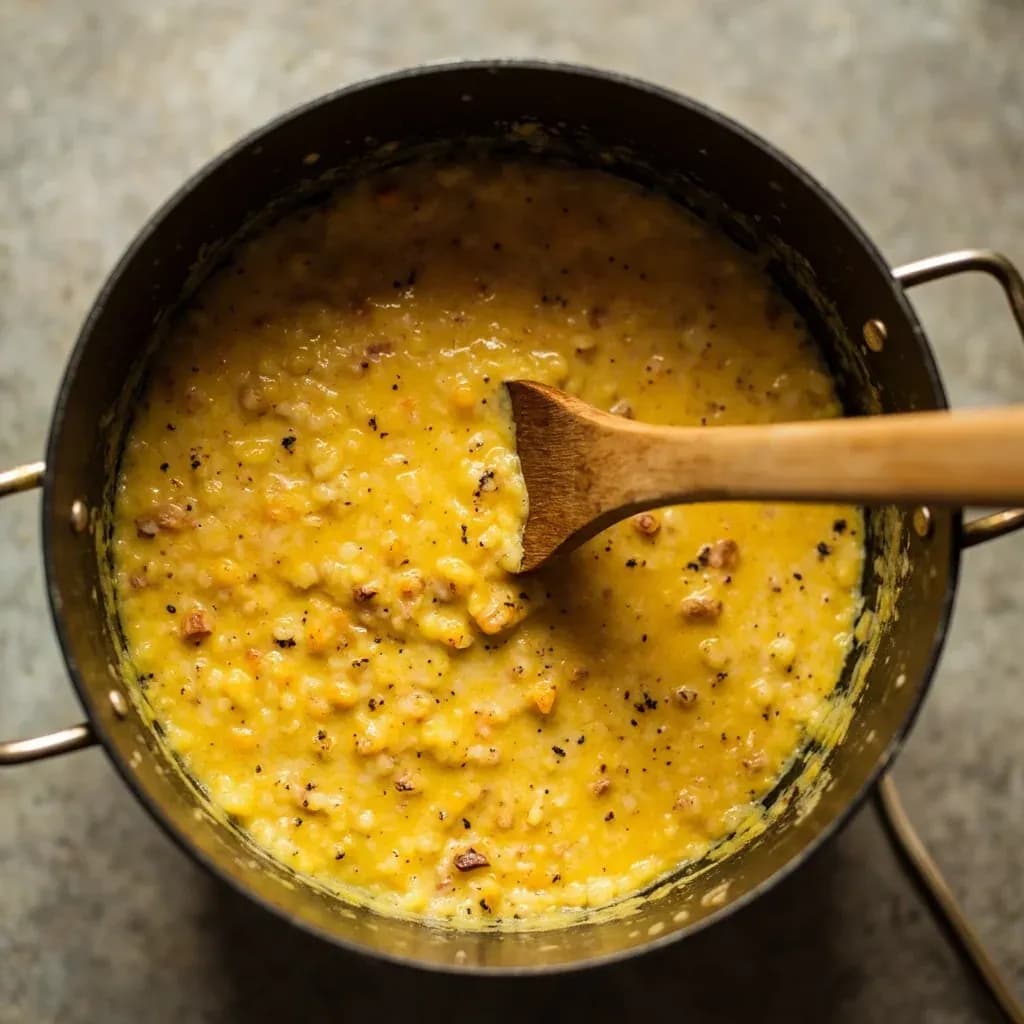
Prep & Assembly
Stiff-Porridge Stirring
Vigorously stirring grain flour into water to cook a dense staple porridge.
Stiff-porridge stirring works grain or starch flour into boiling water with constant, forceful turning until it cooks into a dense, smooth staple. It is the technique behind ugali, nsima, pap, polenta, fufu, banku, and many African swallows. The sustained muscle and steady additions of flour are essential to avoid lumps and reach the right firm, elastic texture.
Stiff-porridge stirring is the disciplined cooking method behind the dense, hand-moldable maize porridges that anchor meals across sub-Saharan Africa — South African stywe pap, Kenyan and Tanzanian ugali, Zimbabwean sadza, and Malawian and Zambian nsima. The cook brings salted water to a boil, sifts maize meal in a thin, steady stream while stirring constantly, and then works the resulting dough against the hot pot for fifteen to thirty minutes until it forms a single elastic mass that holds a clean ridge when the paddle is lifted. The technique is less about a single recipe than about a method: the same logic of gradual hydration, sustained agitation, and patient cooking produces a whole family of related dishes that differ mostly in ratio, regional flour preference, and how the final mound is shaped for the table.
What separates stiff-porridge stirring from ordinary porridge making is the sustained physical labor and the deliberate working of a heavy dough. As the starch granules hydrate, swell, and burst, the mixture tightens from a pourable batter into something closer to bread dough. The cook has to keep folding and pressing it against the pot so heat penetrates evenly, raw flour flavor cooks out, and a smooth, lump-free texture develops. Get it right and you have a neutral, slightly sweet, scoopable staple that absorbs sauces, stretches stews, and feeds a family cheaply; undercook or under-stir it and the core stays gritty, chalky, and faintly raw.
The method is also a small piece of culinary engineering. The paddle — traditionally a shaped stick, sometimes forked — is chosen as much for how it folds the dough as for how it stirs. The pot is heavy because thin pans scorch where the mass sits against the base. The water-to-flour ratio is calibrated to produce a final product stiff enough to mold by hand yet soft enough to swallow without chewing. Understanding those choices is what turns a recipe for ugali or sadza into a transferable technique you can apply to polenta, millet porridge, or any other stiff grain dish.
- Difficulty
- Hard
Types & varieties
The stiffest version; molded by hand and used as a scoop for stew, or served with a central well of sauce (pap en sous).
Same flour, much looser 1:5 ratio; spoonable and often eaten at breakfast with milk and sugar.
White maize meal cooked stiff and cut into slabs, served alongside sukuma wiki, beef stew, or grilled fish.
White or yellow maize porridge shaped into a flat disc, then topped with greens (muriwo), beef, or peanut butter.
Very stiff maize porridge pinched off in fist-sized balls and used to scoop up stews and relishes.
Same stirring principle, often cooked with milk or stock; served loose or chilled, set, and pan-fried.
Used across the Sahel, parts of Southern Africa, and rural India; same method, slightly more bitter and more nutritious.
Related in role and texture but usually pounded rather than stirred, and typically made from cassava, plantain, or yam.
A fermented stiff maize dumpling wrapped in maize husks or banana leaves and steamed, not stirred.
How to do it
- 1
Set up the pot and water
Pour 1.25–1.5 L of water into a heavy pot or cast-iron potjie. Add about 1 teaspoon of salt and bring to a full rolling boil over high heat.
- 2
Make the first slurry
Reduce the heat to medium. With one hand sprinkling and the other stirring constantly, sift in roughly one-third of the 500 g maize meal. Stir in a rapid figure-of-eight with a wooden paddle until you have a smooth, lump-free paste the consistency of thick cream.
- 3
Build the body in stages
Add the next third of the maize meal in a thin, steady stream, still stirring. The mixture will thicken into a heavy paste. Add the final third the same way, allowing each addition to be fully incorporated before the next.
- 4
Work the dough
Stir firmly and continuously, pressing the dough against the sides and bottom of the pot and folding it over on itself. This 15–30 minute stage is the heart of the technique — it cooks the starch, drives off raw flavor, and develops the smooth, elastic texture that defines a good stiff porridge.
- 5
Adjust consistency
If the dough becomes too stiff to move, splash in 2–4 tablespoons of hot water and work it in. The finished dough should pull away from the sides of the pot cleanly and form a single mass around the paddle.
- 6
Test for doneness
Pull the paddle straight up: the porridge should hold a clean ridge for several seconds. Scoop a small piece and roll it between wet palms — it should form a smooth, crack-free ball. Taste a pinch; there should be no gritty, raw flour flavor.
- 7
Shape and serve
Wet a wooden spoon, scoop the porridge into a serving bowl, and shape it into a domed mound with wet hands. For pap en sous, press a well into the top to hold sauce. Serve immediately with stew, chakalaka, sukuma wiki, or grilled meat.
The Tools of the Trade
The right equipment is half the technique. A heavy pot — cast iron, a three-legged cast-iron potjie, or a thick-bottomed stockpot — holds and distributes heat so the dough does not scorch where it sits against the base. Thin aluminum pans are the most common reason for a burnt layer on the bottom of pap.
The paddle matters as much as the pot. A long, smooth wooden spoon or a shaped wooden stick lets the cook reach the bottom without burning a hand on the rim. In many rural kitchens, the traditional tool is a Y-shaped branch, because the fork creates extra turbulence that breaks up lumps more effectively than a flat blade. Whatever the shape, the paddle should be wiped or dipped in water between stirs to keep the dough from clagging onto it.
Reading the Dough
Stiff-porridge cooking is judged almost entirely by eye, hand, and paddle. Three small tests tell the cook when the work is done.
- The paddle test: pull the paddle straight up. The porridge should hold a clean ridge for several seconds before slowly settling.
- The hand test: scoop a small piece and roll it between wet palms. A ready porridge forms a smooth ball with no cracks; an underdone one crumbles.
- The taste test: a tiny pinch should taste cooked, slightly sweet, and free of any chalky, raw flour flavor.
Working with What You Have
The method was developed on open fires with simple tools, and it adapts gracefully to modern kitchens. A flat-bottomed heavy Dutch oven replaces the potjie; a sturdy wooden spoon replaces the forked stick. Cooks in a hurry can split the work by bringing the water to a boil, whisking in about a third of the flour to make a smooth slurry, then finishing on lower heat with steady stirring. The discipline matters more than the exact pot.
Common uses
Tips & pitfalls
- Use a heavy-bottomed pot — thin pans scorch where the dough sits against the base during the long stir.
- Sift the flour in a thin stream with one hand while stirring with the other; never dump it in, or you will fight lumps for half an hour.
- A traditional forked stick is a clever tool — the fork creates extra turbulence that breaks up clumps better than a flat paddle.
- Wet the paddle between stirs to keep the dough from sticking and pulling away from the pot.
- Press any lumps firmly against the hot side of the pot with the back of the paddle to work them out.
- Cook the dough longer than you think you need to — a raw maize taste lingers if the flour is underdone.
- Keep a small jug of hot water beside the pot to loosen the dough if it tightens; never add cold water, which drops the temperature.
- Cover the finished mound with a cloth or lid for a few minutes before serving so the interior steams and finishes cooking.
- Under-stirring once the dough thickens, leaving a raw, mealy core.
- Using very fine maize flour — coarser 'mealie meal' or polenta-style grits give better texture and the traditional bite.
- Salting the dough instead of the water — salt slightly toughens starch, so add it at the boil.
Good to know
- Also known as
- Stywepap, stywe pap, ugali, sadza, nsima, stiff mealie meal, African stiff porridge
- Origin / region
- Indigenous to sub-Saharan Africa; a daily staple across Southern, Eastern, and parts of Central Africa
- Primary flour
- Maize meal (mealie meal); sorghum and millet are common substitutes in drier regions
- Stiff porridge ratio
- Roughly 1 part maize meal to 2–3 parts water; soft pap is closer to 1:5
- Target texture
- Dense and elastic; the paddle stands in it, and a scoop rolls into a clean, crack-free ball
- Active cooking time
- 20–45 minutes of stirring after the initial boil
- Equipment
- Heavy pot (cast iron or three-legged potjie), long-handled wooden paddle or forked stick
- Yield
- About 4–6 servings from 500 g maize meal and 1.25–1.5 L water
- Difficulty
- Medium; physically demanding because of the sustained, vigorous stirring
- Storage
- Best served fresh; leftover slab can be sliced and pan-fried the next day (krummelpap) or wrapped and refrigerated 2–3 days
- Common pairings
- Chakalaka, tomato-and-onion relish, stews, curries, grilled meat, sukuma wiki, mopane worms
Also called
Pap Stirring · Ugali Stirring · Fufu Stirring · Polenta Stirring · Nsima
Related

Whisk
Beat ingredients smooth and aerated with a looping wire motion

Sift
Pass dry ingredients through mesh to aerate and remove lumps

Strain
Pour through mesh to separate solids from liquid for a smooth result

Filter
Pass liquid through fine material to clarify out the smallest particles

Rice
Press cooked potatoes through small holes for fluffy, lump-free texture

Mash
Crush soft cooked food into a rustic, creamy purée

Grind
Crush food into a coarse to fine texture, from spices to meat

Grate
Shred food into fine bits against a sharp-toothed surface