Heat & Fire
Texas Crutch (Foil/Paper Wrap)
Wrapping smoking meat in foil or butcher paper to push through the stall and shorten cook time.
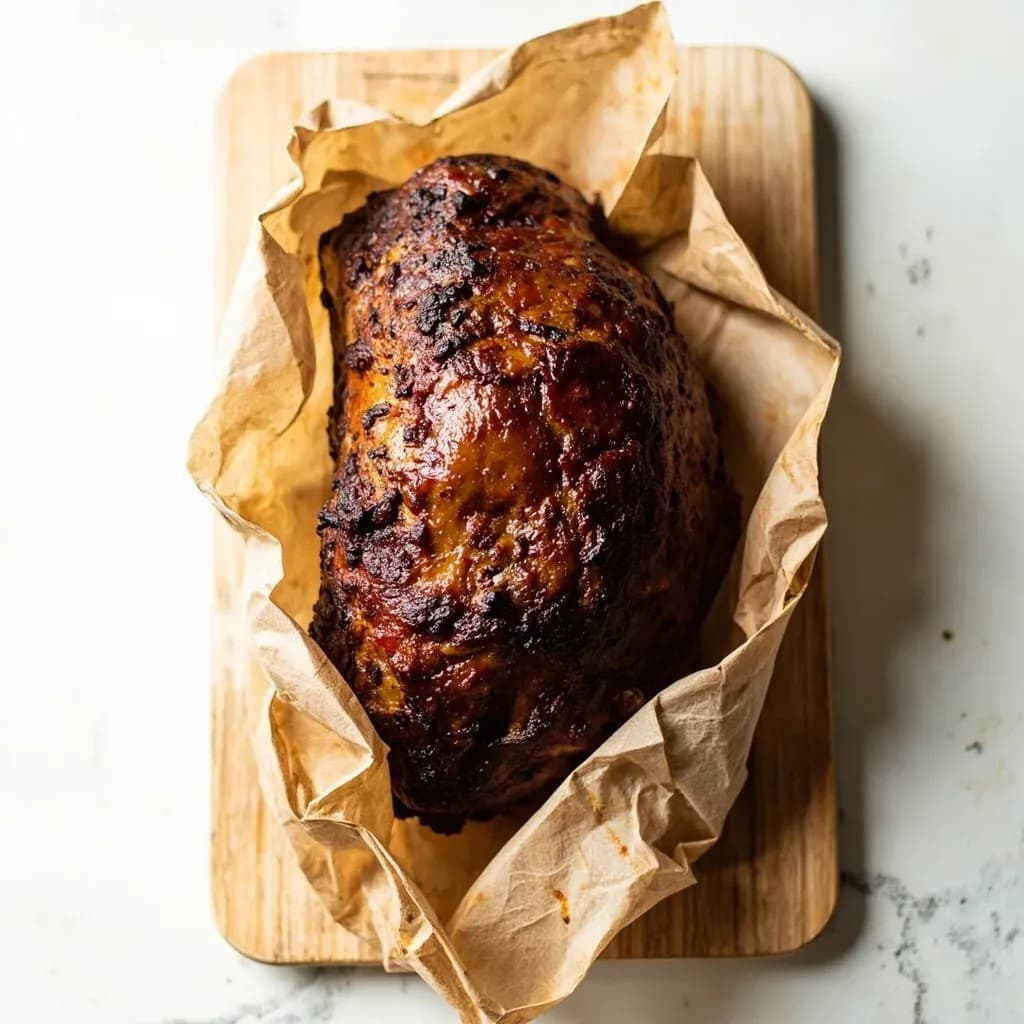
The Texas crutch wraps barbecue meat, usually brisket or pork, tightly in aluminum foil or butcher paper partway through smoking. The wrap traps moisture and steam, breaking the evaporative cooling 'stall' where internal temperature plateaus, so the meat finishes faster and stays juicy. Butcher paper is often preferred over foil because it keeps a firmer bark by letting some moisture escape.
The Texas Crutch is the practice of wrapping a long-smoked cut — typically in heavy-duty aluminum foil or pink butcher paper — partway through the cook to push it past 'the stall,' that frustrating temperature plateau that can pin a brisket at 160°F for hours as evaporative cooling on the meat's surface fights the fire. By sealing in moisture and heat, the wrap stops that cooling effect, lets internal temperature climb again, and shortens total cook time by roughly 1–2 hours on a 12-hour brisket. The trade-off is bark: foil softens it by trapping steam, butcher paper preserves a firmer crust by breathing. Born in American competition barbecue in the 1980s and 90s, the technique spread into restaurant and home smoking and is now the dominant approach whenever finish time, volume, or food-safety margin matters more than maximum crust. It remains a point of friendly heresy in traditional Central Texas pit culture, where many old-school hands still smoke unwrapped from start to slice.
- Difficulty
- Easy
Types & varieties
Two perpendicular layers of heavy-duty foil sealed with a small splash of liquid. Fastest method; produces a more braised, pot-roast-like texture and a soft, moist bark.
A single sheet of food-grade peach paper in a butcher's 'burrito' fold. Breathable enough to preserve bark, tight enough to retain heat — the style most associated with Aaron Franklin's Austin barbecue.
Foil folded up around the sides of the meat but left open on top. Shields from direct radiant heat and grease flare-ups without fully braising — a useful middle ground on offset smokers.
Butcher paper wrapped first to protect the bark, then a loose foil layer over the outside to retain heat. Common in competition for control of both texture and finish time.
Not the crutch itself but the competing school: meat goes on the cooker bare and stays bare for maximum bark and crust, accepting a longer total cook. Useful baseline when judging the crutch's trade-offs.
How to do it
- 1
Smoke unwrapped through bark development
Season the meat and place it on the cooker fat-side up (or toward the heat source). Maintain a steady 225–275°F pit temperature. Leave the meat unwrapped until a firm, mahogany bark has formed and the surface feels tacky rather than wet — usually 3–5 hours, or once internal temperature reaches roughly 150–165°F and growth slows (the stall).
- 2
Prep the wrap station
Tear off two 18-inch sheets of heavy-duty foil perpendicular to one another, or one large sheet of pink butcher paper. Have a ladle of warm beef tallow, stock, or apple juice ready, and a cutting board or sheet pan to wrap on. Work near the smoker — a wrapped brisket loses heat fast during a long wrap on the counter.
- 3
Position and add moisture (optional)
Lift the meat onto the wrap surface. Pour 2–4 tablespoons of tallow or liquid over the top — just enough to baste, not pool. Keep the liquid on top so the bark on the underside stays dry and intact.
- 4
Wrap
Foil: fold the long sides up and over the meat, crimping tightly along the seam, then fold in the short ends like a present. Paper: bring the long edge over the top, tuck the short ends under, and roll the meat away from you seam-side down into a snug bundle. Don't compress — you want a firm wrap without crushing the bark.
- 5
Return to heat or hold
Place the wrapped meat back on the smoker (foiled meat can tolerate higher pit temps like 275–300°F) or set it in a pre-warmed dry cooler closed with a clean towel. Either way, hold until the probe slides into the thickest part of the meat with little resistance — typically 203°F internal for brisket, 195–203°F for pork butt.
- 6
Rest, then unwrap and slice
Rest the wrapped meat for a minimum of 1 hour and up to 4 hours in a cooler. Unwrap just before slicing. For brisket, separate the point from the flat, slice the flat against the grain at pencil-width, and cut the point into slightly thicker slices or cubes for burnt ends.
The Science of the Stall
The plateau isn't a malfunction — it's physics. As the meat's surface heats, water migrates outward and evaporates, and that phase change carries heat away faster than the pit can supply it. The result is a flat period on the temperature graph, often 150–170°F internal, that can last anywhere from thirty minutes to four hours. Wrapping stops the evaporation by sealing the surface in a humid micro-environment, and the meat's temperature resumes climbing. Foil does it almost completely (hence the speed); butcher paper does it partially, since the porous paper lets a small amount of vapor escape, which is why bark survives.
- Evaporative cooling is the same mechanism that makes a fan cool your skin — water carries heat away as it changes phase.
- A tightly foil-wrapped brisket can climb 20–30°F in an hour after wrapping, versus the 5–10°F of an unwrapped piece in stall.
- The 'crutch' label stuck because the wrap is something the cook leans on to get to the finish line, not a method in itself.
Foil vs. Butcher Paper: Choosing
Think of foil as a braise that happens to still be on the smoker, and butcher paper as a controlled environment that lets the meat finish as if nothing changed except humidity. Foil wins on speed, moisture retention, and forgiveness — the brisket comes out supple, almost pot-roasted, and you can push a higher pit temperature to shorten the cook further. Paper wins on bark integrity, dry-rubbed crust, and a cleaner slice with visible pepper and smoke on the surface. In competition, foil is more common for turn-in reliability; in Central Texas tradition, paper (or no wrap) is the prevailing choice.
- Pick foil when finishing time is tight, when the meat is lean and at risk of drying, or when a softer, juicier bite is the goal.
- Pick paper when bark presentation matters — sliced brisket for a table, competition boxes, anything where the crust is part of the visual.
- Use a foil boat when running a hot offset smoker and worried about flare-ups or charred undersides, but the bark up top is still developing nicely.
Common uses
Tips & pitfalls
- Hold off wrapping until the bark has set — the surface should feel tacky but not rub off when touched, usually 150°F+ internal. Wrapping too early is the most common mistake and produces a pale, mushy crust.
- Use heavy-duty foil; standard foil tears when lifting a 12-lb brisket and you'll lose the juices (and your patience).
- For foil wraps, lay two long sheets perpendicular so the meat sits on a cross and the edges fold up into a sealed packet without gaps.
- For butcher paper, wrap like a burrito: front, back, then roll, leaving the seam down. Don't wrap foil over the paper unless you're doing the combo method on purpose.
- Use only FDA-grade pink or peach butcher paper. Kraft paper, parchment, and shipping paper may contain inks or additives not rated for cooking temperatures.
- Add a thin pour of tallow or stock — about 2–4 tablespoons. Too much liquid steams the bark into mush rather than braising the meat.
- If the bark is already dark enough, wrap earlier; if color is still light, give it another 20–30 minutes unwrapped before sealing it in.
- A pre-warmed faux cambro (empty cooler with a towel) can coast a wrapped brisket up to 10°F over 1–2 hours without burning extra fuel — useful on a long cook's tail end.
Good to know
- Also called
- The Crutch; Foil Wrap; Paper Wrap
- Primary purpose
- Power through the stall — a temperature plateau caused by evaporative cooling on the meat surface
- Stall onset
- Typically begins around 150–170°F (66–77°C) internal for brisket and pork butt
- Typical wrap point
- Brisket: 160–170°F internal; Pork butt: 165–170°F; Ribs: after about 2 hours of smoke
- Wrap materials
- Heavy-duty aluminum foil (18-inch width is standard) or FDA-grade pink/peach butcher paper, 40–50 lb basis weight
- Time saved
- Roughly 1–2 hours off a 12-hour brisket cook; foil is faster than paper
- Effect on bark
- Foil softens bark via trapped steam; butcher paper preserves a firmer, more textured bark
- Resting after cook
- Minimum 1 hour, ideally 2–4 hours wrapped in a towel inside a dry cooler (faux cambro)
Also called
texas-crutch-wrap · Foil Wrap · Butcher Paper Wrap
Related

Sear
Blast the surface hot for a deep-browned, savory crust

Sauté
Cook quickly in a little fat over lively heat, tossing as you go

Stir-Fry
Toss bite-sized pieces over roaring heat for fast, smoky cooking

Pan-Fry
Crisp food in a shallow layer of hot fat, turning once or twice

Deep-Fry
Submerge in hot oil for an all-over crackling crust

Roast
Cook uncovered in dry oven heat for browned edges and tender centers

Bake
Cook with steady, surrounding oven heat — the soul of bread and pastry

Broil
Hit food from directly above with fierce overhead heat