Prep & Assembly
Time/Temperature Control (HACCP)
Tracking how long food sits in the danger zone to keep it safe to eat.
Time and temperature control limits how long perishable foods spend in the bacterial danger zone, roughly 5 to 60 degrees Celsius, by chilling, holding hot, and cooking to target temperatures. It is a cornerstone of HACCP food-safety systems, with cooks logging temperatures at receiving, storage, cooking, holding, and cooling. Reliable monitoring prevents pathogen growth in TCS (time/temperature control for safety) foods.
Time/temperature control is the operational backbone of HACCP (Hazard Analysis and Critical Control Points), a food-safety management system developed in the late 1950s by Pillsbury, NASA, and the U.S. Army Natick Research Laboratories to ensure that astronaut meals would be free of microbial risk. In practical kitchen terms, it is the disciplined practice of measuring, recording, and acting on the internal temperature of food at every stage it could become unsafe: receiving, thawing, cooking, cooling, hot-holding, cold-holding, and reheating. The system works because nearly every foodborne illness in a commercial or home kitchen is preventable, and the overwhelming majority of those illnesses are caused by food sitting in the temperature range where bacteria multiply fastest — what the FDA Food Code calls the danger zone, 41°F to 140°F (5°C to 60°C).
The rules that fall out of this principle are concrete and numeric. Cook poultry to 165°F, ground meats to 155°F, whole cuts of red meat to 145°F with a rest, and fish or eggs in hot-held dishes to 145°F. Cool cooked food from 135°F to 70°F within two hours, then to 41°F within four more hours. Hold hot food at 135°F or above, cold food at 41°F or below, and reheat leftovers to 165°F within two hours of starting. Most importantly, the 4-hour total in the danger zone is cumulative across the food's entire life in your kitchen: the 90 minutes a braise spent cooling on the counter, the 40 minutes a roast sat in a warming drawer, and the 30 minutes a pan of rice waited before going into the cooler all add up. Master the numbers and you master the risk.
- Difficulty
- Medium
Types & varieties
Maintaining prepped or stored food at 41°F (5°C) or below using refrigeration units, ice baths, and chilled prep tables.
Keeping cooked food at 135°F (57°C) or above using steam tables, heat lamps, bain-marie, or held ovens.
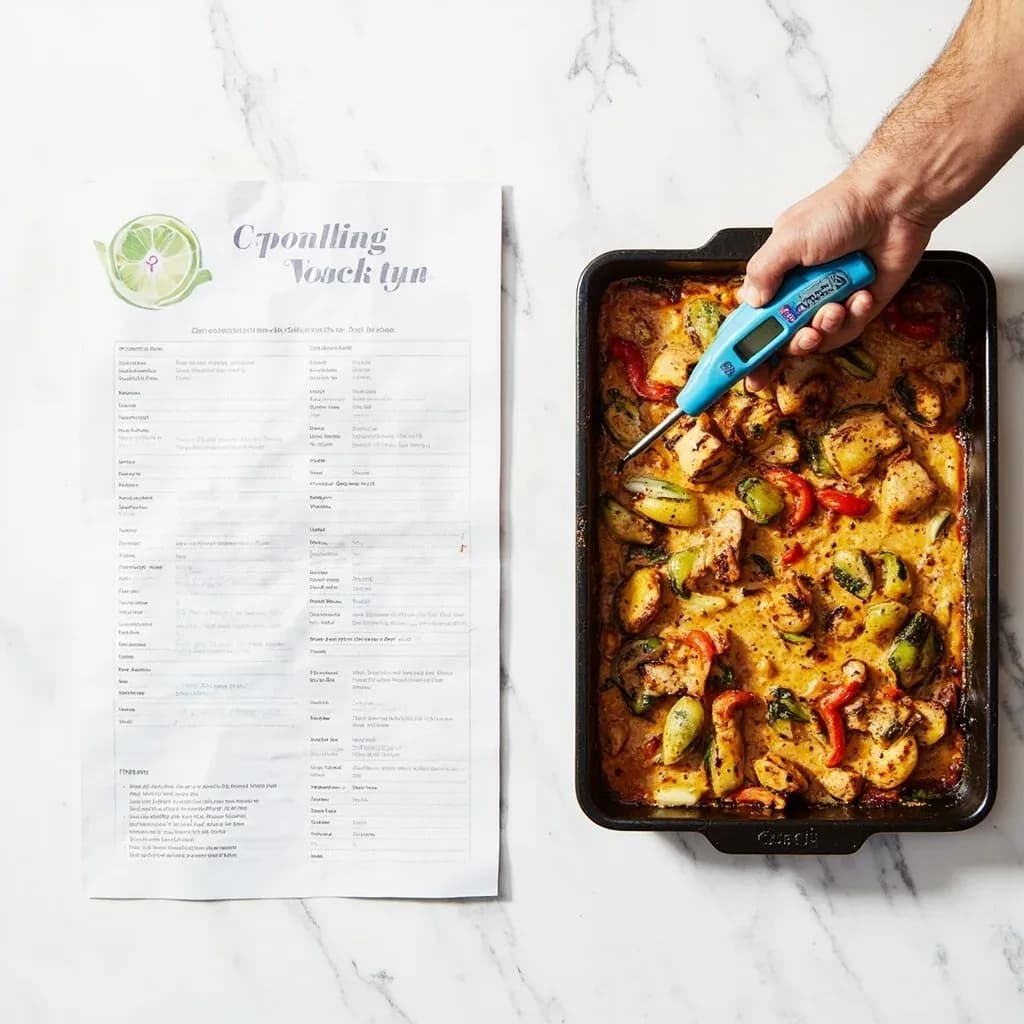
Verifying internal endpoint temperatures with a calibrated probe for each protein and dish type.
The two-stage cooling process from 135°F to 70°F, then 70°F to 41°F, using ice baths, shallow pans, blast chillers, or ice paddles.
Bringing cooled food to 165°F (74°C) within 2 hours for hot service; never use a steam table for this step.
Inspecting incoming goods with a probe to confirm cold items at 41°F or below and frozen items at 0°F or below.
Thawing under refrigeration, in cold running water at 70°F or below, in the microwave for immediate use, or as part of cooking — never on the counter.
7-day ready-to-eat labeling (4 days under stricter codes) for in-house prepared potentially hazardous food.
How to do it
- 1
1. Identify the hazards
Map each menu item and prep process for biological, chemical, and physical hazards. Focus on potentially hazardous foods (PHF): dairy, eggs, meat, poultry, fish, cooked starches, cut melons, garlic-in-oil, and sprouts. Biological hazards usually name a specific organism — Salmonella in poultry, Listeria in deli meats and smoked fish, E. coli in ground beef, Clostridium perfringens in slow-cooled roasts, Bacillus cereus in held rice, and Staphylococcus aureus from bare-hand contact.
- 2
2. Determine the Critical Control Points (CCPs)
For each hazard, decide where time and temperature actually control the risk. In nearly every operation, the CCPs are receiving, thawing, cooking, cooling, hot-holding, cold-holding, and reheating. Steps like washing produce or sanitizing cutting boards are important but are not CCPs in the HACCP sense — they are pre-requisite programs that support the system rather than control points that must be logged.
- 3
3. Set critical limits
Write a number for every CCP and post it where the work happens. Standard limits: cook poultry to 165°F, ground meats to 155°F for 17 seconds, whole cuts of beef, pork, lamb, and veal to 145°F with a 3-minute rest, fish and eggs in hot-held dishes to 145°F for 15 seconds, hot-hold at 135°F or above, cold-hold at 41°F or below, cool from 135°F to 70°F within 2 hours and to 41°F within 4 more hours, reheat to 165°F within 2 hours.
- 4
4. Establish monitoring procedures
Assign a person, a tool, and a frequency to each CCP. Example: 'Line cook checks and logs chicken breast internal temperature with a calibrated 1.5 mm instant-read probe at the geometric center of the breast, every batch, on the Cooking Log.' Specify the probe type, the calibration schedule, and the exact spot on the food to be measured. Monitoring without a defined frequency and a defined person is not monitoring — it is hoping.
- 5
5. Define corrective actions
For each CCP, write in advance what to do when a limit is breached. The four options are: discard, reprocess (re-cook to a safe endpoint), reheat to 165°F within 2 hours, or isolate-and-test. Example: 'If braised pork drops to 110°F in the holding cabinet, reheat to 165°F within 30 minutes; if it sat below 135°F for more than 4 cumulative hours, discard and log the loss with date, time, quantity, and the corrective action taken.'
- 6
6. Build verification activities
Verification proves the system is actually working, not just that the paperwork exists. Schedule daily thermometer calibration in an ice slurry (32°F) and boiling water (212°F at sea level), weekly spot-checks of held food, monthly review of temperature logs, periodic microbiological swabs of prep surfaces, and an annual review of the entire HACCP plan when the menu changes. Verification catches drift before it becomes an outbreak.
- 7
7. Set up record-keeping and training
Maintain daily receiving, cooking, cooling, hot-hold, cold-hold, and cleaning logs; train every employee on the plan in their primary language and at their literacy level; and retain records for the period required by local code (typically 90 days minimum, sometimes 6 months). Logs that nobody can read and that nobody reviews are worse than no logs at all — they create a false paper trail during an inspection or an outbreak investigation.
The Danger Zone and Its Worst Offenders
Within the 41°F–140°F range, the most dangerous band is 70°F–125°F (21°C–52°C), where common pathogens can double their population in roughly 20 minutes. Two organisms in particular drive catering and restaurant outbreaks when cooling is mishandled: Clostridium perfringens, the leading cause of catering-related illness because it flourishes in large, slow-cooling roasts and starches, and Bacillus cereus, the classic 'fried rice syndrome' bacterium that thrives when cooked rice or pasta is held at room temperature. Both form heat-resistant spores, which is why reheating to 165°F does not undo the damage done during a long, warm cooling window — the toxins some of these organisms produce are already there. The takeaway: the danger zone is not a single temperature but a window of time, and that window is the one number every cook should treat as gospel.
- 70°F–125°F is the rapid-growth band: bacterial populations can double in ~20 minutes.
- Clostridium perfringens is the most common cause of catering-related outbreaks — it loves slow-cooling roasts and gravies.
- Bacillus cereus spores survive cooking; it is the reason fried rice left on the counter is a public-health cliché.
- Staphylococcus aureus produces heat-stable enterotoxins during growth in the danger zone; reheating will not destroy them.
Why the Numbers Changed
Older American kitchens were taught 40°F and 140°F; the current 41°F and 135°F pair is the FDA's effort to align with international Codex Alimentarius standards and to give operators a small margin against probe error. The 135°F hot-hold minimum is also a food-quality win: holding braises and sauces at 150°F or 160°F dries them out and burns energy without measurably improving safety. The two-stage cooling rule — fast through 70°F, then a longer walk to 41°F — reflects a specific biological reality: most spore-forming pathogens do not germinate and multiply rapidly until food drops below 130°F, so the steepest part of the curve deserves the most aggressive cooling, and the final descent can be more relaxed.
- 41°F/135°F aligns U.S. practice with international Codex Alimentarius thresholds.
- Hot-holding above 140°F dehydrates food and wastes energy without meaningful safety gain.
- The first 65°F of cooling (135→70) is biologically the most dangerous stretch.
- The final 29°F of cooling (70→41) is when most psychrotrophic spoilage organisms start to dominate.
Common uses
Tips & pitfalls
- Calibrate thermometers daily in an ice slurry (32°F / 0°C) and in boiling water (212°F / 100°C at sea level). Probe accuracy matters more than the digital bells and whistles on the display.
- Use the thinnest probe you can for thin items like fish fillets and burger patties — a 1.5 mm instant-read tip gives a true reading in under 4 seconds; a 3 mm stem reads the air pocket before the food.
- Measure temperature at the geometric center: the coldest spot of a hot item and the warmest spot of a cold item. Corners, edges, and surfaces always lie.
- Cool in pans no deeper than 2 inches. The FDA's 6-hour cooling target is essentially impossible in a deep hotel pan without an ice bath or blast chiller to back it up.
- Ice baths and ice paddles beat walk-in coolers for active cooling. A 5-gallon stockpot can drop from 140°F to 70°F in about 20 minutes in an ice bath versus several hours on a sheet pan in the fridge.
- Never stack hot pans in the cooler. The inner pan stays in the danger zone for hours while the outer pan pulls the walk-in temperature up and threatens everything else inside.
- Hot-hold at 135°F, not 150°F. The higher number is legal but it dries out braises, scorches sauces, and wastes energy without adding meaningful safety margin.
- The 4-hour rule is cumulative, not consecutive. If chicken sat at 80°F for 2 hours, was chilled, then sat at 90°F for 2.5 hours, the total is 4.5 hours and the food must be discarded.
- Label everything in low-temperature storage with prep date, discard date, contents, and initials. 'Mystery Tupperware' is the most common HACCP failure in both home and professional kitchens.
- Wiping the probe with a sanitizer towel between proteins is not enough on a raw-chicken-to-rare-beef transition — use a clean, sanitized probe or a fresh alcohol wipe, and let it air-dry before the next reading.
Good to know
- Acronym
- HACCP — Hazard Analysis and Critical Control Points
- Danger zone (FDA Food Code)
- 41°F–140°F (5°C–60°C)
- Cold-hold maximum
- 41°F (5°C) or below
- Hot-hold minimum
- 135°F (57°C) per FDA Food Code
- Two-stage cooling target
- 135°F → 70°F in 2 hours, then 70°F → 41°F in 4 more hours (6 hours total)
- Reheat target
- 165°F (74°C) within 2 hours, held 15 seconds
- Discard rule
- Cumulative >4 hours in the danger zone → discard; 1–4 hours may be re-chilled or re-heated; <1 hour may be used
- Core HACCP principles
- Seven: hazard analysis, CCP identification, critical limits, monitoring, corrective actions, verification, record-keeping
Also called
TCS · HACCP Monitoring · Danger Zone Control
Related

Whisk
Beat ingredients smooth and aerated with a looping wire motion

Sift
Pass dry ingredients through mesh to aerate and remove lumps

Strain
Pour through mesh to separate solids from liquid for a smooth result

Filter
Pass liquid through fine material to clarify out the smallest particles

Rice
Press cooked potatoes through small holes for fluffy, lump-free texture

Mash
Crush soft cooked food into a rustic, creamy purée

Grind
Crush food into a coarse to fine texture, from spices to meat

Grate
Shred food into fine bits against a sharp-toothed surface