Transform & Preserve
Whirlpool Hopping
Adding hops to hot wort after the boil in the whirlpool stage for aroma without harsh bitterness.
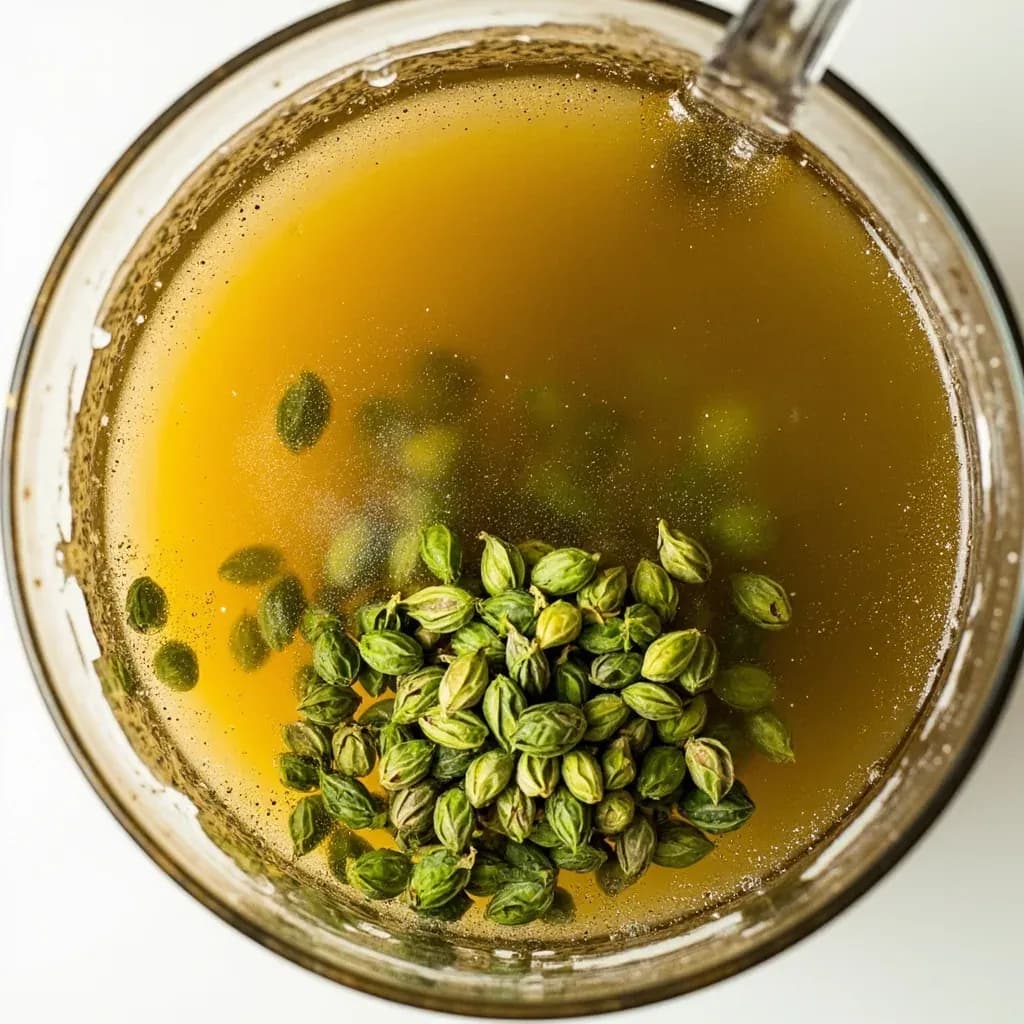
Whirlpool hopping adds hops to wort once the boil has ended but the liquid is still hot and spinning in the whirlpool. At these sub-boiling temperatures, more aromatic and flavor oils are extracted while less bitterness is isolated than during a full boil. Brewers use it to build the bright, juicy hop aroma characteristic of modern IPAs.
Whirlpool hopping is a late-kettle technique in which hops are added to wort that has been cut from a rolling boil and held at a controlled temperature, usually around 180°F (82°C), while the wort is kept in gentle rotational motion. The motion forms a central cone of trub and hop debris, clarifies the wort slightly, and gives the hot wort a few extra minutes of contact with hop oils without the sustained near-boil temperatures that drive alpha-acid isomerization. In practice it sits between flame-out additions (which happen at 212°F and tend to extract harsher, "cooked" flavors) and dry hopping (which happens cold after fermentation and produces rounder, rawer aromatics).
The technique matters because it solves a specific problem in modern hop-forward brewing: getting big, bright, tropical and citrus aroma into a beer without piling on the kind of sharp, lingering bitterness that a long boil charge would create. By dropping the wort temperature below a rolling boil, brewers dramatically slow the conversion of alpha acids into iso-alpha acids while still extracting essential oils like myrcene, humulene, linalool, and geraniol, plus the polyphenols that contribute body, haze stability, and juiciness. This is the move that, alongside dry hopping, defines the New England IPA category and most contemporary American IPAs.
How the technique behaves depends on three variables the brewer can actually control: temperature, time, and motion. Drop below 170°F and extraction efficiency falls off quickly; push above 200°F and bitterness contribution climbs again because you are back in the range where isomerization, while slower, still accumulates over twenty minutes. Time follows a curve of diminishing returns, with most of the aroma extracted in the first ten to fifteen minutes. Motion matters because a true vortex concentrates hop debris in a central cone, which both maximizes wort contact with the hops in the cone and leaves cleaner wort to transfer to the fermenter.
- Difficulty
- Medium
Types & varieties
One hop addition at the target temperature (usually about 180°F / 82°C), held for 15–20 minutes while wort is gently spun.
Two additions: a 'high' charge near 200°F for 10 minutes, then a 'low' charge once wort has cooled to about 170°F for another 10–20 minutes. Stacks aroma depth and complexity.
A pump pulls wort from the kettle bottom and returns it tangentially, creating continuous flow through a bed of hops. Common on larger craft systems and pro brewhouses.
Hops are simply steeped in hot, non-boiling wort and stirred occasionally rather than spun into a true vortex. Lower trub pickup, slightly less efficient extraction.
A chamber packed with fresh hops that wort is gravity-fed through after the boil. Ancestor of the modern whirlpool; still used by some traditional English and American brewers.
A layering practice: whirlpool for bright top notes, then dry hop for fuller hop character after fermentation has begun.
How to do it
- 1
Finish the boil and cut heat
Once your timed boil (including any bittering and flavor hop charges) ends, kill the burner. If you want to avoid even the mild isomerization that happens at 212°F, wait until the rolling boil fully subsides before moving on.
- 2
Confirm target temperature
Let the wort settle until it reaches your target; most brewers aim for 180°F (82°C) for a balanced whirlpool. Use a calibrated thermometer in the kettle, not the kettle wall, since wall readings lag reality by several degrees.
- 3
Start the whirlpool
Begin a steady, in-plane circular motion using a paddle, spoon, or pump return. You want a smooth cone in the center of the kettle, not a violent churn. Direction matters less than consistency, but always go the same way each batch for reproducibility.
- 4
Add whirlpool hops
Add the hop charge once the vortex is established. For pellets, sprinkle them in slowly so they distribute rather than clump in the center. For a double whirlpool, add the first charge now and the second once wort has cooled to about 170°F (77°C).
- 5
Hold and maintain motion
Keep the wort gently moving for 10–20 minutes (longer for a single-charge hop stand). Do not let it go still; hop debris should collect in the central trub cone, not float back out into the wort.
- 6
Begin cooling
Start your chiller (immersion, plate, or counterflow) at the end of the stand. Cooling through the 140–80°F range is where DMS is driven off, so move efficiently. Many brewers cool during the last few minutes of the stand to save total process time.
- 7
Rest, then transfer
Once wort hits pitching temperature (about 68°F for ales, about 50°F for lagers), let the trub cone settle for 5–10 minutes if your kettle design allows. Rack wort from the side or above the cone, leaving the compacted hop trub behind.
- 8
Pitch yeast promptly
Whirlpool wort carries dissolved oxygen if the kettle was agitated. Pitch healthy yeast quickly so it scavenges O2 before staling compounds form in finished beer.
Whirlpool vs. Its Brewing Neighbors
Whirlpool hopping is best understood in contrast to the techniques that flank it on the brewing timeline. Each one trades different things, and modern hop-forward recipes often use two or three of them in combination.
- Flame-out addition: hops dropped in the moment the boil ends. Similar goal to a whirlpool, but wort is still at 212°F when the hops go in, and the motion is typically just the residual churn of a cut burner. Flavor tends to read slightly harsher and more 'cooked' than a properly temperature-controlled whirlpool.
- Dry hopping: hops added to cooled, often fermented, wort at near-room temperature. Preserves the most delicate aromatics and produces rounder, juicier character, but contributes no bitterness and a different (less cooked) profile. Many modern recipes pair a whirlpool charge with a dry hop charge to layer bright top notes on top of rounder base notes.
- First-wort hopping: hops added to the kettle as the first runnings collect, before the boil. The opposite tradeoff; it maximizes alpha-acid utilization and is used when brewers want a smoother, less harsh bittering profile than a 60-minute charge delivers.
Chemistry: Why It Works
Two parallel extractions are happening in the whirlpool, and pulling them apart explains the whole technique. Alpha-acid isomerization, the reaction that creates iso-alpha acids (i.e., bitterness), proceeds efficiently only at sustained near-boil temperatures. Drop wort to 180°F and the reaction rate slows dramatically, so bitterness contribution falls off. At the same time, the essential oils (myrcene, humulene, caryophyllene, linalool, geraniol) and polyphenols that drive hop flavor and aroma continue to dissolve readily. Hot-side polyphenol extraction also helps with haze stability in clear styles and with mouthfeel in hazy styles, which is one reason whirlpool additions are almost universal in modern NEIPAs.
Hop Variety Selection
Not all hops reward a whirlpool charge equally. The biggest aromatic payoff comes from high-oil modern varieties, while traditional noble hops give more modest gains and are often still added at flame-out in classic recipes.
- Strong responders: Citra, Mosaic, Galaxy, Simcoe, Amarillo, Centennial, Cascade, Idaho 7, Strata, Nelson Sauvin, Sabro, HBC 586, and most modern public varieties bred for high oil content.
- Modest responders: Noble hops like Hallertau, Tettnang, and Saaz can be whirlpooled, but the payoff is smaller and many traditional German and Czech recipes still favor late-boil or flame-out additions for those varieties.
Common uses
Tips & pitfalls
- Aim for 180°F (82°C) as a default. Below 170°F you lose extraction efficiency; above 200°F you creep back into meaningful alpha-acid isomerization and unwanted bitterness.
- Use a hop spider or mesh bag if you want to keep hop debris out of the trub cone. Loose hops are fine if you will be filtering or if a bit of hop sediment in the fermenter is acceptable (common in hazy styles).
- Account for hop absorption: 1 kg of leaf hops can soak up roughly 0.7–1.0 L of wort; pellets absorb less. Top off or adjust your strike volume accordingly so you hit your target batch size.
- Do not stack a 30-minute whirlpool on top of a 60-minute bittering charge unless the recipe is engineered for it; total kettle IBU climbs faster than people expect.
- Cool the wort actively during or immediately after the stand. Long, slow cooling above 100°F risks DMS pickup and infection.
- Choose hops by oil content, not just by name. High-oil modern varieties (Citra, Mosaic, Galaxy, Strata) give the biggest aromatic payoff; noble hops give a smaller return for the same whirlpool time.
- If brewing hazy beer, oxidize less. Avoid splashing and open-lid work during the whirlpool; dissolved O2 picked up at 180°F stays in solution and stales hop character fast.
- Log temperature and time at each addition. Whirlpool results are extremely sensitive to small changes, and reproducibility is your friend when dialing in a recipe.
Good to know
- Stage
- Post-boil, pre-fermentation; wort is held hot but below a rolling boil.
- Typical temperature
- 170–200°F (76–93°C), with 180°F (82°C) as the most common target.
- Stand time
- 10–30 minutes; 15–20 minutes covers most recipes.
- Bitterness contribution
- Low to moderate; roughly 5–20 IBU depending on variety, temperature, and time.
- Primary goal
- Extract hop oils and polyphenols for aroma and flavor while limiting alpha-acid isomerization.
- Also called
- Hop stand, whirlpool steep, post-boil steep.
- Common in styles
- American IPA, New England IPA, Hazy IPA, American Pale Ale, modern hop-forward lagers and IPLs.
- Wort loss
- Plan for hop absorption of roughly 0.5–1.0 L per kg of hops, more for whole leaf than pellets.
Also called
Whirlpool Hopping · Hop Stand · Whirlpool Addition
Related

Confit
Cook slowly submerged in fat for silky tenderness and keeping

Cure
Draw out moisture with salt and time to preserve and concentrate

Pickle
Steep in acidic brine for bright, tangy, crunchy preservation

Ferment
Let friendly microbes transform food into tangy, complex flavor

Marinate
Soak in a seasoned mix to flavor and tenderize before cooking

Brine
Soak in salt water so meat stays juicy and seasoned throughout

Dehydrate
Slowly dry out moisture to concentrate flavor and extend shelf life

Cold-Smoke
Perfume cured food with smoke without cooking it through