Knife Skills
Wire Cutting
Using a taut wire to slice cleanly through soft or sticky foods like cheese, butter, and dough.
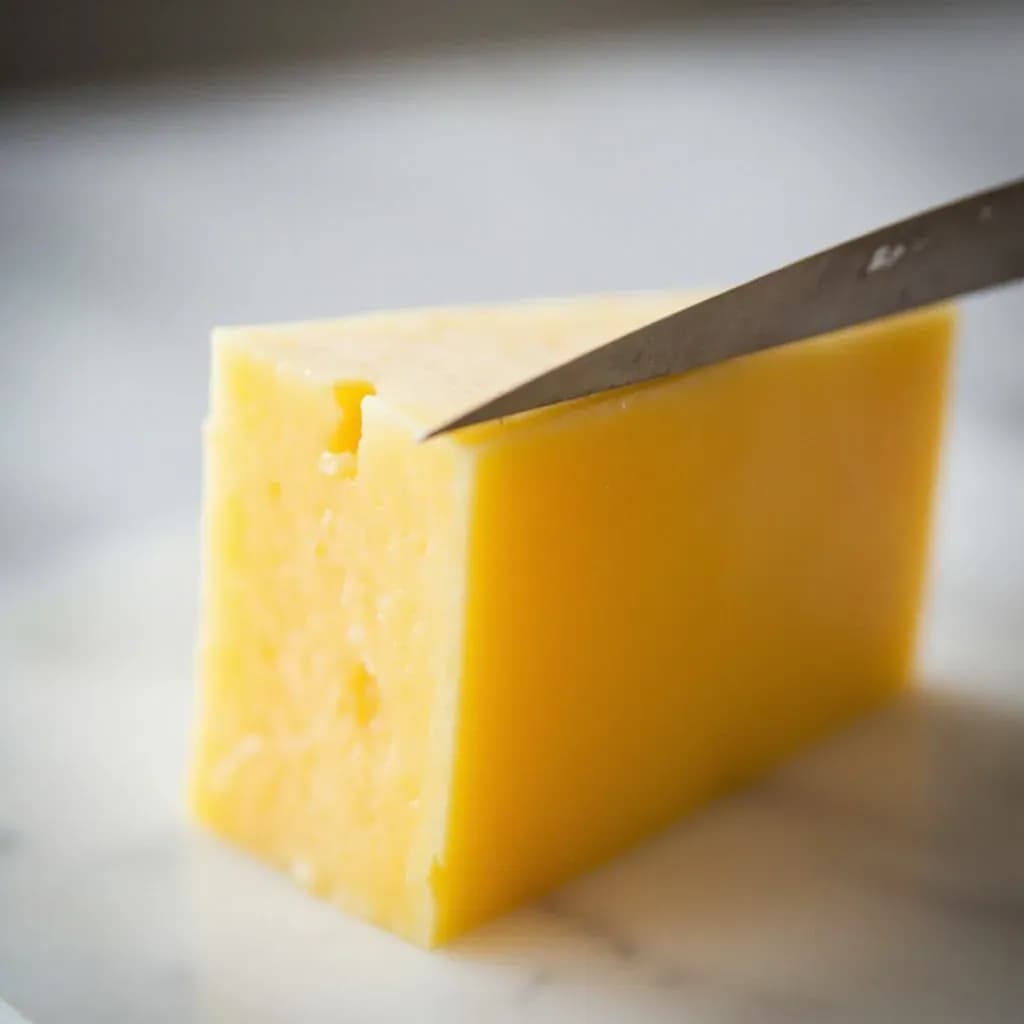
Wire cutting draws a thin taut wire through a food rather than pressing a blade, producing a clean cut without dragging or smearing. It excels on soft, sticky, or crumbly materials such as fresh cheese, fudge, butter, and aged wheels, and on hard cheese a wire avoids the cracking a knife can cause. Cheese wires, butter cutters, and harp slicers all rely on this principle.
Wire cutting is a portioning technique in which a taut, fine-gauge metal or nylon wire — rather than a knife edge — is drawn through a food to divide it. Where a blade works by crushing downward and slicing sideways at once, a wire exerts almost pure lateral shearing force. The result is dramatically less compression of the food's cells, a cleaner face on the cut, and far less sticking or smearing on soft, cold, or fragile items such as cheese, butter, tofu, sticky doughs, and glutinous-rice confections. It is a complementary technique rather than a replacement for knife work: reach for a wire when a blade would drag, gum up, or crush the thing you are trying to cut cleanly.
The wire's diameter and tension govern everything about the cut. Typical kitchen wires run from about 0.3 mm for confections and tofu up to 0.5 mm for cheese and butter, and they must be perfectly taut and straight to track true; a slack or kinked wire wanders and tears. The technique itself is mechanically simple — a single, continuous pull rather than a sawing stroke — which is why the difficulty is low even though the tool selection and food temperature matter a great deal. Cold but not frozen is the sweet spot for most targets: roughly 8–15 °C (45–60 °F) for butter and cheese, straight-from-the-fridge for tofu and dough.
The modern flat cheese slicer, or ostehøvel, was patented in 1925 by the Norwegian cabinetmaker Thor Bjørklund, but the underlying idea — using a thread or line to divide a sticky food — is much older. Fishing line, kitchen twine, and the wire strung across traditional mochi cutters are all variants of the same logic. In professional kitchens and serious home practice, wire tools earn their keep on the items that defeat an ordinary knife, not as a general-purpose substitute for one.
- Difficulty
- Easy
Types & varieties
Flat wooden or composite handle with a single horizontal wire; rests flat on a wheel of cheese and shaves a thin slice.
Bow-shaped frame strung with several parallel wires; pulled down through a block to produce several even slices at once.
Downward-facing wire (sometimes paired with a steel blade) for portioning sticky doughs and pastry on a work surface.
Hinged cast-aluminum frame with parallel wires; designed for hard-boiled eggs and useful for mushrooms and soft fruit.
Japanese-style box or guillotine tool with a fine wire that produces uniform tofu cubes without crushing the curds.
Frame strung with fine wire traditionally used with glutinous-rice cakes; thread and fishing line are the traditional non-tool versions.
Small handheld device with a single taut wire that minces by rocking the food over it.
A length of stainless cable anchored to two uprights in a cutting board, common in pizzerias and bakeries for repeatable dough portioning.
How to do it
- 1
Select the right wire tool
Match a single-wire plane for cheese and butter, a multi-wire harp for batch slicing, a fine-wire frame for tofu or mochi, and a bench wire for dough. Confirm the wire is taut, straight, and free of kinks before you start.
- 2
Temper the food
Bring cheese, butter, or chocolate work to a working chill of roughly 8–15 °C / 45–60 °F. Tofu and doughs are usually cut straight from the refrigerator. Items that are too soft drag; items that are too hard can snap a fine wire.
- 3
Set up the work surface
Place a non-slip board or damp cloth under the food. For round cheese wheels or dough balls, brace the item against a bench stop or the edge of the board so it cannot roll into the wire.
- 4
Position the food against the wire
Lay the wire in contact with the food at the chosen cut line. For a cheese plane, set it flat on top of the wheel; for a harp, drop the frame over the block so all wires rest on the surface at once.
- 5
Pull the wire through in one motion
Draw the wire toward you — or down, in the case of a harp — with steady, even speed. Do not rock or saw. The wire's tension is doing the cutting; your hand is just guiding direction.
- 6
Release and wipe the wire
Lift the tool clear of the food. Wipe the wire with a damp cloth between cuts so residue does not drag the next slice. For sticky items, dust the wire with rice flour or brush it lightly with neutral oil.
- 7
Portion the remainder
Slide the food forward by your chosen slice thickness and repeat. For consistent portions, use the first slice as a gauge for the rest of the block.
- 8
Clean and store
Hand-wash the wire and frame in hot water, dry thoroughly, and store flat so the wire is not bent out of true. Do not put wire tools in the dishwasher; high heat and harsh detergents corrode the metal and loosen anchor points.
Why a wire beats a blade on soft or sticky food
A knife edge cuts by wedging apart the food and, in doing so, crushes the cells immediately under and ahead of the edge. With a soft or sticky food, that crushed layer smears across the blade, drags, and leaves a ragged, glossy face on the cut. A taut wire has no edge to wedge — it parts the food along the line of tension alone, with almost no compression. Cheese releases cleanly instead of smearing against steel, cold caramel snaps instead of bending around a knife, and tofu keeps its curd structure intact instead of weeping. The trade-off is that the wire must be thin and very tight, and it cannot cut through anything hard or bony — which is why a wire tool sits next to a good knife in a drawer rather than replacing it.
Matching wire and tool to the job
Choosing the right tool is half of getting a clean cut.
- Single-wire cheese plane: cheese wheels, butter, terrines — anything you want sliced paper-thin on a flat face.
- Multi-wire harp: semi-soft to firm cheese blocks where you want several identical slices at once for plating or sandwiches.
- Bench dough wire or DIY two-post rig: sticky enriched doughs, pizza balls, laminated dough blocks, and focaccia rounds.
- Fine-wire tofu or mochi cutter: silken or firm tofu, mochi, daifuku, marshmallow, pâte de fruit — anywhere a thicker wire would tear or crush.
- Egg slicer: hard-boiled eggs, button mushrooms, strawberries, bananas, and small soft fruits.
- Replace a wire at the first sign of sag, kink, or corrosion — a slack wire ruins the cut no matter how steady your hand.
Common uses
Tips & pitfalls
- Pull the wire through the food in a single, continuous motion — sawing compresses the surface and tears soft items.
- Chill the food to the right working temperature; too soft and the wire drags, too hard and a fine wire can snap.
- Keep the wire taut: a stretched, sagging, or kinked wire wanders and leaves a ragged edge, and it should be replaced immediately.
- For sticky items like cold caramel or mochi, oil the wire lightly or dust it with rice flour so the food releases cleanly.
- Wipe the wire between cuts on cheese — residue build-up is the main cause of dragging and uneven slices.
- For soft cheeses, rest the slicer flat on the wheel and let the wire do the work; pressing down with your palm just compresses the surface.
- Match wire diameter to the food: about 0.5 mm for cheese and butter, finer wire or thread for tofu, mochi, and confections.
- When portioning dough, anchor the wire between two fixed posts on a cutting board so the slice thickness is repeatable.
Good to know
- Category
- Knife skills / portioning technique
- Tool type
- Taut thin-gauge metal (or food-grade nylon) wire stretched across a frame, handle, or board
- Wire diameter
- About 0.3–0.5 mm; finer for confections and tofu, at the thicker end for cheese and butter
- Best food temperature
- Cold but not frozen — soft cheeses 8–12 °C / 45–55 °F, butter around 13–15 °C / 55–60 °F
- Cutting force
- Pure shearing from wire tension, with minimal downward pressure
- Effect on food
- Low cell rupture and little sticking compared with a blade; clean, non-sticky cut face
- Origin of namesake tool
- The ostehøvel (flat cheese plane) was patented in 1925 by Norwegian cabinetmaker Thor Bjørklund
- Difficulty
- Low mechanical difficulty; tool selection and food temperature are the real variables
Also called
Breaking (Cleaving Hard Cheese) · Cheese Wire Cutting · Wire Slicing
Dishes that rely on it



Related

Chop
Cut into rough, irregular pieces — the everyday workhorse cut

Dice
Cut into uniform cubes for even cooking and a tidy look

Mince
Cut as fine as possible so flavor melts evenly into the dish

Slice
Cut into even, flat pieces for consistent cooking and presentation

Julienne
Cut into thin matchsticks for fast cooking and elegant garnish

Brunoise
Cut into tiny, precise cubes — the finest dice in the kitchen

Chiffonade
Roll and slice leafy greens into delicate ribbons

Batonnet
Cut into tidy sticks, thicker than julienne — think classic fries