Southern Europe
Cretan
Also: Cretan cuisine, Κρητική κουζίνα, Minoan diet
The world's most-studied longevity diet — Crete's ancient Mediterranean table of wild greens, barley rusks, olive oil, lamb, and thyme honey, untouched by the shortcuts of modernity.
Cretan cuisine is the culinary tradition of the island of Crete, Greece's largest island and one of the cradles of European civilization. It is distinguished from mainland Greek cooking by its extraordinary reliance on wild foraged greens (horta), extra-virgin olive oil at quantities that exceed any other regional cuisine, minimal meat (traditionally only for feast days), abundant legumes and whole grains, and a pantry shaped by the island's rugged interior and long coastline. Crete was the subject of Ancel Keys's landmark Seven Countries Study (1950s–60s), which identified the Cretan diet as the Mediterranean diet's purest expression and the template for the longevity patterns of its population.
The flavour base
Extra-virgin Cretan olive oil (the island produces some of the world's highest phenolic-content oil) combined with wild mountain herbs — savory (throumbi), thyme, rigani — and stamnagathi (wild endive) forms the fundamental flavor grammar. Lemon, garlic, and vinegar add acidity. For meat dishes, a slow-braised base of onion, tomato, and wine anchors stifado and lamb preparations.
Pantry staples
Key ingredients
Signature techniques
Signature dishes
Cretan on the table


At the table
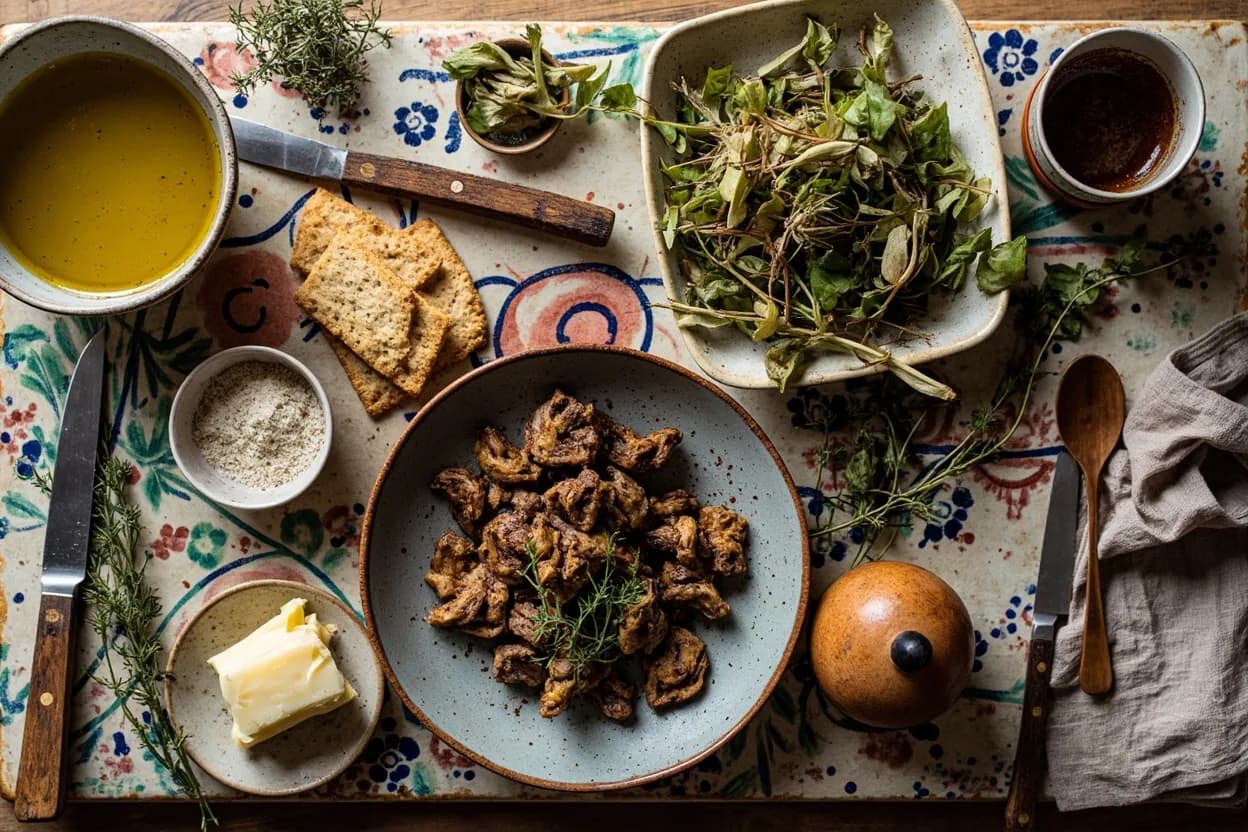
Traditional Cretan meals are built around vegetables, legumes, and bread as primary sustenance, with meat reserved for Sundays and celebrations. A typical daily meal: morning raki and olives or paximadi with olive oil; midday pulse soup or vegetable dish; evening horta with lemon and oil plus cheese and bread. Festive meals involve whole-roasted lamb and communal table-setting with multiple dishes served simultaneously rather than sequentially. Raki (tsikoudia) is the social lubricant served before, during, and after meals — often with mezedes.
History & context
Crete's culinary tradition reaches back to the Minoan civilization (c. 2700–1450 BC), which cultivated olives, grapes, and grain at an advanced level — olive oil was the island's primary trade commodity. The island passed through Venetian rule (1204–1669), which introduced pasta, vinegar-based preserving, and wine-centric cooking, and then Ottoman rule (1669–1913), which added pilaf, stuffed vegetables, and coffee. Unlike mainland Greece, Crete maintained robust pastoral and foraging traditions through these occupations. Ancel Keys and his colleagues documented Cretan diet patterns in the 1950s–60s as part of the Seven Countries Study, finding strikingly low rates of cardiovascular disease despite high fat consumption from olive oil — establishing Crete as the archetype of the Mediterranean diet and triggering decades of nutritional research.
Regional variations
- Western Crete (Chania)
Most traditional and least influenced by tourism; home of boureki, sfakianopita, and Chania's pichtogalo soft cheese PDO; strong mountaineer-shepherd food culture in the Lefka Ori (White Mountains).
- Central Crete (Heraklion)
Island's commercial center; blends traditional cuisine with wider Greek influences; home of the Minoan Palace of Knossos and the main wine region (Peza appellation, red Kotsifali grapes).
- Eastern Crete (Lassithi)
Drier, warmer microclimate; strong herb-foraging tradition; produces distinctive thyme honey from the plateau; more legume-heavy diet.
- Sfakia (mountain interior)
The most isolated sub-region; extreme pastoral tradition; sfakianopita (fresh cheese in olive oil flatbread) is its signature; dairy-rich diet from mountain flocks.
Related cuisines
Cretan cuisine is a regional expression of Greek cuisine but is studied as a distinct model due to its exceptional health data and pre-industrial integrity.
Crete contributes graviera Kritis, pichtogalo Chanion, anthotyros, and mizithra to the Greek PDO cheese canon.
Parallel eastern Mediterranean island tradition with overlap in lamb preparations, legumes, and dairy.
Convergent Mediterranean diet structure — olive oil, legumes, wild herbs, grain, minimal meat — though distinct ingredient set.
Canonical recipes
The dishes that define Cretan, documented in the Canon.
References
- 1.The Feast of the Olive — Maggie Blyth Klein (1983)
- 2.The Foods of Greece — Aglaia Kremezi (1993)
- 3.Cretan Cuisine — Nikos Psilakis & Maria Psilakis (2003)
- 4.Seven Countries: A Multivariate Analysis of Death and Coronary Heart Disease — Ancel Keys (1980)
- 5.Mediterranean Diet and Cardiovascular Health: The Lyon Diet Heart Study — de Lorgeril et al., Circulation (1999)
Confidence: high
Notes
Wild greens as nutritional cornerstone
Cretans eat wild greens (horta) in quantities far exceeding any other Mediterranean population — studies in the 1960s documented over 80 species foraged and eaten regularly. Stamnagathi (Cichorium spinosum), vlita (Amaranthus blitum), and agrioradiko (wild chicory) are rich in polyphenols, omega-3 precursors, and bitter compounds associated with liver and gut health. The practice of foraging persists among older Cretan women and is considered a key longevity factor.
Raki as social institution
Cretan raki (tsikoudia) is a grape-marc spirit distilled in autumn from the remnants of wine pressing. Nearly every village has communal distilling days (kazanemata) that function as harvest festivals. Raki is not a digestif but an all-purpose social offering — poured for guests on arrival at any time of day, served with a small bite (meze), and considered a marker of Cretan hospitality inseparable from the food culture.