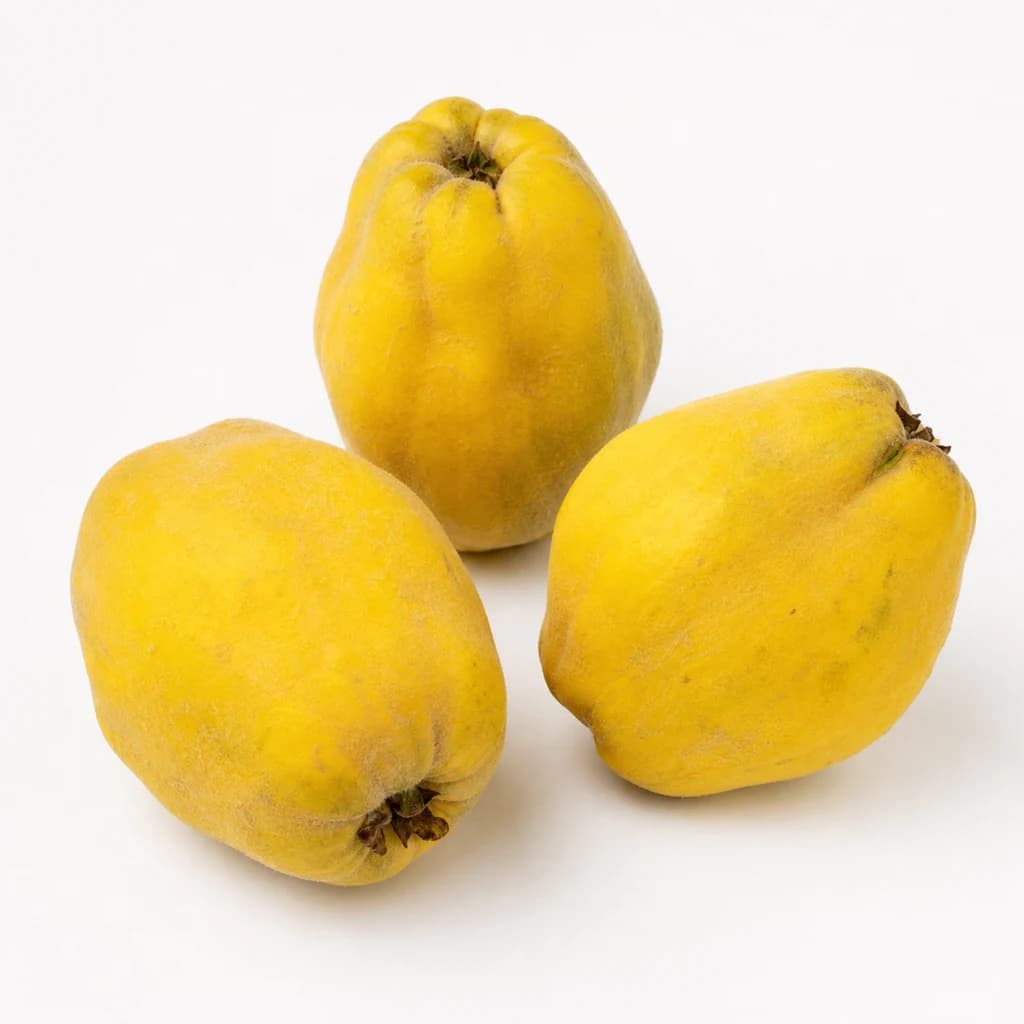
Natural form
Whole quince fruit showing knobbly golden-yellow skin and pear-like shape.
Shows readers the identifying exterior — distinctive knobbled surface, golden-yellow color, and overall silhouette that distinguishes quince from pear or apple.
Produce
Quince
Hard, fragrant autumn fruit, inedible raw, cooked into pastes, jellies, and stews.
Quince is a knobbly, golden-yellow fruit with hard, astringent flesh that is inedible raw but transforms when cooked. Slow cooking turns it tender and rosy-pink and develops an intense floral aroma, making it ideal for pastes like membrillo, jellies, and Middle Eastern meat stews. Its high pectin content also makes it a natural setting agent for preserves.
Quince is the sole member of its genus, a hard, fragrant autumn fruit that has been cultivated for at least 4,000 years in the Caucasus region. It belongs to the Rosaceae family alongside apples and pears, but unlike those fruits, quince is inedible raw—the flesh contains stone-like cells and high tannins that make it gritty, sour, and intensely astringent. The transformation when cooked is one of the most dramatic in all of cooking: hard, white, tannic flesh becomes soft, buttery, and melts to a translucent amber-pink, releasing a perfume that is floral, tropical, and perfumed with notes of melon, vanilla, and citrus. This metamorphosis, paired with quince's exceptional pectin content, is why the fruit has been treasured since ancient Greek and Roman times, when it was reserved for patricians and often prepared as preserves. Today, quince appears across cuisines from Spain (membrillo) to Turkey (ayva tatlısı) to Iran (khoresh-e beh), yet it remains a fruit most home cooks have never worked with—making it one of the most rewarding to discover. The trees themselves are ornamental, bearing large pink-white blossoms in spring, and the fruit's perfume during autumn ripening is unmistakable.
- Measured in
- piece
- Storage
- Fridge
Types & varieties
Most common commercial variety in the US; round to slightly pear-shaped; good all-purpose
Large, pear-shaped; widely grown in Turkey; classic variety for paste and preserves
Large, roundish; historically important in Iberian cuisine; rich flavor
Milder, slightly tropical flavor; slightly less astringent raw
Russian variety; reportedly can be eaten raw when fully ripe
Serbian origin; exceptionally large fruit; high quality for paste
French variety; traditionally used in French liqueurs and preserves
American heirloom variety; reliable and productive
French variety; prized for its aromatic quality
The Raw-to-Cooked Transformation
Quince behaves unlike most fruit. Raw, the flesh is so hard it can damage knives, and the astringency comes from tannins concentrated in the cell walls and the membrane between seed cavities. Cooking breaks down these tannins through heat and sugar, and the stone-like cells (called sclereids) soften. The flesh also contains lycopene, which is normally colorless but becomes visible red when the fruit's cell walls break down and acid is present—hence the characteristic pink blush when cooked with lemon juice or the skin on. This color is one of the defining visual markers of properly cooked quince. The fragrance, concentrated in the fruit's volatile oils, intensifies dramatically with heat, filling kitchens with a scent unlike any other autumn fruit.
- Always cook quince; raw is genuinely inedible
- The pink/red color in cooked quince comes from lycopene reacting with acid—cook with the skin on or add lemon juice for best results
- The membrane between seed cavities is especially tough; remove it for smooth pastes and compotes
Buying and Storing
Quince looks deceptively ordinary—often bumpy, faintly fuzzy like a peach, and ranging from golden yellow to pale green. The most reliable ripeness indicator is fragrance: a ripe quince will smell intensely floral and tropical from across the room. Avoid any fruit with soft spots, bruises, or blemishes, as these spread quickly and the fruit will not keep. Unlike apples and pears, quince does not continue to ripen significantly after picking—it can, however, develop more concentrated flavor in storage. Keep whole, unblemished quinces in a cool, dark place (a cellar or cold pantry is ideal) for up to 2–4 weeks. Once cut, use immediately or store submerged in acidulated water, but only for a day or two maximum.
- Smell the fruit before buying—fragrance indicates ripeness and flavor development
- Inspect carefully for hidden bruises; quince bruises more easily than it appears
- Store whole fruit unwashed in a cool, dark place; do not refrigerate
Common uses
Tips & pitfalls
- Always cook quince; eating raw is a mistake due to extreme astringency and hardness
- Blanch before peeling for easier handling: score around the equator, boil 10–15 minutes, then slip off skins
- Quince oxidizes quickly; drop peeled or cut fruit into acidulated water (lemon juice or vinegar) immediately
- The core and seeds are not edible; remove them as you would an apple, or halve and scoop out with a spoon
- For the characteristic pink color: cook with the skin on and add a splash of lemon juice—the acid and lycopene in the skin create the blush
- Low and slow is the rule: quick cooking leaves quince hard; simmer a minimum of 30–45 minutes, or bake for 1–2 hours
- Add sugar gradually, not all at once, to draw out more pectin and achieve a better set in jams and pastes
- Taste as you go; some quinces are more astringent than others and may need additional sugar or longer cooking time
- If paste refuses to set, return it to the pot and cook longer, adding commercial pectin if needed
- Buy whole, unblemished fruit; the outside appearance is often worse than it looks—fragrance is a reliable ripeness indicator
Nutrition
Energy
238 kJ · per 100 g
Where the calories come from
Protein
0.4g
1% DV
Carbs
15.3g
6% DV
Fat
0.1g
0% DV
Fiber
1.9g
7% DV
Sodium
4mg
0% DV
Source · USDA FoodData Central · Quinces, raw
View on FDC →In the shops
Matched grocery products
No matched grocery products for Quince yet.
Good to know
- Scientific name
- Cydonia oblonga
- Family
- Rosaceae (rose family, related to apples and pears)
- Origin
- Caucasus region (modern-day Georgia/Azerbaijan); cultivated for at least 4,000 years
- Season
- Late autumn, October through December
- Raw flavor
- Intensely astringent, tannic, gritty, and sour; inedible
- Cooked flavor
- Floral and tropical, with notes of melon, vanilla, and citrus; intensely fragrant
- Pectin content
- Very high; excellent for jams, jellies, and pastes
- Storage
- Whole, unblemished quinces keep 2–4 weeks in a cool, dark place; improve in flavor over time
Substitutes
- Green apples (Granny Smith or Bramley) — Best substitute; cook with extra sugar and lemon juice; will not achieve the same floral notes or pink color
- Pears — Closest texture; Bartlett or Bosc work well; lacks quince's fragrance and requires longer cooking to break down
- Firm apples + commercial pectin — For jam or paste applications; use firm apples and add pectin to compensate for the missing natural set
- Cranberries — For jelly; similar pectin and astringency but completely different flavor profile
Pairs with
Also called
Membrillo
Appears in these dishes
Related

Tomato
Juicy, sun-sweet fruit for sauces, salads, and slow-cooked depth

Yellow Onion
The aromatic backbone of soups, sofritos, and braises

Garlic
Pungent cloves that perfume nearly every savory dish

Lemon
Bright, acidic citrus that wakes up almost any dish

Potato
Humble, hearty staple — roast, mash, fry, or boil

Carrot
Sweet, crunchy root — raw, roasted, or the base of a sofrito

Cucumber
Cool, crisp, and watery — for salads, pickles, and tzatziki

Lettuce
Crisp leaves for salads, wraps, and a fresh crunch