Southern Europe
Nueva Cocina Vasca
Also: New Basque Cuisine, Nouvelle cuisine vasque, Basque New Wave
The 1970s modernist movement that stripped Basque cooking back to its Atlantic essence — then rebuilt it with French rigour, leaving a legacy that runs through every serious kitchen on earth.
Nueva Cocina Vasca (New Basque Cuisine) is the reform movement launched in San Sebastián and Bilbao in the early 1970s by a generation of Basque chefs — principally Juan Mari Arzak, Pedro Subijana, Karlos Arguiñano, Luis Irizar, and their contemporaries — who applied the lessons of French nouvelle cuisine to the exceptional indigenous larder of the Basque Country. Where classical Basque cooking was rich and sauce-heavy, Nueva Cocina Vasca pursued lighter reductions, shorter cooking times, respect for primary ingredients, and rigorous technique. It was not imitation of France but a deliberate, proudly Basque project of modernisation that preserved identifiable Basque flavours — salt cod, hake, anchovy, txakoli, peppers — while freeing them from heavy cream sauces and exhaustive braising. Its downstream effect on Ferran Adrià, Heston Blumenthal, René Redzepi, and the global avant-garde makes it one of the most consequential culinary movements of the 20th century.
The flavour base
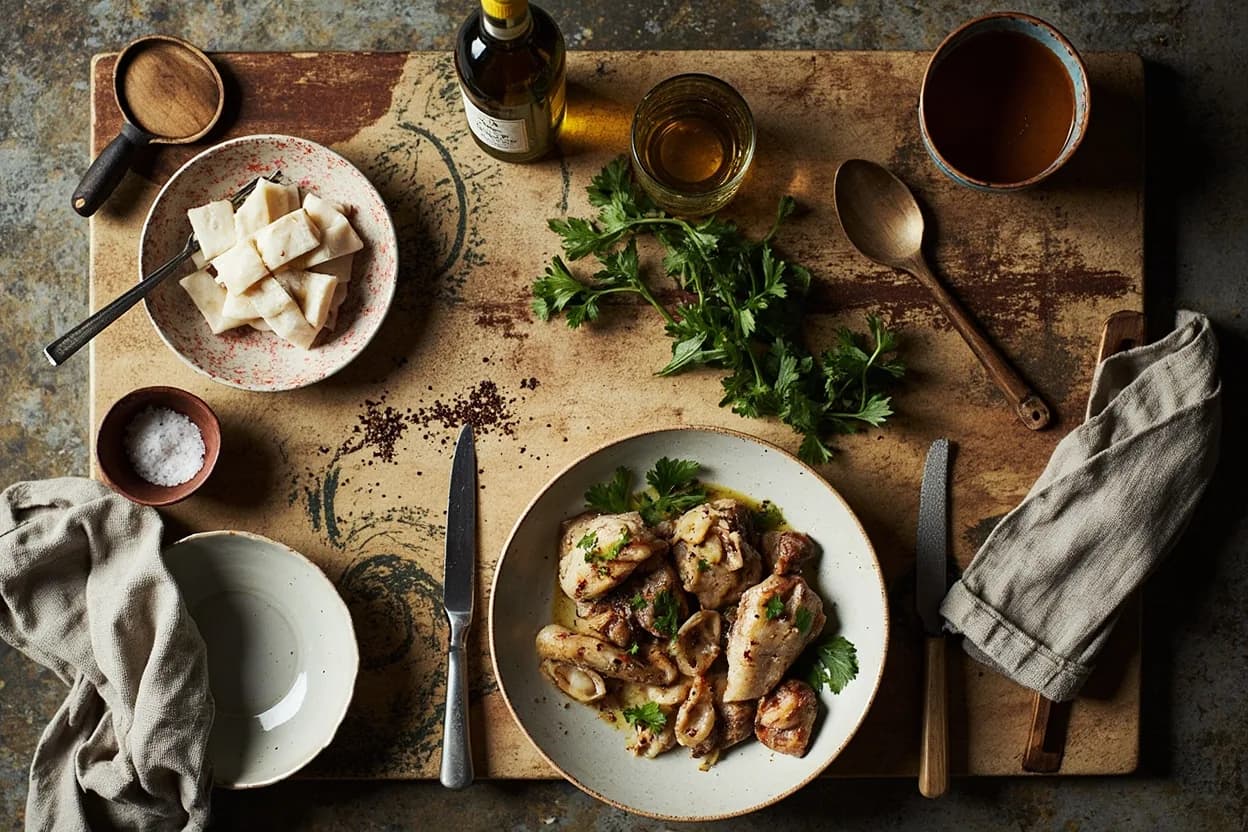
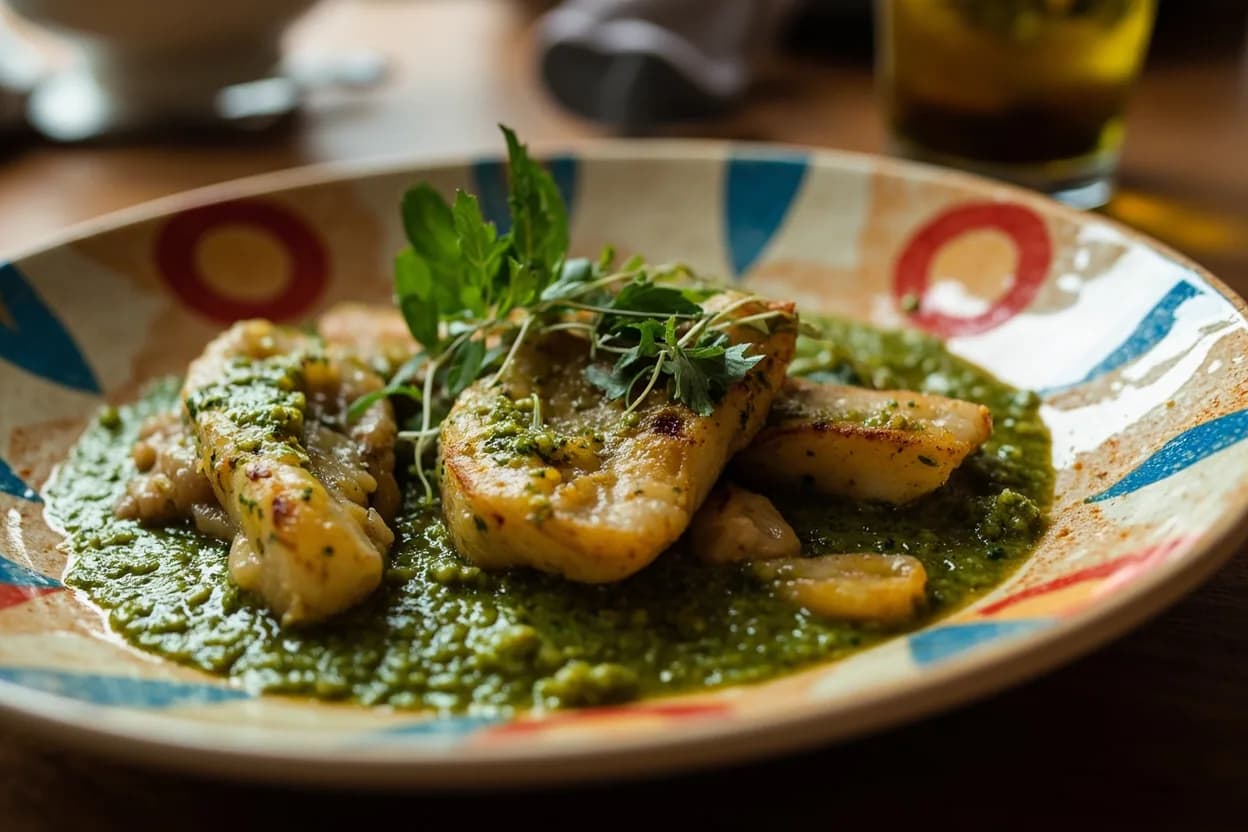
The classical Basque base updated for lighter handling: salsa verde (olive oil, garlic, parsley, fish stock — emulsified by pan movement rather than flour roux); reduced txakoli wine or dry white wine as an acid signal; pilpil technique (cold-hot oil emulsification from salt cod gelatin); high-quality Basque coast fish and shellfish as the non-negotiable starting point.
Pantry staples
Key ingredients
Signature techniques
Signature dishes
Nueva Cocina Vasca on the table

At the table
The formal restaurant expression of Nueva Cocina Vasca established the tasting-menu format in Spain — multiple small courses showcasing a single seasonal ingredient in evolving treatments, with Basque wines (txakoli, Rioja, Navarra) pacing the progression. The tradition of pintxos (Basque bar snacks) runs parallel: Nueva Cocina elevated the pintxo counter into a competitive arena where the movement's techniques appeared in one-bite form.
History & context
The movement's origin is conventionally dated to 1976, when Juan Mari Arzak and Pedro Subijana attended Paul Bocuse's congress in Lyon and returned determined to apply nouvelle cuisine discipline to Basque ingredients. They co-signed a manifesto with nine other Basque chefs in 1977 at the Eureka restaurant in San Sebastián, declaring principles of seasonal primacy, lighter technique, and innovation rooted in tradition. The timing was charged: Franco's dictatorship was ending (he died November 1975), and Basque cultural nationalism — which had been suppressed — surged; food became part of cultural assertion. Arzak (San Sebastián, Michelin three stars since 1989) and Subijana (Akelarre, three stars) became the movement's public faces. By the 1980s their alumni had fanned across Spain and Europe. Ferran Adrià stages at El Bulli began in 1983; the Basque movement's influence on what he and Heston Blumenthal would later do is direct and acknowledged. The Basque Culinary Center (BCC) in San Sebastián, opened 2011, institutionalised the tradition.
Regional variations
- San Sebastián (Donostia) school
Arzak and Subijana's home ground; most progressive, France-facing, ingredient-first; pintxos culture at its most refined.
- Bilbao (Vizcaya) tradition
Heavier bacalao centrality; bacalao a la vizcaína (dried pepper-based sauce) is the flagship; slightly more conservative classicism alongside modernist shoots.
- Vitoria-Gasteiz inland
More pastoral — lamb, mushrooms, local black pudding (morcilla de Beasain); less seafood-centric.
- French Basque (Labourd/Iparralde)
Espelette pepper as the defining local spice; piperade; dishes straddle French and Spanish Basque identity; shares the philosophical base of Nueva Cocina across the border.
Related cuisines
- Classical Basque
The tradition Nueva Cocina reformed — deeply coastal, pork-fat-enriched, long-braised; pil-pil and salsa verde predate the movement but were freed of heaviness by it.
- French Nouvelle Cuisine
The direct philosophical trigger; Bocuse, Guérard, and the Troisgros brothers catalysed the Basque movement via the 1976 Lyon congress.
- Molecular / avant-garde (El Bulli, Fat Duck)
Nueva Cocina is the acknowledged upstream source; Adrià's early work at El Bulli is partly traceable to his formative exposure to the Basque reform chefs.
- Nordic New Wave
Shared philosophy of terroir-first cooking with modernist technique; René Redzepi has cited the Basque model as an influence on Noma's founding ethos.
Canonical recipes
The dishes that define Nueva Cocina Vasca, documented in the Canon.
References
- 1.Anya von Bremzen, The New Spanish Table (2005)
- 2.Colman Andrews, Country Cooking of Ireland (comparative reference); Andrews, Catalan Cuisine (1988) — contextual
- 3.Juan Mari Arzak & Elena Arzak, Arzak: Secrets (2012)
- 4.Joxe Mari Aizega, Basque Culinary Center documentation (2011–present)
- 5.Paul Richardson, A Late Dinner: Discovering the Food of Spain (2007)
Confidence: high
Notes
The 1977 manifesto
The founding document of Nueva Cocina Vasca was signed by eleven chefs at Eureka restaurant and published in the Basque press in 1977. Its principles: use only the finest seasonal local products; master and modernise traditional Basque recipes without losing their character; invent new dishes while respecting a culinary heritage; pair Basque wines with Basque food; maintain an open, collegial relationship between chefs (a departure from the secretive French brigade tradition). The manifesto was simultaneously a culinary and a political act — asserting Basque cultural distinctiveness under a newly post-Franco Spain.
Pil-pil as technical touchstone
The pil-pil sauce — a cold-start olive oil emulsification driven entirely by the gelatin released from salt cod skin — became the emblematic technical demonstration of what Nueva Cocina was about: understanding the science of an existing technique (the old Bilbao cooks knew it worked, not why), then executing it with precision and teaching it consciously. The sauce contains only salt cod, olive oil, garlic, and sometimes dried pepper — no thickener, no cream, no flour. Its success depends entirely on temperature control and the circular pan-swirl movement. Arzak and Subijana's articulation of why it works is a model of the movement's philosophy.