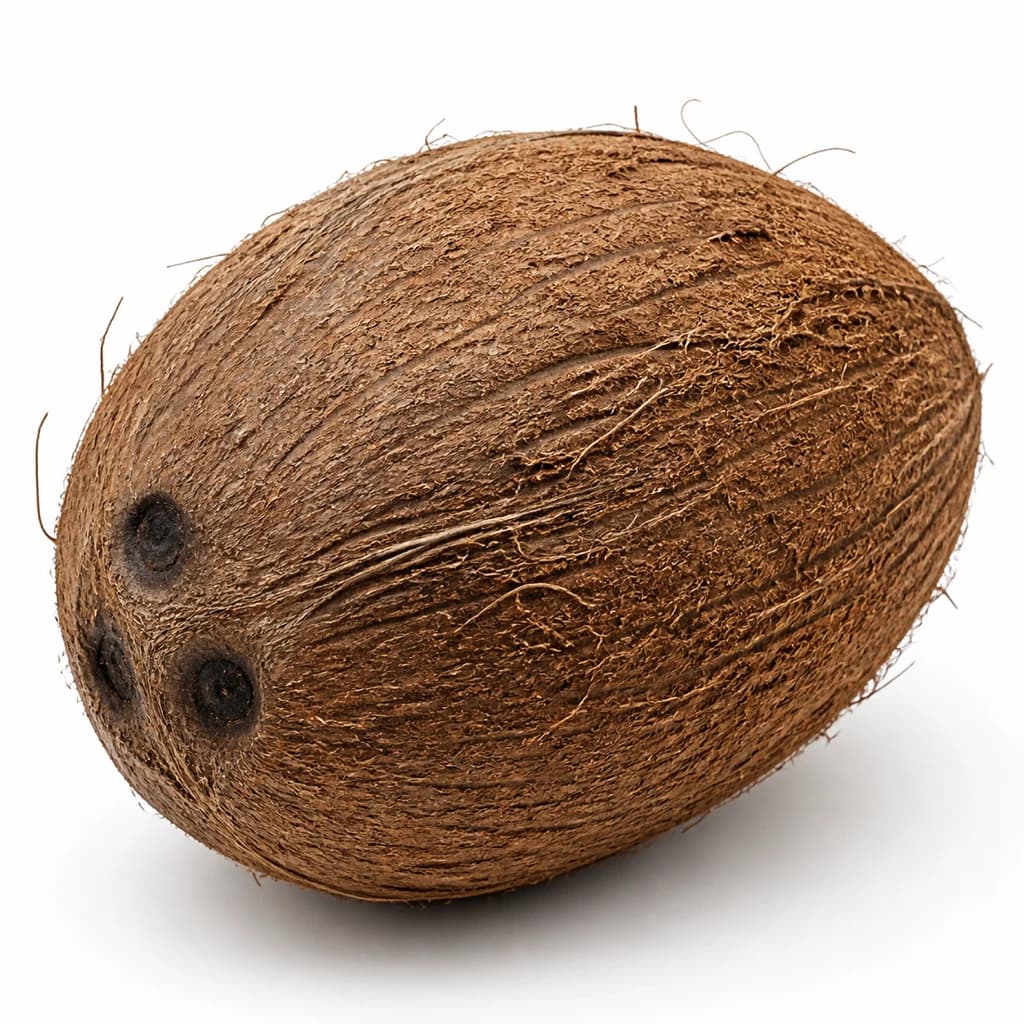
Natural form
Whole mature coconut with intact brown fibrous husk and hard shell visible.
Shows the reader the coconut exactly as found in markets — the large brown drupe with its distinctive fibrous outer layer and three dark eye spots.
Produce
Coconut
Tropical drupe yielding water, white flesh and milk for sweet and savory cooking worldwide.
The coconut is a large tropical drupe whose hard brown shell holds firm white flesh and refreshing water. Fresh or grated flesh enriches curries, rice and sweets, and is pressed into coconut milk and cream. It is fundamental to South Asian, Southeast Asian, Caribbean and Pacific cuisines.
Coconut (Cocos nucifera) is a tropical drupe—a fleshy fruit with a hard stone—despite being commonly misidentified as a nut. The white flesh lining the hard inner shell is the endosperm, available in varying textures from young coconut's soft gelatin to mature coconut's firm meat. The clear liquid inside the cavity, called coconut water, is actually the liquid endosperm, while the fibrous brown husk encases everything in a natural protective layer. Coconut palms are extraordinarily adaptable, thriving on sandy tropical shorelines worldwide and producing 50 to 200 fruits per tree annually. The fruit's ability to float enabled its natural dispersal across oceans, making it one of the most widely distributed fruits on Earth.
What makes coconut remarkable in cooking is its complete utility: every part yields something edible or useful. The flesh produces milk, cream, oil, flour, and sugar. The water serves as a beverage and electrolyte source. Coconut milk and cream are emulsions rather than true solutions—fat droplets suspended in water—which explains why they can curdle when exposed to acid or high heat during cooking. Understanding this behavior is essential for troubleshooting curries, soups, and sauces. The oil's high smoke point (approximately 350°F/175°C) and pure-fat composition make it exceptionally stable for frying, while its 90% saturated fat content (predominantly lauric acid) provides richness that no other cooking fat replicates.
Coconut appears in cuisines spanning Southeast Asia, India, the Caribbean, West Africa, and the Pacific Islands, where it functions as a primary cooking medium, a source of richness and texture, and a carrier for spices and aromatics. Its flavor profile—sweet, nutty, creamy with subtle tropical notes—integrates seamlessly into both savory and sweet preparations. From Thai curries to Haitian akasan, from coconut shrimp coatings to macaroon cookies, the ingredient bridges cultures and course categories with remarkable versatility.
- Measured in
- piece
- Storage
- Pantry
Allergens
Types & varieties
Thin, green exterior. Predominantly water (8–16 oz), soft gelatinous flesh. Used for water, mild flesh for smoothies and desserts. Hawaiian and Thai cuisine staples
Brown, fibrous husk. Firm white flesh, less water. Standard for milk, cream, shredded, and oil. Most common in cooking worldwide
Orange-brown dwarf variety. Sweeter, more aromatic water. Primarily consumed locally; used in traditional sweets. Seldom exported fresh
Genetic mutation producing abnormally soft, thick, jelly-like flesh filling the entire cavity. Premium variety; used in pastries, ice cream, and desserts. Not widely available outside the Philippines
Common commercial variety with good flesh-to-water ratio. Favored in cooking for consistent milk yield. Most imported to Western markets
Dried, shredded flesh with no additives. Standard in savory cooking, baking, and milk production. Finely or coarsely shredded variants available
Coconut flesh dried with added sugar. Moister than desiccated. Used in baked goods, confectionery, granola. Not a substitute for unsweetened in savory cooking
Desiccated or flaked coconut browned in dry heat. Nutty, intensified flavor. Used as garnish, in baking, granolas, and some savory dishes
Choosing and Storing Coconut Products
Different coconut products have vastly different shelf lives. Fresh whole coconuts keep 1–2 weeks at room temperature or 2–3 weeks refrigerated once purchased. Once opened, use fresh flesh within 2–3 days. Canned coconut milk should be stored unopened in a cool, dark place; shake well before using as natural separation is normal. Opened canned coconut milk transfers to an airtight container and keeps refrigerated up to 5 days. Desiccated and shredded coconut keeps 6–12 months sealed in a cool, dark place, while coconut flour maintains quality for 8–12 months under the same conditions. For maximum freshness, freeze leftover coconut flesh wrapped tightly in plastic wrap then aluminum foil for up to 6 months.
- Shake canned coconut milk before opening—separation is natural, not a defect
- Frozen coconut flesh actually grates more easily for some preparations
- Refrigerating a can of coconut milk overnight yields coconut cream from the congealed top layer
Understanding Coconut Milk and Cream
Coconut milk and cream are not interchangeable by volume in all contexts. Cream contains less water and more fat, producing richer sauces and thicker results. The distinction matters most in Southeast Asian curries where the characteristic texture is expected. For recipes specifying cream, using milk will produce a thinner result; for milk recipes, using cream makes the dish richer but generally acceptable. Coconut milk and cream are emulsions—fat droplets suspended in water—which means they behave differently than dairy. They curdle when combined with acidic ingredients over direct heat, and they can break if cooked at too high a temperature for too long. These properties are not flaws but characteristics that, once understood, become tools for controlling texture and consistency.
- Add acidic ingredients (lime, tamarind) off-heat or at the end of cooking to prevent curdling
- If coconut milk curdles, whisk vigorously or blend to re-emulsify
- Re-press leftover coconut pulp with fresh water for a thinner second milk useful in soups
Common uses
Tips & pitfalls
- Select fresh coconuts by shaking—heavy sloshing indicates ample water. Avoid those with cracks, soft spots at the eyes, or that feel unusually light (desiccated interior)
- When substituting desiccated coconut for fresh or sweetened shredded, adjust recipe moisture accordingly
- Common mistake: Using sweetened shredded coconut in savory dishes—it adds unwanted sugar and different texture. Reserve for baking and sweet applications only
- Coconut flour cannot substitute 1:1 for wheat flour; it absorbs roughly four times more liquid and requires significantly more eggs or binding agents in recipes
- Coconut water and coconut milk are not interchangeable—they differ fundamentally in fat content, thickness, and culinary function
- Do not add acid directly to simmering coconut milk; this causes immediate curdling. Add lime, tamarind, or other acids off-heat or at the end of cooking
- Test oil temperature for frying without a thermometer: drop a piece of desiccated coconut—if it sizzles immediately and browns within 30 seconds, oil has reached ~350°F (175°C)
- Avoid overheating coconut oil; while its smoke point is higher than many oils, burnt coconut oil develops bitter flavor that ruins dishes
Nutrition
Energy
1481 kJ · per 100 g
Where the calories come from
Protein
3.3g
7% DV
Carbs
15.2g
6% DV
Fat
33.5g
43% DV
Fiber
9g
32% DV
Sugars
6.2g
of which
Sodium
20mg
1% DV
Source · USDA FoodData Central · approx. Nuts, coconut meat, raw
View on FDC →In the shops
Matched grocery products
No matched grocery products for Coconut yet.
Good to know
- Type
- Tropical drupe (fruit of Cocos nucifera palm)
- Origin
- Indo-Malay region; spread globally through tropical cultivation
- Major Producers
- Indonesia, Philippines, India, Brazil, Sri Lanka, Vietnam
- Primary Season
- Year-round in tropics; peak November–January in Southeast Asia
- Parts Used
- Flesh (endosperm), water (liquid endosperm), milk, cream, oil, flour, sugar, vinegar
- Flavor
- Sweet, nutty, creamy with subtle tropical, sometimes faintly vanilla-like notes
- Yield
- One medium mature coconut (~1.5 lbs): 1–1.5 cups shredded flesh, 1–1.5 cups water, 2–4 cups milk when pressed
- Fat Content
- Fresh flesh: ~35%. Coconut milk: 17–24%. Coconut cream: ~22–30%. Coconut oil: 100%
Substitutes
- Coconut cream for coconut milk — Thin with water or thin milk from a second press, roughly 1:1 ratio. The dish will be slightly richer but acceptable in most preparations
- Coconut milk for coconut cream — Add 1 tablespoon butter or oil per cup of coconut milk to approximate richness. Works directly in most recipes with minimal adjustment
- Full-fat dairy cream — Suitable for desserts and beverages. Not appropriate in savory dishes requiring coconut flavor—the dish will lack characteristic taste
- Cashew cream or other nut milks — Work in smoothies and some desserts. Cashew cream best for sauces and curries; coconut remains irreplaceable for authentic tropical flavor in regional cuisines
- Coconut oil for butter or other cooking oils — Excellent 1:1 substitute in most baking and cooking. For butter in volume-sensitive cakes, use 3/4 the amount of solid butter (coconut oil is pure fat versus butter ~80% fat)
- Coconut flour for wheat flour — No direct 1:1 swap. Use approximately 1/4 to 1/3 cup coconut flour per cup wheat flour and significantly increase eggs and liquid. Requires recipe adaptation
- Coconut water for sports drinks or plain water — Direct substitute in beverages. Cannot substitute for milk or broth in cooking—too thin and lacks fat content
Pairs with
Also called
Fresh Coconut · Grated Coconut
Appears in these dishes

Related
Tomato
Juicy, sun-sweet fruit for sauces, salads, and slow-cooked depth
Yellow Onion
The aromatic backbone of soups, sofritos, and braises
Garlic
Pungent cloves that perfume nearly every savory dish
Lemon
Bright, acidic citrus that wakes up almost any dish
Potato
Humble, hearty staple — roast, mash, fry, or boil
Carrot
Sweet, crunchy root — raw, roasted, or the base of a sofrito
Cucumber
Cool, crisp, and watery — for salads, pickles, and tzatziki

Lettuce
Crisp leaves for salads, wraps, and a fresh crunch