Beverages
Dry Sherry (Cooking)
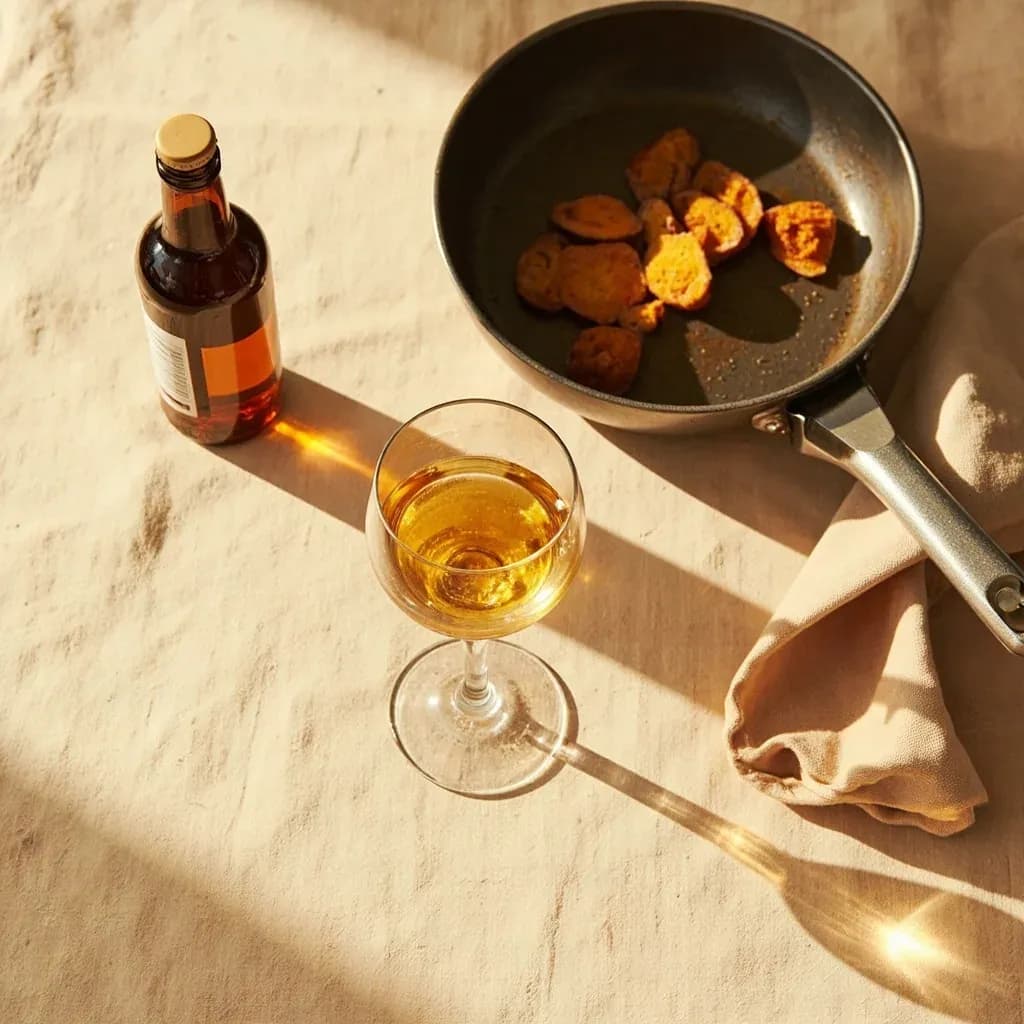
Crisp fortified Spanish wine that deglazes and adds nutty savor — splash into pan sauces, mushroom dishes, bisques, and Chinese stir-fries as a stand-in for Shaoxing wine.
Dry sherry is a fortified white wine from the Jerez-Xérès-Sherry region of Andalusia, produced principally from the Palomino Fino grape and aged through the solera system — a stacked-barrel fractional blending method that yields wines of remarkable consistency and depth. The dry styles (fino, manzanilla, amontillado, palo cortado, oloroso) gain their distinctive nuttiness from two very different aging paths: a layer of yeast called flor that protects the wine from oxygen, or full oxidative aging that concentrates walnut and amber notes. In the pan, sherry behaves like wine amplified — the same acidity that brightens a sauce, plus a savory, almost broth-like backbone that comes from years of barrel aging before the bottle is even opened.
For cooks, the practical appeal is that a small splash does the work of both wine and a fortifying spirit. It lifts fond off a hot pan more efficiently than table wine because of its higher alcohol, and it carries nutty, yeasty aromatics that survive short reductions beautifully. The result is a sauce with more dimension than one built on Sauvignon Blanc, and a faster path to depth than one built on stock alone.
The crucial decision is which style to buy. Most Western recipes calling for 'dry sherry' are written with amontillado in mind — the amber, nutty workhorse that stands up to cream, mushrooms, and longer reductions. Fino is sharper and more delicate, the right pick for quick seafood dishes and Chinese stir-fries. Oloroso brings walnut richness to long braises. The American supermarket bottle labeled 'cooking sherry' is a separate, salted product and should be avoided.
- Measured in
- ml
- Storage
- Pantry
Find it in
Suits
Types & varieties
Pale straw, sharp and almondy with bready notes from flor. Lightest, freshest choice — best for delicate sauces, seafood, and quick pan work.
A fino from Sanlúcar de Barrameda, aged closer to the Atlantic; faint briny tang. Excellent with shellfish and vegetables.
Amber, richer and nuttier than fino because the flor dies and the wine oxidizes for years. The most versatile cooking sherry — stands up to cream, mushrooms, and long reductions.
Rare; dry but unusually full-bodied and aromatic. A luxury option for special sauces where you want depth without sweetness.
Dark amber, dry yet rich and walnutty, no flor contact. Heavier weight — good for game, braises, and reductions, though it carries a trace more sugar than fino.
Avoid for serious cooking — usually an oloroso or pale cream base with salt added; flat aroma and a saline edge that no amount of reduction will fix.
Building a Sherry Pan Sauce
Sherry's role in a pan sauce is to dissolve the fond left by searing and to contribute its own nutty, oxidative flavor in the same step. The technique is short and forgiving once you understand the timing — the sherry goes in after the aromatics, reduces on its own, then meets stock or cream.
- Sear the protein (chicken thighs, pork medallions, sliced cremini) over high heat in fat until deeply browned; remove and rest.
- Lower heat to medium, sweat minced shallots in the rendered fat until translucent — about 1 minute.
- Pour in ¼ to ⅓ cup amontillado (or fino for seafood); it will bubble hard and the fond will dissolve in seconds.
- Reduce the sherry by about half — this concentrates flavor and burns off the raw alcohol edge, usually 1–2 minutes.
- Add stock, cream, or accumulated pan juices and reduce to the consistency you want; swirl in cold butter off the heat to mount.
- Finish with herbs (thyme, parsley, chervil) and a pinch of salt; taste before adding extra acid — sherry contributes some brightness, though a squeeze of lemon may still help balance richer sauces.
Common uses
Tips & pitfalls
- Buy drinking-quality sherry and skip the salted 'cooking sherry' on grocery shelves — the flavor gap between a $10 bottle of amontillado and a $3 bottle of salted cooking sherry is enormous in a finished dish.
- Add sherry late in cooking; its delicate nutty and yeasty aromatics dissipate with long boiling, especially for fino and manzanilla.
- Reduce the sherry by roughly half on its own before adding stock or cream — this concentrates flavor and cooks off the raw alcohol edge.
- Refrigerate after opening and use fino and manzanilla within 1–2 weeks; amontillado keeps 3–4 weeks, oloroso several months.
- Don't substitute sweet cream sherry (Bristol Cream and similar) unless a recipe explicitly calls for it — the residual sugar will throw savory dishes off-balance.
- When an older Anglo-American cookbook says 'dry sherry' it almost always means an amontillado-equivalent, not a modern fino; modern cookbook usages vary.
- For Chinese dishes specifically, Shaoxing wine is closer in character to amontillado than to fino, so reach for amontillado if your Shaoxing has run out.
- Freeze leftover sherry in ice cube trays — one cube is roughly two tablespoons and thaws fast in a hot pan, eliminating the 'finish the bottle' pressure.
Nutrition
Nutrition
No USDA FoodData Central match for Dry Sherry (Cooking) yet. We surface a per-100 g profile once a generic whole-food entry is matched and verified.
In the shops
Matched grocery products
No matched grocery products for Dry Sherry (Cooking) yet.
Good to know
- Origin
- Jerez de la Frontera, Cádiz, Andalusia, Spain (also Sanlúcar de Barrameda and El Puerto de Santa María)
- Denominación
- Denominación de Origen 'Jerez-Xérès-Sherry' granted in 1933
- Style
- Fortified white wine, typically 15–17% ABV
- Fortification
- Grape spirit (aguardiente) added to base wine to raise alcohol to sherry's signature strength
- Base grapes
- Palomino Fino for dry styles; Pedro Ximénez and Moscatel for sweet styles
- Aging system
- Criaderas y solera — fractional blending across stacked barrels
- Flor veil
- Fino and manzanilla age under a Saccharomyces yeast film; amontillado starts under flor then oxidizes; oloroso ages oxidatively only
- Sweetness
- Drinking sherries contain a small amount of residual sugar (fino under 5 g/L); 'dry' refers to perception, not zero sugar
- Salt content
- True sherry contains no added salt; American 'cooking sherry' is salted (about 1.5%) to make it undrinkable and bypass liquor taxes
- Shelf life, opened
- Fino and manzanilla 1–2 weeks refrigerated; amontillado 3–4 weeks; oloroso several months
- Shelf life, unopened
- Several years in a cool, dark place; fino and manzanilla best within 1–2 years of bottling
Substitutes
- Dry white wine (Sauvignon Blanc, Pinot Grigio) — Closest everyday substitute; lacks nutty depth, so add a splash of dry vermouth or a few drops of soy sauce to mimic the savor.
- Dry vermouth — Excellent 1:1 substitute — already fortified, herbal, and slightly nutty; one of the most reliable swaps in classic French and Spanish recipes.
- Shaoxing wine — Right swap in Chinese recipes; nutty and amber; not ideal in Spanish or French contexts where the flavor profile reads foreign.
- Dry Madeira (Sercial or Verdelho) — Works in long-simmered sauces; richer and more acidic than sherry, so use a little less and taste as you go.
- Dry Marsala (secco) — Similar nutty character with slightly heavier body; works in mushroom and veal dishes particularly well.
- Champagne or dry sparkling wine — Good for deglazing delicate seafood dishes where you want brightness more than nuttiness.
- Rice vinegar plus a splash of white wine — Last-resort substitute when no alcohol is on hand; misses the body and aroma, but saves a sauce in a pinch.
Pairs with
Also called
fino sherry · cooking sherry · manzanilla
Appears in these dishes
Related

White Rum
Light, clean rum for mojitos, daiquiris, and piña coladas

Dark Rum
Rich, molasses-deep rum for tiki drinks and sipping

Tequila
Bright agave spirit for margaritas, palomas, and shots
Mezcal
Smoky agave spirit for sipping and smoldering cocktails
Vodka
Clean, neutral spirit for mixing into almost any cocktail
Gin
Botanical, juniper-forward spirit for G&Ts and martinis

Whisky
Warm, oak-aged spirit for sipping and classic cocktails

Brandy
Rich, fruity grape spirit for sipping, sauces, and flambé