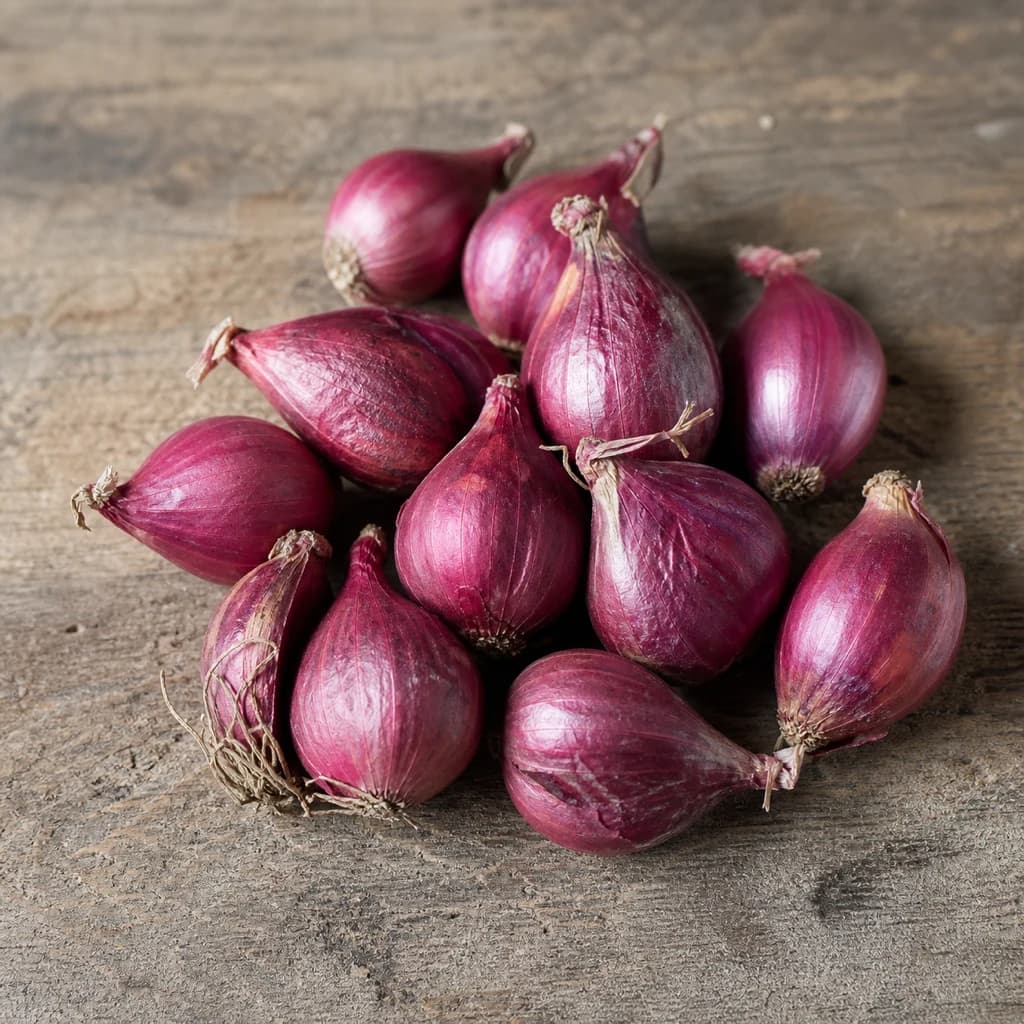
Natural form
Whole red shallots showing their deep purple-red papery skin and small, slender bulb clusters.
Shows the reader the unmistakable appearance, color, and form of the raw ingredient as found in a market or pantry.
Produce
Red Shallot (Bawang Merah)
Small purple-red shallots that form the aromatic base of Southeast Asian curries, sambals, and crispy fried garnishes.
Red shallots are small, slender alliums with a deep purple-red skin and sweet, pungent flesh that mellows when cooked. They are the workhorse aromatic across Indonesian, Malaysian, Thai, and Vietnamese kitchens, pounded into spice pastes or thinly sliced and fried into crisp shallots. Their sugar content makes them caramelize quickly and turn golden when deep-fried.
Red shallots (Allium cepa var. aggregatum) are the foundational aromatic of Southeast Asian cooking, distinct from both yellow onions and the French echalion. Smaller and more elongated than yellow onions—typically 2–5 cm in diameter—with copper-pink to deep purple-red skins and flesh that blushes purple at the edges. Their flavor profile is more concentrated and sweeter than yellow onions when cooked, yet moderately sharp and pungent when raw, with less water content that makes them uniquely suited to frying. Cultivated extensively across Indonesia, Malaysia, Thailand, and the Philippines, red shallots are not interchangeable with other alliums—they perform specific culinary functions that other onions cannot replicate. The sulfur compound profile differs from yellow onions, producing less tear-inducing agents but more concentrated flavor impact per volume. In tropical growing regions, peak harvests occur during dry seasons (April–June and October–December), though they are available year-round. Properly stored in a cool, dry, ventilated space, whole shallots keep 2–3 weeks; refrigeration promotes sprouting and must be avoided.
- Measured in
- g
- Storage
- Pantry
Types & varieties
Popular Malaysian cultivar; round, medium-sized, consistently deep red color; excellent for frying
Slightly smaller with more intense red color; standard in Thai cuisine; prized for even frying and consistent results
Larger variety with lighter pinkish-red skin and milder flavor; actually a type of aggregatum onion rather than true shallot
Indonesian cultivar with slightly greenish tinge; popular in Sumatra and Java for its subtle flavor difference
Malaysian cultivar named after a town in Selangor; known for strong aroma and excellent storage quality
Regional Nomenclature
Naming conventions vary across Southeast Asia and can cause confusion. In Malay and Indonesian, 'bawang merah' refers specifically to this red shallot variety—other shallot types are uncommon. The Vietnamese term 'hành tím' denotes shallots, distinct from 'hành tây' for common onion. Philippine cuisine uses 'sibuyas' broadly for both onions and shallots, with 'sibuyas na pula' specifically indicating red shallots. Always identify the specific type when shopping at specialty markets.
Why Red Shallots Cannot Be Substituted
Red shallots perform culinary functions that other alliums cannot replicate. Their lower water content and higher sugar concentration make them capable of crisping to a delicate, golden crunch when fried—a feat yellow onions cannot achieve. Their concentrated sweetness balances chile heat in sambals differently than milder onions. Their structural integrity when raw holds up in brunoise and thin-slice garnishes where yellow onion would overwhelm. Using yellow onion in a sambal or for crispy fried topping fundamentally alters the dish's character and texture.
Common uses
Tips & pitfalls
- Always bring shallots to room temperature before frying—cold shallots absorb more oil and steam rather than crisp.
- Chill shallots 30 minutes before cutting to minimize tears, or use a very sharp straight-blade knife which causes less cell damage than serrated or scalloped edges.
- For crispy garnish, maintain oil at 180–190°C (355–375°F) and fry in small batches to prevent steaming.
- Never substitute yellow onion for raw applications—the flavor difference is significant and texture is wrong for sambals or fresh garnishes.
- Press sliced shallots gently with paper towels before frying to remove excess moisture for maximum crispness.
- Store away from potatoes—potatoes release moisture and gases that accelerate shallot sprouting and spoilage.
- Do not refrigerate whole shallots; cold temperatures promote sprouting and degrade flavor.
- Slice shallots uniformly for even cooking; a mandoline or V-slicer produces consistent thickness for frying.
Nutrition
Energy
301 kJ · per 100 g
Where the calories come from
Protein
2.5g
5% DV
Carbs
16.8g
6% DV
Fat
0.1g
0% DV
Fiber
3.2g
11% DV
Sugars
7.9g
of which
Sodium
12mg
1% DV
Source · USDA FoodData Central · Shallots, raw
View on FDC →In the shops
Matched grocery products
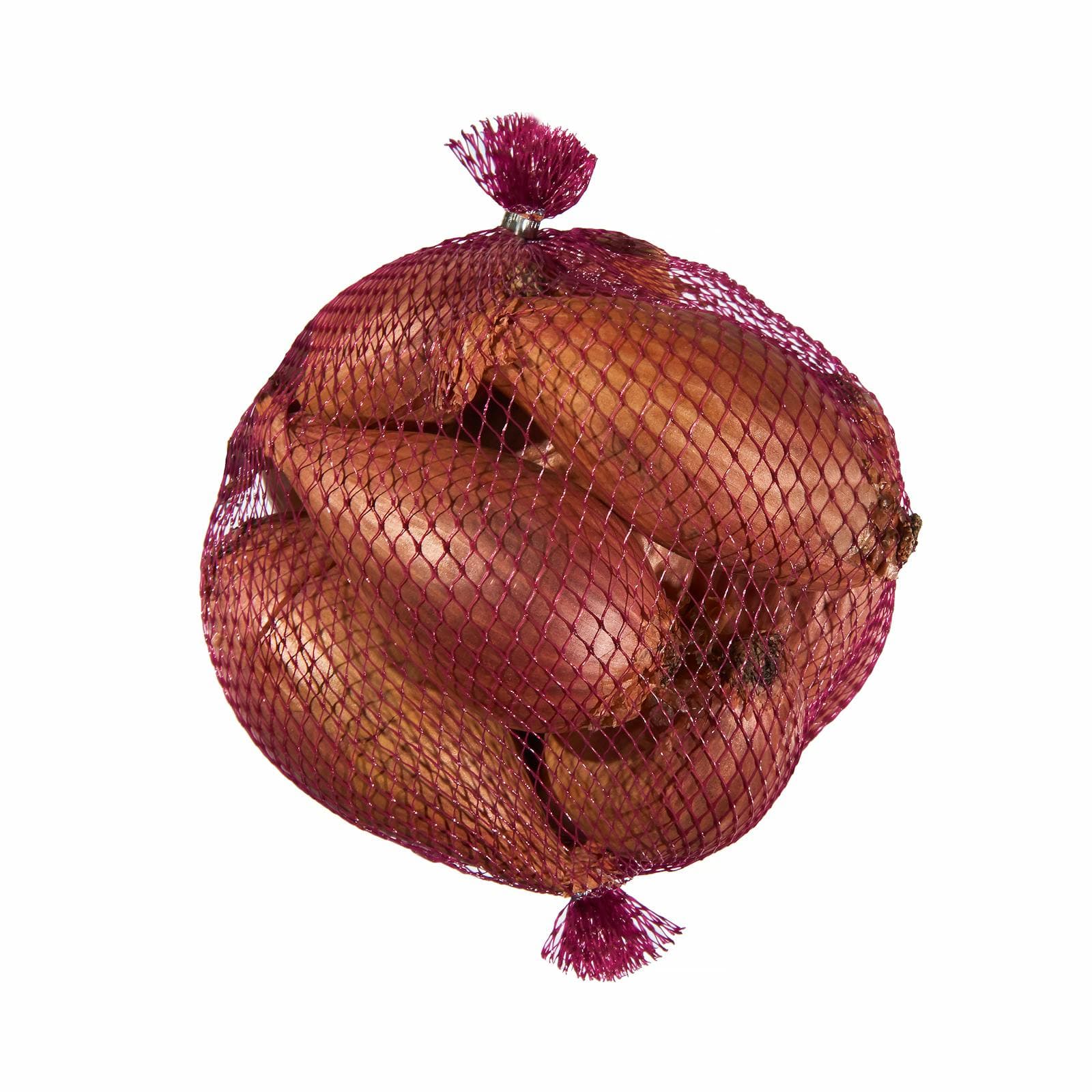 €1.75
€1.75Shallots
250 g · Mercadona
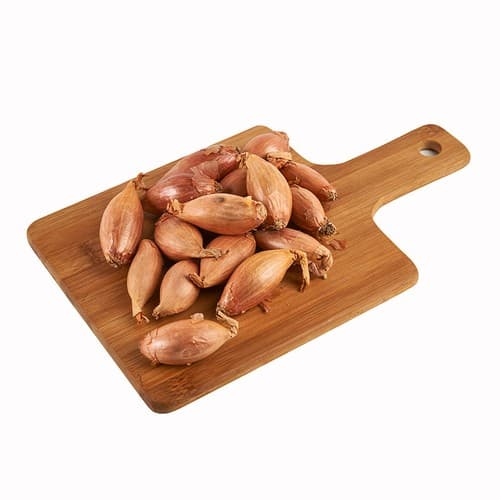 €1.59
€1.59Shallots in Mesh Bag 250 g
kg · Bonpreu
Good to know
- Scientific Name
- Allium cepa var. aggregatum
- Origin
- Southeast Asia; cultivated extensively in Indonesia, Malaysia, Thailand, and the Philippines
- Color
- Purple-red to copper-pink outer skin; flesh off-white with purple-red tinges at the edges
- Size
- 2–5 cm in diameter; smaller and more elongated than yellow onions
- Flavor
- Sweeter and more delicate than yellow onion when cooked; sharper and more concentrated when raw
- Peak Season
- Year-round in tropical regions; main harvests April–June and October–December
- Storage
- Cool, dry, ventilated area away from sunlight; 2–3 weeks. Never refrigerate whole. Refrigerate sliced shallots in airtight container up to 1 week.
- Yield
- One medium shallot (20–25g) yields 2–3 tablespoons sliced, or 1–2 tablespoons minced
- Pungency
- Mild when cooked; moderately sharp when raw
- Key Compound
- Sulfur compounds including syn-propanethial-S-oxide, but in lower concentration than yellow onion
Substitutes
- Yellow (Brown) Onion — Acceptable only when cooked; use 1 yellow onion in place of 3–4 shallots. Not suitable for raw applications or crisping.
- Red Onion — Better than yellow for raw uses but lacks concentrated sweetness; slice thinner for raw applications. Does not crisp as well.
- French Shallot (Echalion) — Good flavor substitute—similar sweet, delicate profile—but significantly more expensive and harder to find in Southeast Asian markets.
- Thai Shallot — Direct substitute; same species and origin; use in equal proportion for any Southeast Asian application.
Pairs with
Also called
Bawang Merah · Asian Shallot · Thai Shallot
Related

Tomato
Juicy, sun-sweet fruit for sauces, salads, and slow-cooked depth

Yellow Onion
The aromatic backbone of soups, sofritos, and braises

Garlic
Pungent cloves that perfume nearly every savory dish

Lemon
Bright, acidic citrus that wakes up almost any dish

Potato
Humble, hearty staple — roast, mash, fry, or boil

Carrot
Sweet, crunchy root — raw, roasted, or the base of a sofrito

Cucumber
Cool, crisp, and watery — for salads, pickles, and tzatziki

Lettuce
Crisp leaves for salads, wraps, and a fresh crunch