Proteins
Wagyu Beef
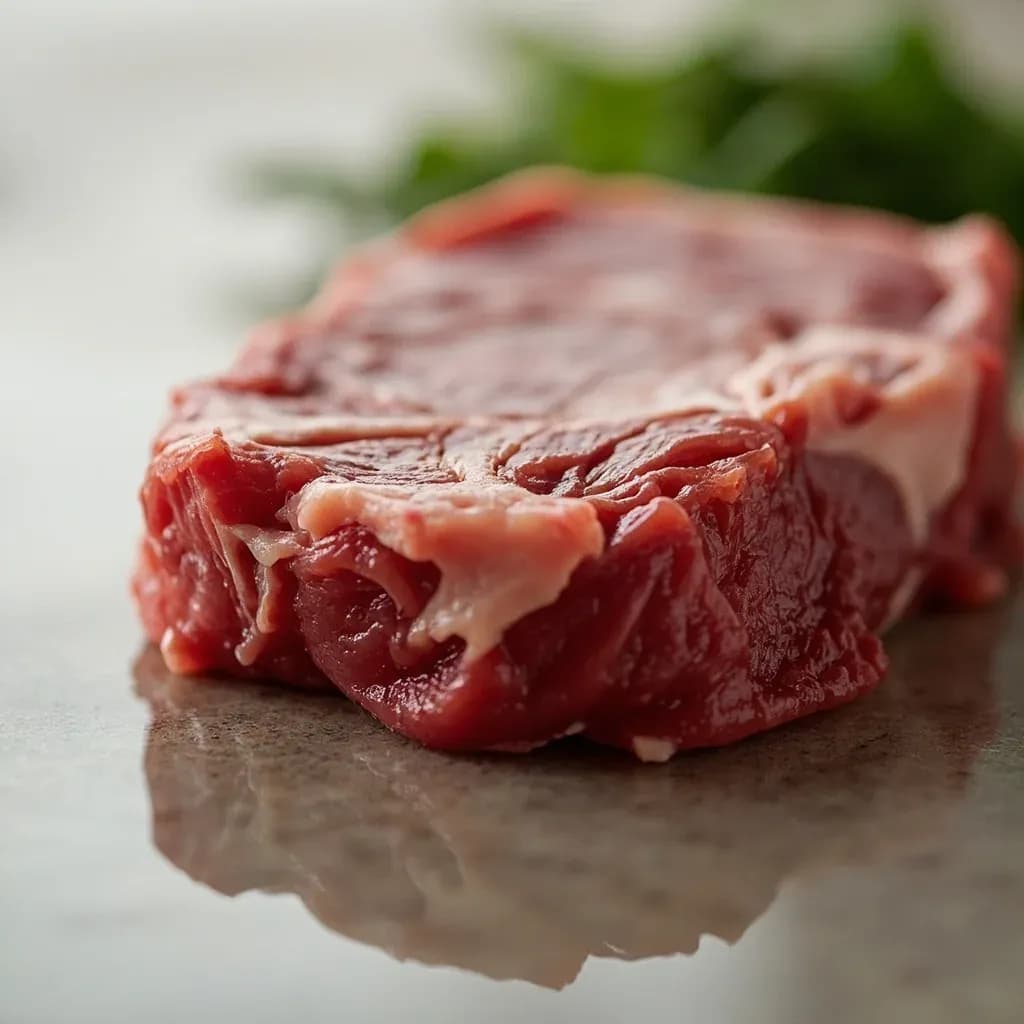
Intensely marbled Japanese beef, seared briefly so its rich fat melts and renders.
Wagyu is beef from specific Japanese cattle breeds famed for dense intramuscular fat marbling that gives a buttery, melt-in-the-mouth richness. Highly graded cuts are seared briefly or grilled in thin slices for shabu-shabu and sukiyaki, where the fat renders quickly. Because it is so rich, it is usually served in small portions.
Wagyu (和牛, literally "Japanese cow") is beef from one of four native Japanese breeds, but the word has become shorthand for an entire philosophy of marbling. What separates true Wagyu from a heavily marbled American or Australian steak isn't only the volume of intramuscular fat — it's the composition. Wagyu fat is unusually rich in oleic acid, the same monounsaturated fat that dominates olive oil, and that gives it a melting point near 25 °C / 77 °F. The fat liquefies at body temperature, which is why a properly cooked slice dissolves on the tongue rather than sitting heavy and greasy the way the fat in conventional beef can.
Modern Wagyu descends from cattle used for draft work in rice paddies, then selected for meat quality from the Meiji era onward, with marbling intensification accelerating through the twentieth century. In Japan, the Japan Meat Grading Association scores yield (A through C) and meat quality (1 through 5), while a separate Beef Marbling Standard (BMS) runs from 1 to 12. An A5 striploin at BMS 10–12 can run 35–45 percent intramuscular fat against roughly 10 percent for USDA Prime. Outside Japan the word "Wagyu" is unregulated in most markets, so quality varies wildly; a butcher who can name the prefecture, the BMS score, and the feeding program is the single best safeguard a buyer has.
How you cook Wagyu depends on the cut, the grade, and what you want from it. A5 strips and ribs are at their best seared hard and eaten rare, where the fat has just barely softened and the beef is still cool in the center. Lower-BMS domestic Wagyu, crossbred Wagyu, and the redder Akaushi (Japanese Brown) strain tolerate more heat and longer cooking because they have less of that low-melting fat to begin with. Treat it like a luxury ingredient, not a conventional steak scaled up, and the difference is unmistakable.
- Measured in
- g
- Storage
- Fridge
Types & varieties
Tajima-gyu cattle born, raised, and slaughtered in Hyōgo Prefecture; BMS ≥ 6, meat quality ≥ 4, carcass ≤ 470 kg. Only about 3,000–5,000 head certified per year; look for the official chrysanthemum logo.
From Mie Prefecture, predominantly virgin heifers of the Kuroge Washū strain; known for silky, finely dispersed fat and a characteristic aroma.
One of the oldest branded Wagyu lines, from Shiga Prefecture; finished on grain and historically massaged with sake lees (largely discontinued today).
From Yamagata Prefecture; small production, exceptionally fine marbling (shimofuri), and a long reputation in northern Japan.
From Gifu Prefecture; leaner than the marquee brands but consistently BMS 5+ and a workhorse of high-end restaurants.
Japanese Brown strain; leaner, redder, and beefier than Kuroge Washū, with more mineral flavor and less of the buttery melt.
Crosses of Japanese genetics (originally imported in the 1970s) with Angus and other breeds; typically 50% Wagyu, with some purebred and fullblood lines also produced (e.g., Snake River Farms, Imperial Wagyu).
Fullblood (100% Japanese bloodlines) and crossbred production, grain-fed 350–450 days; some of the most consistent marbling outside Japan.
What makes Wagyu fat different
Every beef animal deposits intramuscular fat, but the chemistry of that fat varies by breed and diet. Wagyu marbling is unusually high in oleic acid — often 40% or more of total fatty acids in A5, compared with roughly 30–45% in conventional beef and 70%+ in olive oil. Oleic acid melts at a lower temperature than the saturated fats that dominate most beef, which is why Wagyu fat softens at room temperature and feels slick rather than waxy in the mouth. The fat also carries more of the volatile compounds responsible for beefy, nutty aroma. Two practical implications: Wagyu rewards minimal seasoning because the fat itself carries a lot of flavor, and it punishes overcooking because once the fat has fully rendered out of the muscle, there is little left to hold onto.
Buying and reading the label
Inside Japan the labels are meaningful: A5, BMS, and a brand name (Kobe, Matsusaka, Ōmi, Yonezawa, Hida) all carry legal definitions enforced by prefectural marketing associations. Outside Japan, the word Wagyu is essentially unregulated. Use these checkpoints before paying premium prices.
- Ask for the prefecture and brand name; vague 'Wagyu' or 'Japanese-style beef' is a red flag.
- For Japanese imports, look for the actual BMS number or meat-quality score; A4–A5 will outperform most domestic Wagyu, but a real BMS 5 Japanese steak can be cheaper than a domestic 'Wagyu' ribeye.
- American Wagyu crosses (50/50) are widely available and excellent for yakiniku and shabu-shabu; purebred and fullblood lines are closer to Japanese character but still not Japanese A5.
- For Akaushi specifically, expect a leaner, redder steak with a higher price than conventional beef but a more mineral, less fatty profile.
- Buy by the gram and portion to 60–120 g per person; Wagyu is rarely improved by eating more of it in one sitting.
Cooking by grade and cut
Not all Wagyu wants the same treatment. Matching technique to grade and cut is the difference between a transcendent bite and an expensive lesson.
- A5 strips, ribeyes, and tenderloin: salt-only, room-temp, screaming-hot cast iron, 30–45 seconds per side, rest 3–5 minutes, slice against the grain. Internal 50–55 °C / 122–130 °F.
- Lower-grade Wagyu and Akaushi: tolerate medium-rare to medium; the leaner profile benefits from slightly more carryover cooking.
- Thinly sliced Wagyu (2–3 mm) for shabu-shabu and sukiyaki: a 2–3 second pass in hot dashi or warishita is enough; longer and the fat renders into the broth and overcooks the slice.
- Yakiniku cubes and steaks from the chuck or sirloin (less-marbled cuts): cook over binchotan or high-heat gas, dip in tare between flips, rest off the heat briefly.
- Leftover cooked Wagyu: best used cold in a rice bowl or salad, where the solidified fat carries flavor without greasiness.
Common uses
Tips & pitfalls
- Do not overcook. Past medium the fat renders out faster than the muscle can stay enjoyable, and the texture turns greasy rather than silky — aim for rare to medium-rare, internal 50–55 °C / 122–130 °F.
- Bring the cut to room temperature for 30–60 minutes before cooking; cold Wagyu seizes and renders unevenly.
- Pat the surface bone-dry and salt immediately before searing; salting earlier draws moisture out of fatty cuts and prevents a proper crust.
- Use a screaming-hot cast iron or carbon steel pan with no added oil; the fat cap provides all the lubrication needed and added oil muddies the flavor.
- Sear 30–45 seconds per side for a 2 cm steak and do not move it; a crusted exterior and cool ruby center is the goal.
- Rest for only 3–5 minutes — half the time of a conventional steak — because the fat stays liquid and the muscle tightens less than lean beef.
- Slice against the grain and on a bias with a sharp, long knife to preserve the silky mouthfeel.
- Skip heavy marinades; flaky sea salt is usually enough, since soy, mirin, or steak sauce can quickly overwhelm an A5.
- Avoid butter-basting unless using a leaner cut like Akaushi; extra fat muddies an already fat-rich steak.
Nutrition
Energy
828 kJ · per 100 g
Where the calories come from
Protein
19.4g
39% DV
Carbs
0g
0% DV
Fat
12.7g
16% DV
Fiber
0g
0% DV
Sugars
0g
of which
Sodium
68mg
3% DV
Source · USDA FoodData Central · approx. Beef, grass-fed, ground, raw
View on FDC →In the shops
Matched grocery products
No matched grocery products for Wagyu Beef yet.
Good to know
- Name meaning
- Wagyu (和牛) means "Japanese cow" — wa (Japanese) + gyū (cattle).
- Native breeds
- Four: Japanese Black (Kuroge Washū), Japanese Brown (Akaushi), Japanese Shorthorn, and Japanese Polled. Kuroge Washū accounts for roughly 90% of all Wagyu.
- Marbling metric
- Beef Marbling Standard (BMS) No. 1–12; No. 12 is essentially all intramuscular fat.
- Quality grade
- Japan Meat Grading Association scores yield (A–C) and meat quality (1–5); A5 is the pinnacle.
- Fat melting point
- Approximately 25 °C / 77 °F — well below body temperature, which is why it melts on the tongue.
- Fat content
- A5 striploin runs 35–45% intramuscular fat, vs. ~10% for USDA Prime.
- Typical portion
- 60–120 g (2–4 oz) per person; a whole steak is often shared because richness builds quickly.
- Storage
- Refrigerate 1–2 days; vacuum- or butcher-paper-wrapped and frozen at 0 °F, up to 6 months. Thaw overnight in the fridge.
Substitutes
- Dry-aged USDA Prime ribeye — Closest Western approximation — deep, concentrated beefy flavor with heavy marbling; lacks Wagyu's low melting point and buttery melt.
- Australian grain-fed Black Angus (270+ days) — Heavy marbling at a fraction of the price; a good fit for yakiniku and shabu-shabu.
- American Wagyu cross (50/50) — More Wagyu character than domestic Prime, less than Japanese A5; the standard middle ground for yakiniku and home steak nights.
- Akaushi (Japanese Brown) — The right move when you want a Wagyu experience but prefer a beefier, leaner profile that takes more heat.
- Hanwoo (Korean native cattle) — Fine marbling and similar tenderness, especially in the top grades (1++ and 1); a credible substitute for sukiyaki and steak.
- Iberico secreto or presa — For shabu-shabu and tataki uses where you want silky, well-marbled texture from a non-beef source.
Pairs with
Also called
和牛 · Japanese Wagyu · Kobe Beef
Related
Egg
The kitchen's everything ingredient — bind, leaven, enrich, or fry
Chicken Breast
Lean, quick-cooking white meat for everyday dinners

Ground Beef
Versatile minced beef for burgers, ragù, tacos, and meatballs
Pork Loin
Lean, tender roasting cut that stays juicy with care
Salmon
Rich, rosy fish that roasts, grills, or cures beautifully

Egg White
Pure protein that whips to airy peaks for meringue and more
Egg Yolk
Rich, golden yolk for custards, mayonnaise, and pasta

Quail Egg
Tiny, speckled eggs for garnishing and elegant bites