Natural form
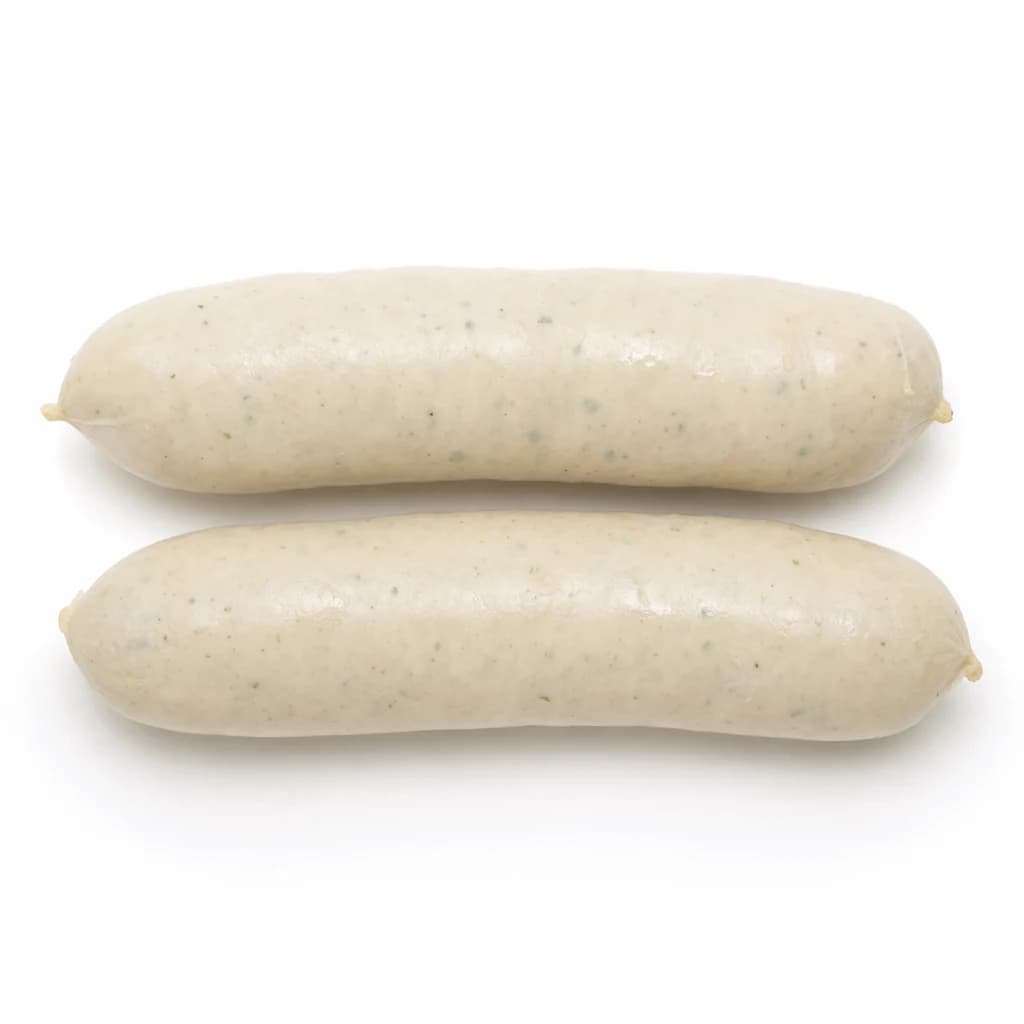
Two fresh Weisswurst sausages showing their pale ivory skin and plump cylindrical form.
Shows the reader the distinctive pale color and shape that makes Weisswurst immediately identifiable before cooking.
Proteins
White Sausage (Weisswurst)
Bavarian veal-and-pork sausage gently poached and eaten with sweet mustard and pretzels.
Weisswurst is a pale Bavarian sausage made from minced veal and pork back bacon, seasoned with parsley, lemon and cardamom. It is poached gently in hot water (never boiled) and traditionally eaten before noon with sweet mustard, soft pretzels and wheat beer. The skin is peeled away or sucked off rather than eaten.
Weisswurst is a fresh, pale-colored sausage from Bavaria made primarily from veal with pork and bacon fat. The ivory-to-white color is not accidental—it is the defining visual characteristic that distinguishes true Weisswurst from any other German sausage, achieved through the high proportion of veal in the blend. The spice profile is deliberately restrained: lemon zest, parsley, cardamom, and sometimes mace create a delicate, almost sweet flavor that would be overwhelmed by heavy smoking or curing. Unlike most German sausages that are grilled or pan-fried, Weisswurst is always gently poached in water at 70–80 °C; boiling causes the delicate pork-intestine casing to split and toughens the fine-textured meat. This cooking method, combined with the sausage's short shelf life (spoiling within 1–2 days refrigerated), explains why Weisswurst was historically made fresh each morning for the breakfast trade—a tradition that persists even today. The sausage exists in a narrow window between raw and cooked, and its quality is immediately apparent: properly made Weisswurst has a smooth, almost velvety interior and a tender casing that splits cleanly when bitten or cut.
- Measured in
- g
- Storage
- Fridge
Types & varieties
The original Munich style; mild with lemon, parsley, and cardamom; regional specialty
Slightly spicier with marjoram; Nuremberg-area variation
Franconian variety; often includes ginger; denser texture than Munich style
The Correct Way to Eat Weisswurst
Weisswurst has an eating protocol as specific as its preparation method. The traditional approach is to cut one end of the casing with a knife and fork, then squeeze the meat out onto your plate—the casing itself is not eaten. The meat is dipped into sweet Bavarian mustard (Bayernsenf) as it is squeezed out, and eaten with bites of a soft Brezn (Bavarian pretzel). This is not mere etiquette; the sausage is served in a bowl of its poaching water, and the clock starts the moment it leaves the heat. Weisswurst deteriorates within minutes of cooling, the casing becoming rubbery and the meat losing its delicate texture. This is why the tradition specifies eating them before noon—the meal must be fresh, and the tradition enforces that freshness.
- Cut one end of the casing, then squeeze the meat out onto the plate
- Dip the exposed meat into Bayernsenf as you squeeze
- Never eat Weisswurst cold or reheated—it is essentially ineditable in that state
Common uses
Tips & pitfalls
- Never boil white sausages; keep water at a gentle simmer (70–80 °C). Boiling causes the casing to split and the meat to toughen irreversibly
- Do not prick the casing before cooking—this releases fat and flavor and causes splitting. Only prick if the sausage is clearly overcooked and puffing
- Use a wide pot so sausages lie flat and single-layer, not stacked, for even heating throughout
- Test doneness with a probe thermometer: internal temperature should reach 68–70 °C
- Serve immediately after cooking; white sausages deteriorate within minutes of cooling, the casing turning rubbery
- If buying fresh, they should smell fresh and mildly sweet, never sour. Reject any with grayish discoloration or a slimy surface
- Sweet Bavarian mustard (Bayernsenf) is the correct condiment—sharp German Dijon is a poor substitute that overwhelms the delicate spice profile
- The traditional accompaniment is a soft Brezn (pretzel) and Obatzda, a Bavarian Camembert spread; sauerkraut is not served with Weisswurst
Nutrition
Energy
649 kJ · per 100 g
Where the calories come from
Protein
18.8g
38% DV
Carbs
0.5g
0% DV
Fat
8.1g
10% DV
Fiber
0g
0% DV
Sugars
0g
of which
Sodium
593mg
26% DV
Source · USDA FoodData Central · approx. Sausage, turkey, fresh, raw
View on FDC →In the shops
Matched grocery products
No matched grocery products for White Sausage (Weisswurst) yet.
Good to know
- Origin
- Munich, Bavaria, circa 1857; attributed to butcher Sepp Iber at the Schlachthof district
- Primary Meats
- Two-thirds veal, one-third pork by weight, with bacon fat for richness
- Color
- Pale ivory to white from high veal content; grayish discoloration indicates poor quality
- Typical Size
- 10–15 cm long, thumb-thick; each sausage weighs 80–100 g
- Casing
- Natural pork intestine, 28–32 mm diameter; far more delicate than smoked sausage casings
- Preparation
- Poached in simmering water (70–80 °C); never boiled, grilled, or fried
- Shelf Life
- 1–2 days refrigerated; spoils faster than cured or smoked sausages
- Traditional Timing
- Eaten before noon; the meal is called Weisswurstfrühstück ("white sausage breakfast")
- Difficulty
- Low; the single critical skill is temperature control during poaching
Substitutes
- Regensburger Weißwurst — Direct substitute with similar texture; slightly more assertively seasoned with marjoram
- Fresh veal bratwurst — Comparable mild veal flavor; must be poached, not grilled
- Fresh pork-and-veal mortadella (Mortadella vitellina) — Northern Italian equivalent; different spice profile but similar pale color and delicate texture
- American-style breakfast sausage links — Only in desperation; too heavily seasoned and lacks the lemon-cardamom character of true Weisswurst
Pairs with
Also called
Weißwurst · Bavarian White Sausage
Related
Egg
The kitchen's everything ingredient — bind, leaven, enrich, or fry
Chicken Breast
Lean, quick-cooking white meat for everyday dinners

Ground Beef
Versatile minced beef for burgers, ragù, tacos, and meatballs
Pork Loin
Lean, tender roasting cut that stays juicy with care
Salmon
Rich, rosy fish that roasts, grills, or cures beautifully

Egg White
Pure protein that whips to airy peaks for meringue and more
Egg Yolk
Rich, golden yolk for custards, mayonnaise, and pasta

Quail Egg
Tiny, speckled eggs for garnishing and elegant bites