Heat & Fire
Black Curry (Roasted Dark Simmer)
Dry-roasting spices until very dark, then simmering them into a deeply toasted Sri Lankan curry.
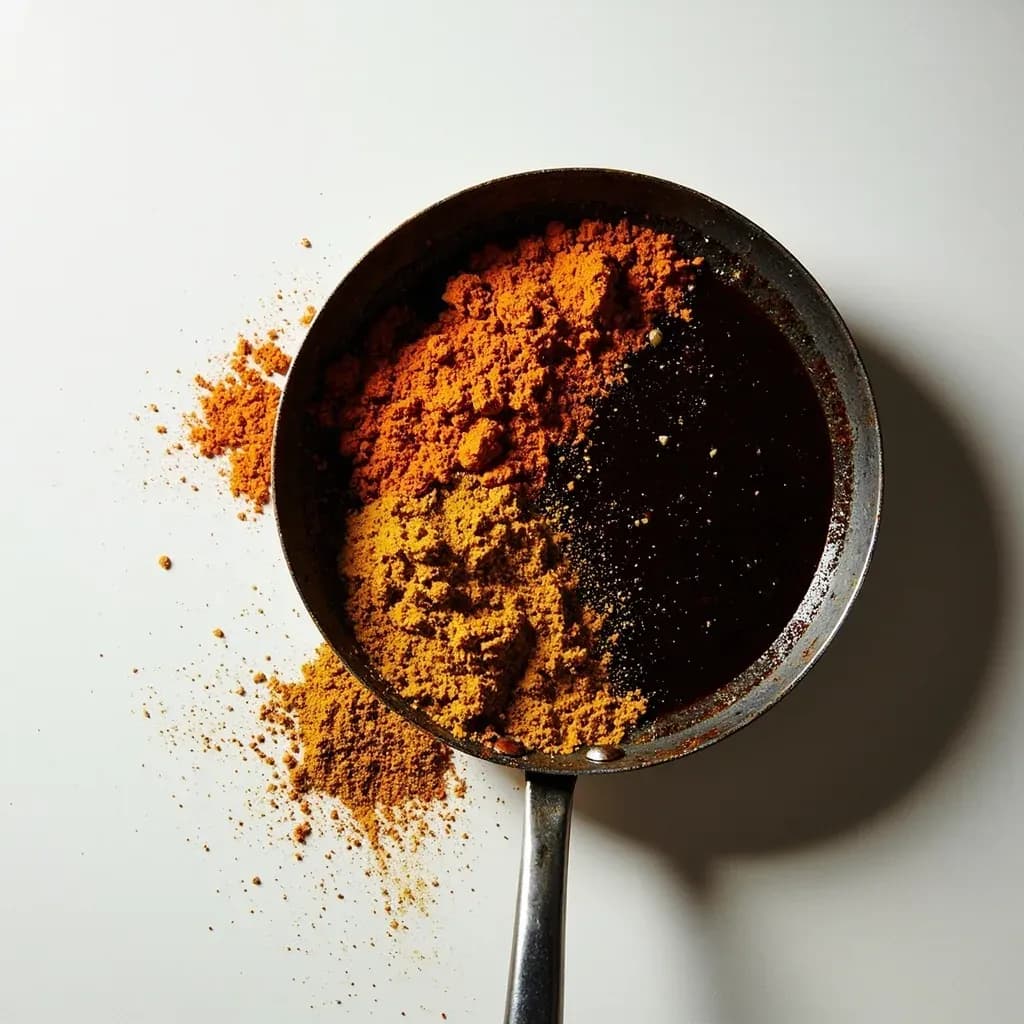
Black curry roasts whole spices, especially coriander, cumin, and curry leaves, until they turn dark brown and smoky before grinding and simmering them into the sauce. The signature dark roast, central to Sri Lankan cooking, gives the curry its near-black color and intense, earthy depth. Roasting must stop just short of burning, since over-charring turns the spices bitter.
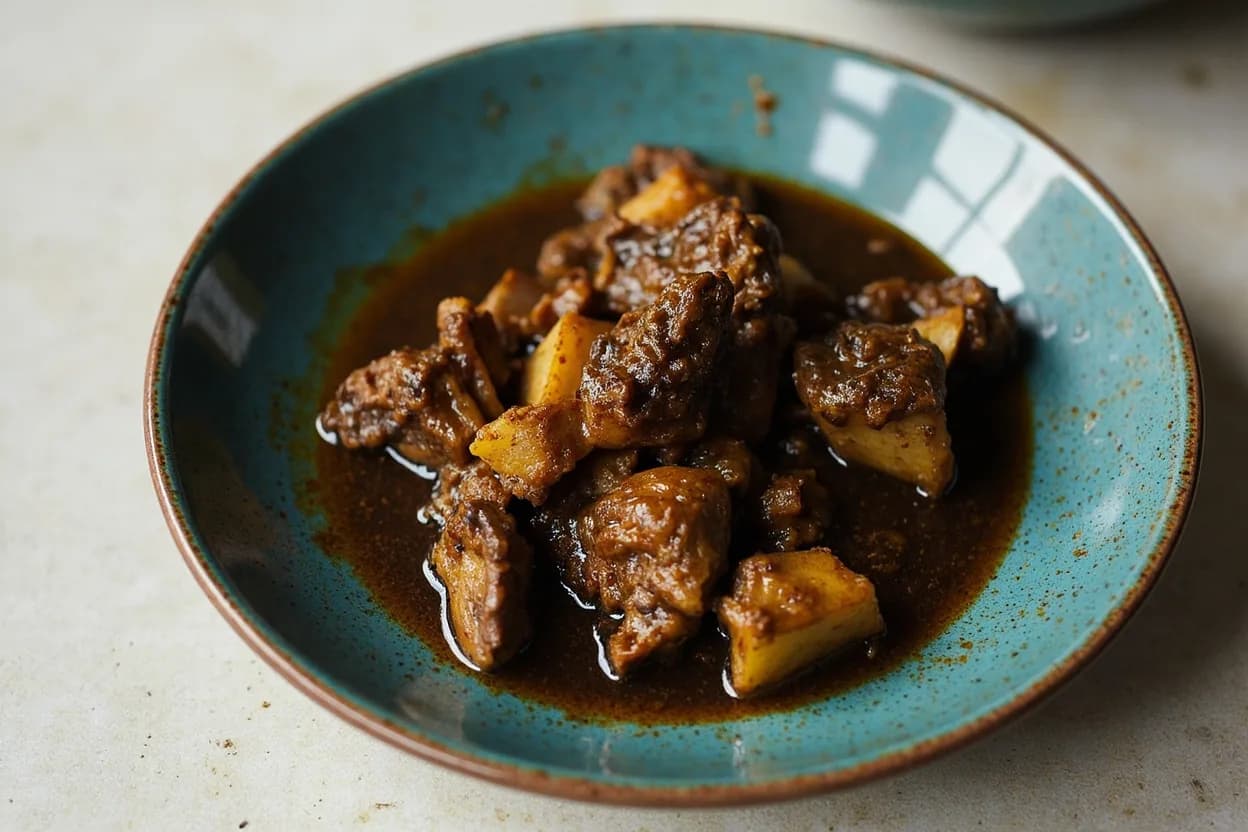
Black Curry, known in Sinhala as kalu pol ("kalu" = black, "pol" = coconut milk curry) and in English often as "burnt curry," is a Sri Lankan technique most closely identified with the Burgher community — descendants of Portuguese and Dutch settlers who married into local families and blended European pantry habits with South Asian spice practice. Its identity is a method rather than a recipe: whole spices are dry-roasted far past the point of ordinary toasting, ground to a coarse dark paste, fried in fat until the oil separates, and then simmered with protein and thick coconut milk until the sauce reduces to a glossy, near-black glaze. There is no soy sauce, no squid ink, and no dark additive at work in the pot; the blackness is the visible record of how aggressively the spices have been driven, and it is the central flavor decision of the cook.
The result is a curry that sits apart from the brighter, fresher "white" coconut curries of everyday Sri Lankan cooking. It is smoky, intensely aromatic, slightly bitter at the edges, and savory-sweet rather than fiercely hot — the warmth comes from black pepper and dried chili rather than from sharp fresh-chili capsaicin heat. That bitterness is not a flaw to be smoothed away but the flavor the dish is built around, and at the table it is balanced by sour, cooling sides: lime, a sharp coconut or cucumber sambol, or pickle. Most of the time in this technique is passive simmer; the real skill is concentrated in the first twenty minutes, in how confidently the cook roasts the spices and the paste.
Because the method is technique-driven, it travels well across proteins. Pork belly is the traditional anchor, but beef shank, tuna, and chicken thighs all yield a recognizable black curry, and the spice base is essentially the same. The dish also keeps and reheats gracefully, and many cooks argue it is better the second day, when the oils have settled back into the sauce overnight.
- Difficulty
- Medium
Types & varieties
The defining version; pork belly or shoulder simmered for roughly two hours until the skin is gelatinous and the sauce has turned almost black.
Beef shank or brisket; the long simmer that defines the technique is well suited to tougher cuts and gives the dish time to settle into its full depth.
Usually tuna, added late so the flesh holds together; the spice paste is built the same way but the cook time is short.
Reduced further than the soupy version until the sauce coats the meat like a thick, dark glaze — the preferred form for hoppers and short-eats.
A modern extension using chicken thighs, which tolerate the heavy roasted spice load better than breast meat.
A Burgher finish with extra slit chilies, a splash of vinegar, and a sweet-savory edge, leaning into the Chinese-influenced devilling tradition of the same community.
How to do it
- 1
Assemble and dry-roast the whole spices
Measure out the thuna paha components separately: cumin seed, fennel seed, coriander seed, black peppercorn, dried chili (stemmed and broken), cinnamon stick (broken short), cardamom pods (cracked), and cloves. Heat a heavy dry skillet over medium-low. Add each spice on its own and toast, tossing constantly, until it is very dark — the color of dark chocolate to nearly black — and smells sharply aromatic. Tip each spice onto a plate the instant it reaches color; residual heat will keep cooking it.
- 2
Toast the aromatics
In the same dry pan, lightly char a handful of fresh curry leaves (if using) until crisp at the edges, then dry-toast peeled garlic cloves, peeled ginger, and peeled small shallots (or red onion) until their surfaces blacken in spots. Combine with the roasted spices.
- 3
Grind to a coarse dark paste
Pound or pulse the roasted spices and aromatics in a stone mortar or spice grinder, adding a small splash of water or vinegar as needed, until you have a coarse, gritty, very dark paste. Do not blend to a smooth purée; the texture should be wet sand, not a sauce.
- 4
Bloom the paste in fat
Wipe the pan, add a generous amount of coconut oil or rendered pork fat, and heat until shimmering. Add the paste along with a slit green chili, a bruised and knotted lemongrass stalk, and a length of pandan leaf if using. Fry over medium heat, stirring and pressing, for 8–12 minutes. The paste is ready when it looks dry, the edges darken further, and oil visibly separates and pools at the edges of the pan.
- 5
Brown the meat in the paste
Pat the protein dry and season with salt. Add it directly to the bubbling paste and turn to coat thoroughly, searing on all sides until every surface is lacquered a deep brown. This step builds much of the color that gives the curry its name.
- 6
Add liquid and begin the slow simmer
Pour in thick coconut milk to come about two-thirds of the way up the meat, topping up with water if needed. Bring to a gentle boil, skim any surface foam, then reduce to a low, lazy simmer with the lid ajar or partially off so the sauce reduces as it cooks.
- 7
Simmer until tender and the sauce turns glossy and dark
Cook largely undisturbed for 1.5–2.5 hours depending on the protein: pork belly about 2 hours, beef shank up to 3 hours, tuna 15–25 minutes added near the end. Stir only in the final 20 minutes to prevent catching. The finished sauce should be thick, almost black, with a clear ring of reddish oil pooling at the edges.
- 8
Finish and rest
Lift out the lemongrass and pandan. Adjust the seasoning with salt, a small spoon of tamarind pulp for sourness, or a pinch of jaggery for roundness. Let the curry rest off the heat for 10–15 minutes so the oils reabsorb into the sauce. Garnish with crisp-fried curry leaves and a squeeze of lime just before serving.
Reading the roast
The single decision that determines whether black curry succeeds is how far the spices and paste are taken. Beginners almost universally under-roast out of caution, producing a grey-tan paste and a thin, one-dimensional curry. The visual targets are darker than feels comfortable: whole seeds should reach the color of dark chocolate before they are tipped from the pan, and the bloomed paste should look dry, almost crusty, with a clear ring of reddish oil separating at the edges of the pan. This is the moment of true doneness for the spice layer, and it is reached only by cooking each spice separately — bark and buds scorch easily, while seeds need longer — and by working at medium-low heat, not high. The bitterness that worries a new cook is the signature flavor; it is balanced later, not prevented now.
- Roast each spice on its own; do not combine them in the pan
- Tip spices onto a plate the moment they reach color — residual heat continues the cook
- Aim for dark chocolate to near-black on seeds; cinnamon and cloves go from aromatic to acrid in seconds
- The bloomed paste is ready only when oil visibly separates from it, not when it merely smells fragrant
How it fits the table
On a Sri Lankan or Burgher spread, black curry is the dark anchor against brighter players. It is the dish a cook reaches for when a meal needs a smoky, slow-cooked counterpoint to a light fish curry, a dhal, a fresh sambol, and rice. Because its flavors deepen overnight, it is also one of the better make-ahead curries in the repertoire — the kind of dish that goes onto the stove the day before a gathering and is reheated, briefly, just before serving.
- Anchor dish on a mixed rice-and-curry plate
- Make-ahead centerpiece that benefits from an overnight rest
- Filling for stuffed hoppers, bread, or short-eats
- Reheated gently, never boiled, to preserve the separated oil on top
Common uses
Tips & pitfalls
- Roast each whole spice separately — seeds darken in 2–4 minutes, while bark and buds (cinnamon, cloves, cardamom) scorch in seconds and need closer attention.
- The visual target is dark chocolate to near-black. A grey-tan spice paste will produce a thin, flat curry; the dish depends on going further than feels safe.
- Use a heavy pan (cast iron or carbon steel) for the dry-roast. Thin pans give uneven color and will scorch half the batch before the rest is ready.
- Add thick coconut milk only after the meat has browned in the paste; adding it earlier can split the milk and dull the roast.
- Salt the meat early so it seasons all the way through during the long simmer — salting only at the end leaves the interior of the meat underseasoned.
- Leave the pot partially uncovered during the simmer. A tight lid traps steam and prevents the sauce from reducing to the dark, glossy consistency that defines the dish.
- Finish with a squeeze of lime and a few crisp-fried curry leaves. The acid and herbal lift are not optional garnish; they are what make the heavy roast palatable at the table.
- Do not substitute pre-ground curry powder for the freshly roasted thuna paha. The dish is built on spices ground and toasted moments before cooking.
Good to know
- Origin
- Sri Lanka; closely associated with the Burgher (Eurasian) community whose cooking blends South Asian spices with Dutch and Portuguese pantry habits
- Also known as
- Kalu Pol, Kalu Kirihodi, or "Black Curry" / "Burnt Curry" in English
- Color source
- Dry-roasted spices and aromatics roasted until nearly charred; no soy, squid ink, or dark coloring additives are used
- Spice base
- Sri Lankan thuna paha — cumin, fennel, coriander, cinnamon, cardamom, cloves, black pepper, and dried chili — with curry leaves, garlic, ginger, shallot, and often pandan and lemongrass
- Traditional protein
- Pork belly or shoulder, often on the bone; beef shank, tuna, and chicken are common alternatives
- Doneness cue
- Oil visibly separates from the spice paste during the fry, and again pools at the edges of the reduced sauce
- Difficulty
- Moderate — technique-driven rather than ingredient-driven; the active work is short but unforgiving
- Best served with
- Steamed white rice, hoppers, pol sambol, lime pickle, and a sharp fresh coconut or cucumber sambol
Also called
Sri Lankan Black Curry · Roasted Curry
Dishes that rely on it
Related

Sear
Blast the surface hot for a deep-browned, savory crust

Sauté
Cook quickly in a little fat over lively heat, tossing as you go

Stir-Fry
Toss bite-sized pieces over roaring heat for fast, smoky cooking

Pan-Fry
Crisp food in a shallow layer of hot fat, turning once or twice

Deep-Fry
Submerge in hot oil for an all-over crackling crust

Roast
Cook uncovered in dry oven heat for browned edges and tender centers

Bake
Cook with steady, surrounding oven heat — the soul of bread and pastry

Broil
Hit food from directly above with fierce overhead heat