Heat & Fire
Dry-Roasting Spices
Toasting whole spices in a dry pan to deepen and unlock their aroma.
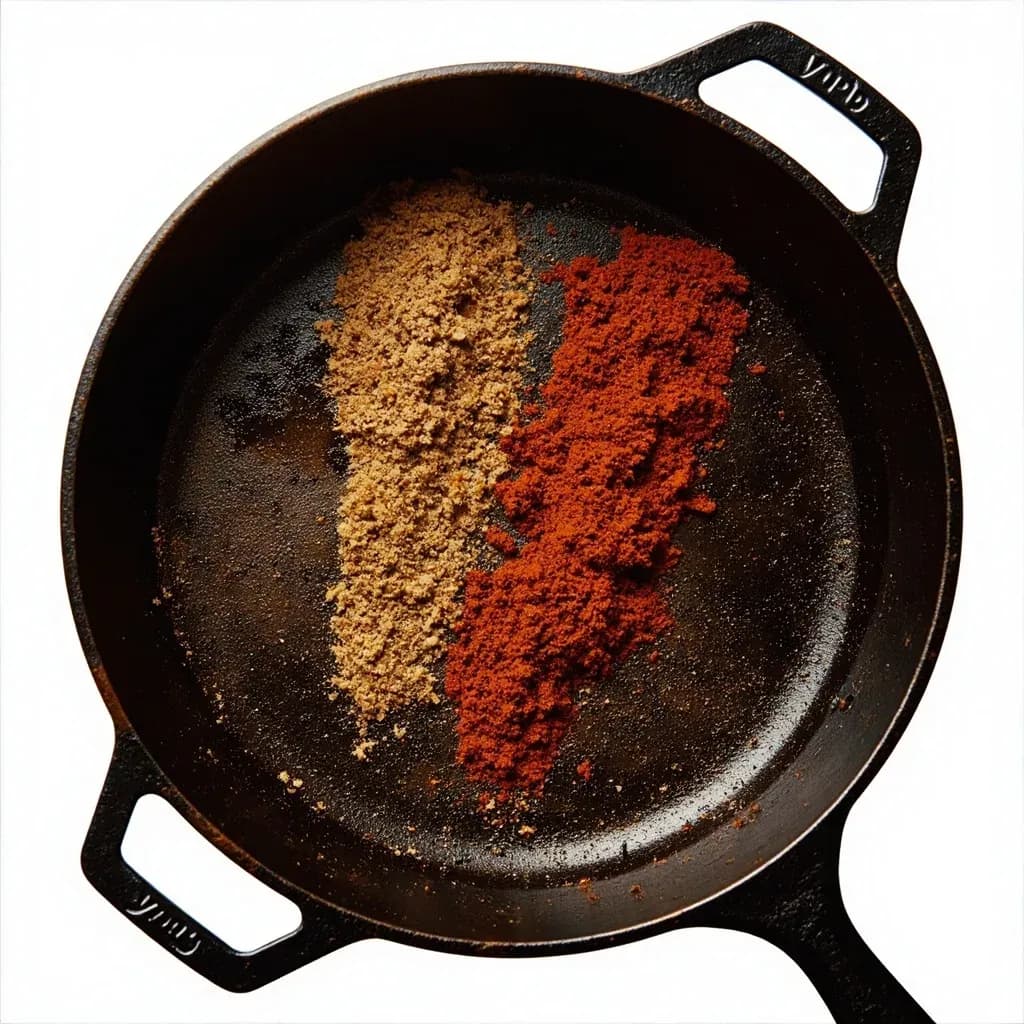
Dry-roasting heats whole spices in a dry skillet or comal with no oil until they darken slightly and turn fragrant. The heat drives off moisture and triggers reactions that bloom the spice's volatile oils, giving ground masalas like bhaja masala their toasty depth. Constant tossing over moderate heat prevents scorching, since burnt spices turn bitter in seconds.
Dry-roasting spices is the practice of heating whole, unground spices in a dry pan—without oil, butter, or any other fat—until their aroma deepens, their color shifts a shade or two darker, and their flavor sharpens from raw and papery to nutty, warm, and round. It is one of the oldest cooking techniques in the world, baked into the cuisines of the Indian subcontinent, the Horn of Africa, the Maghreb, the Levant, Mexico, and much of East and Southeast Asia, long before the cook's vocabulary had a word for it. The point is to drive off residual moisture and gently fracture the seeds' outer coats, releasing the volatile aromatic oils trapped inside—those oils carry most of a spice's character, from the citrusy lift of coriander to the smoky depth of cumin to the almost-sweet anise of fennel.
What changes in the pan is partly a dry form of the Maillard reaction and partly simple evaporation of water and lighter volatiles that mute flavor. Once those water-soluble compounds are gone, the remaining oils concentrate, and a secondary set of pyrazines and other aromatic molecules forms on the seed surface. The result is a spice that tastes more like itself, only louder and more dimensional. The technique is almost always applied to whole spices, not ground—powdered spice has too much surface area and burns in seconds, going from aromatic to acrid in the time it takes to turn around.
A common point of confusion: dry-roasting is the precursor to bloomed spices (tadka, tarka, tempering), but it is not the same thing. In tadka, you drop already-roasted or raw spices into hot ghee or oil, which extracts different fat-soluble compounds. Dry-roasting is the dry step that comes first, building the deeper, woodier notes that survive long cooking; bloomed spices are the bright, finish-of-cooking flourish. Many cooks skip dry-roasting and go straight to fat; the result is flatter.
- Difficulty
- Easy
Types & varieties
The benchmark dry-roasted spice; nutty, deeper, less bitter than raw
Roasting releases citrusy, floral notes; the sharp raw edge softens
Pop in the pan when ready; classic in South Indian tempering
Sweetness intensifies; common in Bengali and Italian cooking
Often gently crushed first; black cardamom takes longer and becomes smoky
Used sparingly; toast briefly, they burn fast
Sharp heat mellows into a warm, woody aroma
Shatter into pieces; woody and sweet when toasted
Becomes more licorice-forward; brittle after roasting
Toast cautiously—bitterness spikes if burned; a tiny amount is potent
Very small, burn quickly; a brief toss is enough
Tear into pieces; char slightly for smoky heat
Toast in seconds; watch constantly, they scorch fast
Nutty, oniony; quick toast brings out aroma
Common in Indian and Eastern European cooking; deepen in flavor
Often toasted together as the base of countless spice mixes
How to do it
- 1
Select and measure
Choose whole, dry spices. Pick over and discard any debris or broken pieces. If spices are dusty, a quick wipe with a dry cloth is enough—do not rinse, as moisture will cause sputtering and uneven toasting.
- 2
Heat the pan
Place a heavy-bottomed skillet (cast iron or clad stainless) over medium to medium-low heat. Let it warm for 1–2 minutes. The pan should be hot enough to sizzle a single seed on contact, not smoking.
- 3
Add spices in a single layer
Pour the spices in so they form one even layer across the pan surface. If you have more than a thin coating, work in batches—heaped spices steam rather than toast.
- 4
Toast with movement
Stir, toss, or shake the pan almost continuously. Watch for color change (1–2 shades darker) and, more importantly, the shift in aroma from raw and papery to rich, warm, and nutty.
- 5
Time it right
Most small seeds (cumin, mustard, ajwain) need 30 seconds to 1.5 minutes. Larger or denser items (coriander, cardamom pods, cinnamon pieces) may need 2–4 minutes. Cloves, fenugreek, and sesame are the fastest—pull them the moment they smell toasty.
- 6
Pull at the peak
Tip the spices onto a cool plate or into a bowl the instant they smell right. Do not leave them in the hot pan—carryover heat will push them past toasted into burnt.
- 7
Cool before grinding or storing
Spread on the plate to cool for several minutes. If grinding, do so only when fully cool; otherwise the heat steams the oils out and gums up the blades, and the flavor blurs.
- 8
Use or store
Use the roasted spices immediately for maximum impact, or seal in an airtight container away from light and heat. Whole roasted spices keep their lift longer than ground.
Why it works: a quick word on the science
Whole spice seeds are tiny capsules. Their hard outer shells lock in volatile oils and a small amount of water. Heat the seed and two things happen at once. First, the internal water evaporates and escapes through micro-fissures in the hull, taking some of the lighter, sharper-smelling volatiles with it—those are the compounds that read as raw, green, or "raw-vegetable" in a fresh seed. Second, once the surface temperature climbs above about 140 °C / 285 °F, the Maillard and pyrolysis reactions on the seed coat generate a second wave of aromatic molecules, the pyrazines and furans responsible for roasted, nutty, almost coffee-like notes. Cumin's signature warmth, for example, comes from a pyrazine called 2-methoxy-3-sec-butylpyrazine, which is barely present in raw seed and explodes in concentration after a minute in a hot pan. The trick is to do enough of the first reaction to lose the raw edge, and just enough of the second to get the toasted character—without driving the surface into actual carbonization, which produces the bitter, acrid compounds that ruin a dish.
- Whole seeds protect their oils; ground spices expose them and burn in seconds.
- Color change is a real but inconsistent cue—each spice darkens at its own rate.
- Smell is the most reliable signal: the moment flat, papery aroma turns warm and rounded, pull the pan.
- Carryover heat in the pan will keep cooking the spices for 15–30 seconds after you turn off the burner.
Dry-roasting vs. bloomed spices (tadka)
These two techniques are often described as the same thing, but they are sequential steps, not substitutes. Dry-roasting drives off water and generates pyrazines; blooming in fat extracts fat-soluble compounds (carotenes, fixed oils, certain aldehydes) and gives the spice a glossier, more savory finish. Most Indian and Sri Lankan dishes use both: dry-roast the whole spices first to deepen the base, then add them to the dish, then finish with a fresh tadka of raw or pre-roasted spices bloomed in ghee or oil at the very end. The final tadka is bright; the dry-roasted base is deep.
- Dry-roasting = dry pan, whole spices, deeper nuttier notes.
- Blooming (tadka) = hot fat, often ground or broken spices, brighter finish.
- They are complementary, not interchangeable.
- Skipping the dry step and going straight to fat gives a one-dimensional result.
Common spice combinations by tradition
Certain pairings repeat across regions because they balance each other—warm with cool, sharp with sweet, dense with quick. Knowing the canonical pairings makes it easier to improvise.
- North Indian base: cumin + coriander + black pepper + cardamom (the spine of garam masala).
- South Indian tempering: mustard seeds + urad dal + curry leaves + dried red chili.
- Ethiopian berbere: dried chilies + coriander + fenugreek + ajwain + cardamom.
- Moroccan ras el hanout: cumin + coriander + cinnamon + black pepper + ginger + turmeric.
- Chinese five-spice: star anise + cloves + cinnamon + Sichuan pepper + fennel.
- Mexican adobo precursor: cumin + coriander + black pepper + dried chili + cloves + cinnamon.
Common uses
Tips & pitfalls
- Use medium to medium-low heat; high heat scorches the surface before the inside warms through, leaving a bitter core and a burnt exterior.
- A heavy-bottomed pan (cast iron or clad stainless) prevents hot spots that cause uneven browning. Avoid nonstick if possible—the dark coating hides color cues and the spices can sit on a slick surface without the slight friction that helps even toasting.
- Spread the spices in a single layer so every seed contacts the pan evenly. A heaped panful steams rather than toasts.
- Stir, toss, or shake the pan constantly once you add spices. The difference between toasted and burnt is often just 10–20 seconds.
- Trust your nose more than your eyes. Smell the change from raw and flat to rich and toasty. Visible smoke is a sign you have overshot.
- Have a cool plate or bowl ready next to the stove and transfer the spices the moment they are done. The residual heat of the pan will continue cooking them.
- Toast whole, not ground. Ground spices have far more surface area and burn almost instantly, going from aromatic to acrid before you can respond.
- Different spices roast at different rates. Toast denser seeds (coriander, cumin) separately from fragile ones (cloves, fenugreek, sesame) so you can pull each at its own peak.
- If a batch burns, do not try to salvage it. Burnt aromatics are bitter and will dominate the dish. Toss and start over.
Good to know
- Also called
- Dry-toasting; the first stage of tempering (tadka) when followed by fat
- Equipment
- Heavy-bottomed skillet, cast-iron pan, or comal
- Heat level
- Medium to medium-low
- Typical time
- 30 seconds to 4 minutes, depending on spice density and size
- Form used
- Whole spices preferred; ground spices scorch in seconds
- Cuisines
- Indian, Sri Lankan, Ethiopian, North African (Moroccan), Middle Eastern, Mexican, Southeast Asian
- Storage of finished spices
- Airtight container, cool, dark; whole roasted spices keep 6–12 months, ground 1–3 months
- Sensory cue
- Spice becomes noticeably more aromatic and may darken 1–2 shades; visible smoke means stop
- Origin
- Ancient; predates written records in spice-using cultures; documented in Ayurvedic and Mesopotamian texts
Also called
Dry Roasting Spices (Bhaja Masala) · Toasting Belacan · Comal Toasting Seeds · Dry Spice Roasting
Dishes that rely on it
Related

Sear
Blast the surface hot for a deep-browned, savory crust

Sauté
Cook quickly in a little fat over lively heat, tossing as you go

Stir-Fry
Toss bite-sized pieces over roaring heat for fast, smoky cooking

Pan-Fry
Crisp food in a shallow layer of hot fat, turning once or twice

Deep-Fry
Submerge in hot oil for an all-over crackling crust

Roast
Cook uncovered in dry oven heat for browned edges and tender centers

Bake
Cook with steady, surrounding oven heat — the soul of bread and pastry

Broil
Hit food from directly above with fierce overhead heat