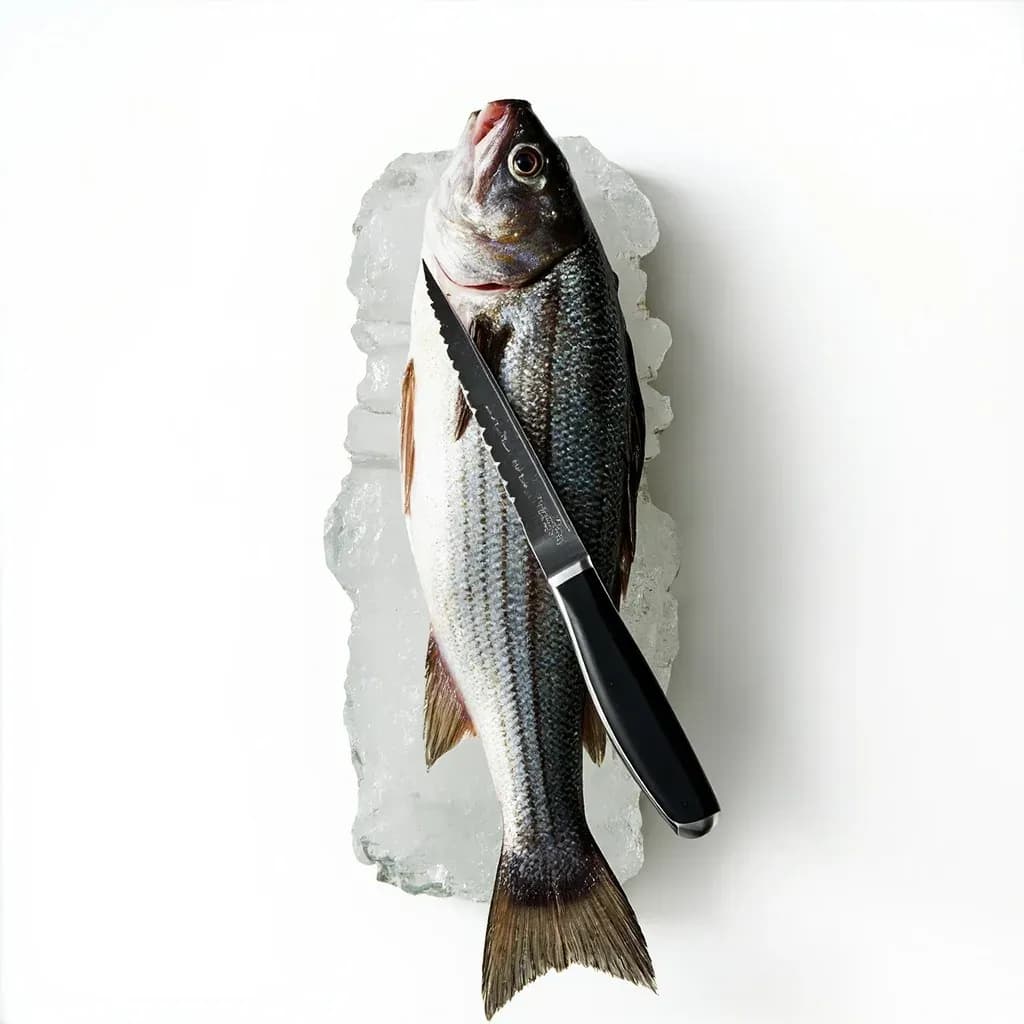
Prep & Assembly
Bleeding Fish
Draining blood from a freshly killed fish to keep the flesh clean-tasting and slow to spoil.
Bleeding fish removes blood right after the catch by cutting the gills or arteries and letting it drain, often in ice water. It is paired with ikejime, where a spike kills the brain instantly to prevent stress and preserve quality. Clean flesh keeps a milder flavor and firmer texture and resists spoilage longer. This handling is prized in sashimi and high-grade fish cookery.
Bleeding is the first thing done to a fish after it is killed and long before it reaches the cutting board. A sharp cut to the gills, the caudal vein behind the anal fin, or the throat opens the circulatory system so that gravity and the surrounding water can flush blood from the capillaries of the flesh. Within seconds, the dark bloodline along the spine begins to fade, and the fillet you eventually lift off the fish is paler, cleaner, and slower to spoil.
The practice matters most for fatty or heavily vascularized species — tuna, salmon, yellowtail, mackerel, mahi-mahi, swordfish, bluefish, striped bass, and snapper — where residual blood carries a metallic note and darkens the flesh within hours. It also matters in hot climates, where warm blood speeds bacterial and enzymatic breakdown faster than ice alone can counteract. Done correctly, bleeding reduces off-flavors, lifts the dark bloodline cleanly away from the spine when you later trim the loin, and buys you hours of extra shelf life at the same temperature.
Bleeding is not a substitute for gutting and icing, but it is the necessary first step. A fish that is bled in a salt-water bath, gutted within a couple of hours, and held at or below 4 °C (39 °F) will out-perform an identical fish that was simply killed and chilled — visibly in the color of the flesh, and unmistakably in the taste.
- Difficulty
- Hard
Types & varieties
Slice across one or both gill arches where the gill cover meets the throat, severing the branchial arteries. The most common method for freshwater fish and small saltwater species; the fish is then submerged in ice brine or hung head-down.
A shallow 1–2 cm cut along the belly midline just behind the anal fin severs the caudal vein running along the spine. Preferred for large pelagics like tuna and billfish, often used together with a gill cut for faster drain.
A spike or thin knife to the brain paralyzes the fish instantly (the 'nerve kill'), after which the caudal cut is made. Standard on Japanese tuna boats for premium sashimi; yields the firmest flesh and the longest shelf life.
Drive a gaff point or thin knife through the throat toward the heart to puncture the heart and great vessels. Common on sportfishing boats landing tuna and billfish at the rail.
The fish is placed directly into a bucket of ice-cold seawater or light salt brine and the gills are cut while submerged; the brine prevents clotting and pulls blood out faster than a freshwater bath.
How to do it
- 1
Prepare the bleed station
Fill a clean bucket halfway with crushed ice and top it up with seawater or fresh water mixed with about 1 tablespoon of table salt per liter. Place it within arm's reach of where the fish will be landed. Have a sharp, thin-bladed knife (boning or fillet knife works well) ready, plus a second bucket of plain ice water for the post-bleed chill.
- 2
Land the fish quickly and keep it wet
Bring the fish over the gunwale or net it without delay. Keep it in the water or wet it with seawater right up to the moment of the cut — stress, thrashing, and slime loss all reduce the efficiency of the bleed. Avoid tossing the fish onto a hot, dry deck.
- 3
Make the gill cut
Lay the fish on its side. Slice firmly across one or both gill arches at the junction of the gill cover and the throat, severing the branchial arteries. For small fish, one side is enough; for large pelagics, cut both sides for a faster drain.
- 4
Or make the caudal cut
Flip the fish upside down. With the knife tip, make a shallow 1–2 cm cut along the belly midline just behind the anal fin, deep enough to nick the caudal vein running along the spine. Do not penetrate into the gut cavity.
- 5
Bleed out in the brine
Immediately submerge the fish in the ice-brine bucket or hang it head-down over the side. Blood should flow steadily — bright red at first, then darkening. Small fish need 2–5 minutes; medium fish 5–10 minutes; large tuna 15–30 minutes.
- 6
Rinse and chill
Lift the fish out, rinse the gill area and body cavity with clean cold water, and transfer it to the plain-ice bucket. The flesh is now drained, the bloodline is set, and the fish can be gutted, filleted, or packed on ice for transport.
- 7
Gut promptly
Within a couple of hours at most, make a shallow belly incision from vent to gills, remove the entrails, and trim out the dark bloodline running along the spine. Re-ice the cleaned fish to below 4 °C (39 °F) as quickly as possible.
Bleeding versus ike-jime
Ike-jime is the rigorous Japanese extension of bleeding and is worth understanding on its own terms. A spike is driven into the brain, which destroys the central nervous system; the fish goes instantly limp, ATP in the muscles is preserved instead of being burned through stress and thrashing, and rigor sets in much more slowly. The caudal cut then follows, draining the now-still blood. The payoff is a fillet that stays firm and translucent for days longer than one from a stressed, thrashing fish, with far less lactic-acid buildup and a much-reduced bloodline to trim out.
For everyday table fish — a trout from the river, a snapper from the pier, a farmed salmon — a straightforward gill cut into a salt-water bath is plenty. The brain spike becomes meaningful when the fish will be eaten raw, served as sashimi, or held for several days on ice before cooking.
- Ike-jime requires a sharp spike and a practiced aim at the brain case — slightly off and you only stun the fish.
- For salmon and steelhead intended for gravlax or sashimi, ike-jime + caudal bleed produces a noticeably cleaner cure.
- Some charter operations now offer ike-jime as an upgrade for an extra fee; the result is visible in the finished plate.
Why saltwater, not fresh
Fish cells and skin are isotonic with seawater, not fresh. Drop a freshly killed fish into a freshwater bath and osmotic pressure drives water into the cells, rupturing them at the surface and giving the skin a pale, waterlogged look and the flesh a soft, mushy bite. A 2–5% salt bath (roughly 1 tablespoon table salt per liter) keeps the cells stable while still allowing blood to diffuse out into the surrounding liquid.
Common uses
Tips & pitfalls
- Keep the knife razor-sharp — a dull blade crushes the artery instead of slicing it open, and bleed-out volume drops sharply.
- Have the ice-brine bucket ready before the fish hits the deck; the gap between capture and cut should be measured in seconds, not minutes.
- Use salted water or seawater in the bleed bucket; fresh water ruptures skin cells and leaves the flesh waterlogged and mushy.
- On large tuna, combine a gill cut with a caudal cut — both cuts drain in parallel and finish the fish in half the time.
- Avoid slicing into the gut cavity when cutting the gills; a nick into the stomach will spill enzymes and taint the flank.
- For clean salmon fillets, bleed the fish within one minute of netting and leave it on ice for at least 30 minutes before scaling and gutting — the bloodline sets and lifts away cleanly when trimmed.
- Don't pour the bleed water overboard at anchor or in a popular spot; the blood trail attracts sharks and seabirds.
- Bleeding is the first step, not the whole job — gut and ice the fish immediately after bleed-out, otherwise the benefit is lost to bacterial growth from the gut.
Good to know
- Purpose
- Drains blood from a freshly killed fish to improve flesh color, reduce metallic off-flavors, slow enzymatic and bacterial spoilage, and firm the texture for sashimi-grade fish.
- Best candidates
- Fatty, warm-blooded, or heavily vascularized species: tuna, salmon, yellowtail, mackerel, mahi-mahi, swordfish, bluefish, striped bass, snapper.
- Time window
- Ideally within 30 seconds to 2 minutes of capture; the faster the cut, the more complete the bleed.
- Recommended water
- Ice-cold seawater or a 2–5% salt slurry; freshwater causes osmotic bruising and a waterlogged, mushy texture.
- Bleeding duration
- Small fish 2–5 minutes; medium (1–3 kg) 5–10 minutes; large tuna 15–30 minutes of active bleeding.
- Temperature
- Fish must be held at or below 4 °C (39 °F) during and after bleeding; in tropical waters, add ice to the bleed bath immediately.
- Related Japanese method
- Ike-jime paralyzes the fish with a brain spike before bleeding, preserving ATP and producing the firmest sashimi flesh.
- Difficulty
- Low with a sharp knife; the main risks are cutting into the gut cavity or crushing, rather than slicing, the arteries with a dull blade.
Also called
Spike Brain-Killing (Ikejime) · Ikejime
Related

Whisk
Beat ingredients smooth and aerated with a looping wire motion

Sift
Pass dry ingredients through mesh to aerate and remove lumps

Strain
Pour through mesh to separate solids from liquid for a smooth result

Filter
Pass liquid through fine material to clarify out the smallest particles

Rice
Press cooked potatoes through small holes for fluffy, lump-free texture

Mash
Crush soft cooked food into a rustic, creamy purée

Grind
Crush food into a coarse to fine texture, from spices to meat

Grate
Shred food into fine bits against a sharp-toothed surface