Prep & Assembly
Coconut Milk Extraction
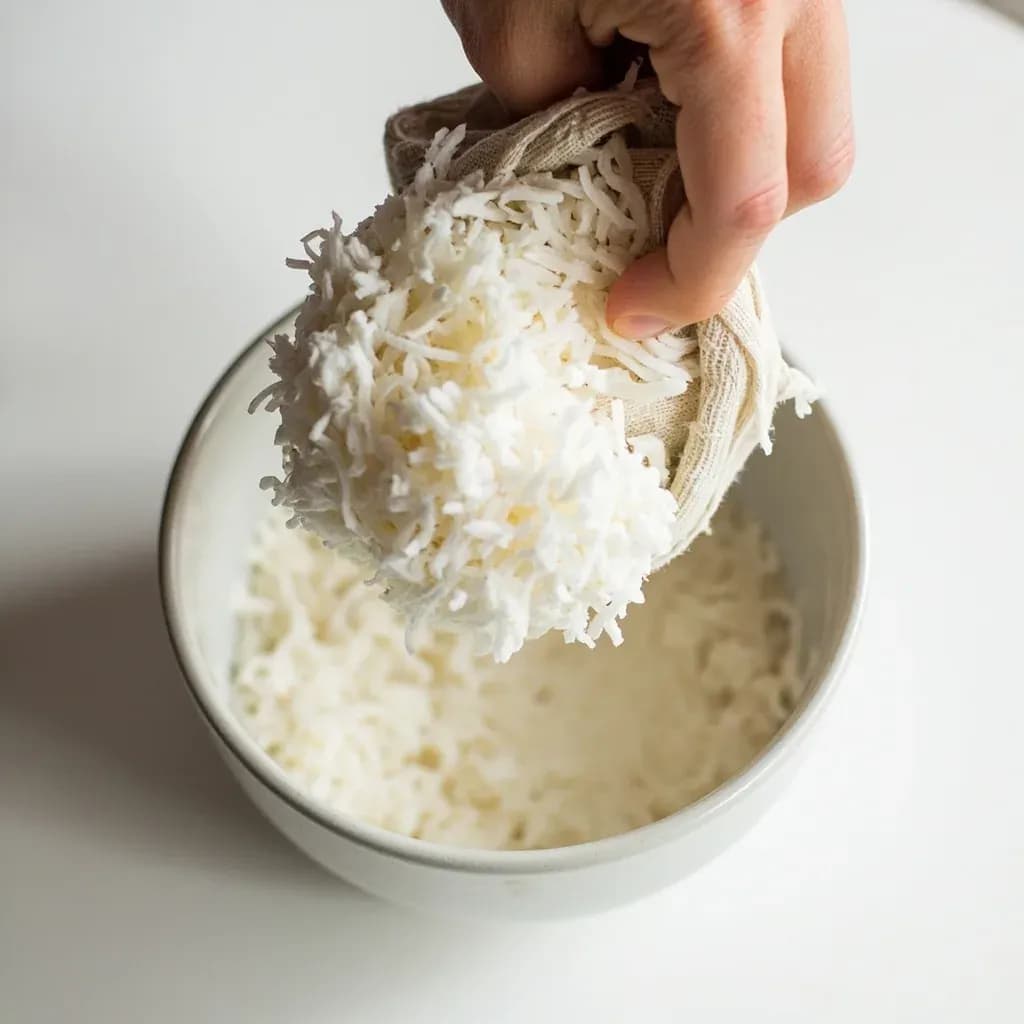
Squeezing grated coconut with water to press out rich coconut milk and cream.
Coconut milk extraction grates or grinds mature coconut flesh, mixes it with warm water, then squeezes and strains the mash to release creamy coconut milk. The first, undiluted press yields thick coconut cream, while later presses give thinner milk for curries, soups, and desserts. Straining through cloth removes the fibrous pulp for a smooth liquid.
Coconut milk extraction is the process of steeping finely grated mature coconut flesh in warm water and pressing it out to release the oil-rich liquid that forms the base of cuisines from South India to the Caribbean, from Thailand to coastal West Africa. Cooks extract their own milk because fresh milk has a brighter, more floral aroma and a cleaner fat profile than most canned products, which are often stabilized with guar gum and have been heat-processed. The technique is also economical in coconut-growing regions, where every part of the nut — water, cream, thin milk, and the leftover pulp (ampas) — is put to use in curries, rice, sweets, and condiments.
At its heart, the method is a two-stage press. The first steep with minimal water draws off the densest, highest-fat liquid — santan kental or coconut cream — which is reserved for finishing and enriching. A second steep with more water draws off a thinner, lower-fat liquid used as a cooking medium. Yield and richness are governed by four variables: the maturity of the nut, the fineness of the grate, the temperature of the water, and the resting time before pressing. Mature brown coconuts, very fine grating, water at 60–80 °C / 140–175 °F, and a 10–15 minute steep together maximize both volume and fat content. Cold water yields a cleaner, less greasy milk suitable for drinks and raw preparations; boiling water muddies the flavor and can drive the emulsion unstable.
The technique scales easily. A traditional cook with a bench scraper, wooden stool, and cheesecloth produces a liter of milk in about half an hour; a modern cook with a blender and nut-milk bag produces the same in under fifteen minutes from desiccated coconut. Either way, the result is a delicate emulsion of coconut oil, water, and protein that separates on standing and should be handled gently — never boiled hard, never over-blended — to keep its silken body intact.
- Difficulty
- Easy
Types & varieties
Grated coconut steeped briefly with minimal warm water; produces a rich, spoonable cream reserved for finishing curries and desserts.
The same pulp re-soaked with more water and squeezed again; lighter in fat, used as the cooking liquid in soups, curries, and rice.
From mature brown coconuts; brightest aroma and highest oil content, the traditional benchmark.
Rehydrated unsweetened dried coconut blended with hot water; convenient and consistent, slightly less fragrant, widely used outside the tropics.
Soak and blend with cool or room-temperature water; cleaner flavor and lower yield, favored for beverages and raw preparations.
How to do it
- 1
Crack and prepare the coconut
Select a heavy mature brown coconut. Pierce the soft eye, drain and reserve the water, then crack the shell with the back of a cleaver or a hammer and lever the halves apart. Pry the white meat loose with a blunt knife, rinse it, and peel off the brown skin if you want a whiter milk.
- 2
Grate the meat
Finely grate the meat. A traditional bench scraper (Thai makraab, Vietnamese mài dừa, or Indian kaddura) held over a wooden stool gives the classic wet, fluffy texture; a box grater or the fine disc of a food processor also works. Aim for a fine grate, not a paste.
- 3
First press — make the cream
Place the grated coconut in a bowl and pour warm (not boiling) water over it at roughly a 1:1 ratio by volume. Stir, then let it steep 10–15 minutes so the water penetrates the cells. Transfer to a nut-milk bag or a colander lined with doubled cheesecloth set over a pot and squeeze firmly in small fistfuls. The liquid that runs out is santan kental — the thick coconut cream.
- 4
Second press — make the thin milk
Return the squeezed pulp (ampas) to the bowl, add more warm water at a 1:2 to 1:3 ratio to the original coconut volume, stir, and steep another 10 minutes. Strain and squeeze again; this is santan encer, the thin coconut milk used as a cooking liquid.
- 5
Rest, separate, and store
Combine or keep the two grades separate according to the recipe. Let the milk rest 10–20 minutes; the cream will rise. Skim if you want a separate cream layer, or stir back in for a uniform milk. Refrigerate immediately in a sealed jar for up to 3–4 days, or chill fully, then freeze in flat bags or ice-cube trays for up to 2–3 months.
- 6
Quick blender method (modern)
For each 1 cup (≈90 g) unsweetened desiccated coconut, add 2 cups hot (not boiling) water to a blender. Blend on high for 60–90 seconds, then steep 10 minutes. Strain through a nut-milk bag, pressing firmly. The first pass is the thick milk; rehydrate the pulp with another 1–1.5 cups water and blend again for the thinner second press.
Understanding the two grades
Most traditional kitchens treat the first and second press as separate ingredients rather than two halves of one product. Knowing the difference is what lets a curry finish glossy and rich instead of thin and watery.
- First press (santan kental) is added at the end of cooking, swirled in off the heat, or used to carry spices in a paste. It thickens as it cools and will split if boiled hard.
- Second press (santan encer) is the workhorse cooking liquid — it can be simmered, reduced, and used to braise proteins and cook rice without breaking the emulsion prematurely.
- If a recipe calls for only thin milk, reserve the cream that rises after refrigeration and skim it off for another use; if it calls for only cream, pour the second-press water back over the pulp to keep the volume up.
Choosing and opening a mature coconut
The quality of the milk is decided before you touch a knife. A young, green coconut has thin, jelly-like flesh that yields almost no fat; a fully mature brown coconut has the thick, oily meat you need.
- Pick a heavy coconut for its size — weight means more water and more meat. Shake it: you should hear a slosh of water inside.
- Pierce the softest of the three eyes with a skewer or screwdriver and drain the water; reserve it to replace part of the soaking water for a deeper, slightly sweet milk.
- Crack the shell with the back of a cleaver or a hammer, rotate, and tap again to split it cleanly. Lever the meat free with a blunt knife.
- Peel off the brown skin with a vegetable peeler for a whiter, milder milk, or leave it on for a more rustic, nuttier extract.
Common uses
Tips & pitfalls
- Use warm, not boiling, water — boiling muddies the flavor and destabilizes the emulsion into a greasy, broken slurry.
- Do not over-blend: 60–90 seconds is enough; over-processing shears the fat globules and produces a separated, oily milk.
- Let the blended or steeped mixture rest 10–15 minutes before straining so the fat can re-emulsify into the water.
- Squeeze in small batches through a nut-milk bag or doubled cheesecloth; twisting the bag with a wooden spoon is faster and stronger than hand-squeezing.
- Substitute the reserved coconut water for part of the soaking water to deepen the flavor with a slight, natural sweetness.
- Chill the finished milk to separate the cream, then skim the cream for finishing and use the skim for curries and rice — this gives you both grades from one extraction.
- Toast the grated coconut lightly in a dry pan before steeping for a deeper, nuttier extract common in Indonesian and Malaysian cooking.
- Stop at two presses: by the third steep the protein and fiber have swollen and clogged the cloth, and almost no usable milk comes out.
- Never boil the finished cream hard — bring it to a bare simmer and finish dishes off the heat to keep the body silky.
- A light pinch of salt before freezing stabilizes the emulsion and seasons the milk for curry work straight from the freezer.
Good to know
- Origin
- Ancient practice across tropical South and Southeast Asia, the Pacific Islands, the Caribbean, and coastal Africa wherever mature coconuts are harvested
- Best coconut
- Mature brown coconuts (11–12 months old); flesh is thick, oily, and aromatic
- Two grades
- First press = santan kental / coconut cream at roughly 20–25% fat; second press = santan encer / thin coconut milk at roughly 5–10% fat
- Typical yield
- 1 medium mature coconut (≈400 g meat) yields roughly 1–1.5 cups thick milk plus 1–1.5 cups thin milk; 1 cup (≈90 g) unsweetened desiccated coconut yields about 2–2.5 cups total milk
- Water temperature
- Warm (60–80 °C / 140–175 °F) extracts significantly more fat than cold; boiling muddies flavor and destabilizes the emulsion
- Steeping time
- 10–20 minutes of resting after the water is added markedly increases yield and helps the fat re-emulsify into the water
- Coconut-to-water ratio
- Roughly 1:1 to 1:2 by volume for thick milk; 1:3 or more for thin milk
- Storage
- Refrigerated in a sealed container, 3–4 days; freezes well for 2–3 months once fully chilled
Also called
Extracting Coconut Milk · Squeezing Coconut Milk · Memeras Santan · Coconut Cream Extraction
Dishes that rely on it
Related

Whisk
Beat ingredients smooth and aerated with a looping wire motion

Sift
Pass dry ingredients through mesh to aerate and remove lumps

Strain
Pour through mesh to separate solids from liquid for a smooth result

Filter
Pass liquid through fine material to clarify out the smallest particles

Rice
Press cooked potatoes through small holes for fluffy, lump-free texture

Mash
Crush soft cooked food into a rustic, creamy purée

Grind
Crush food into a coarse to fine texture, from spices to meat

Grate
Shred food into fine bits against a sharp-toothed surface