Prep & Assembly
Crushing Potatoes
Lightly smashing cooked potatoes to crack them open for crisper roasting or finishing.
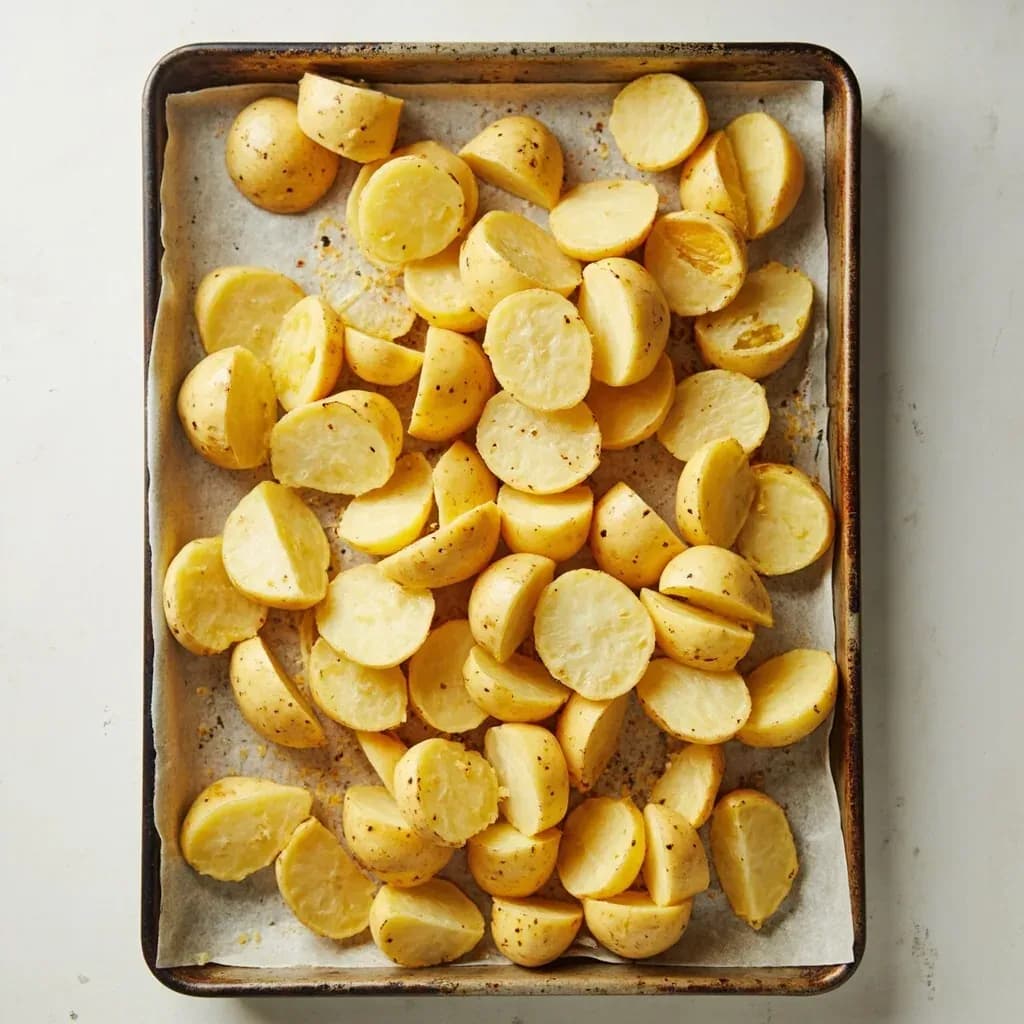
Crushing potatoes presses or cracks boiled potatoes just enough to break the skin and expose craggy flesh, as in Greek patates antinahtes. The rough, opened surface crisps far better when roasted or pan-finished and soaks up oil, herbs, and seasoning. Unlike mashing, the potato stays largely whole with a rustic, textured surface. A glass, a fork, or the palm does the job.
Crushing potatoes is a finishing move that turns already-tender boiled potatoes into rough, craggy discs with deep golden edges and a fluffy interior. It sits deliberately between roasting and mashing: the potato keeps its identity as a single piece, but its smooth skin is broken open so fat, salt, and heat can work their way into every fissure. The result is a side dish that delivers both a shattering crust and a pillowy middle in the same bite — something neither a roasted potato nor a mash can manage on its own.
The technique is forgiving, but the choice of potato is not. Waxy, small, thin-skinned varieties — baby Yukon Gold, baby red, fingerling, new potatoes — hold together under pressure and crack cleanly, exposing the buttery flesh without disintegrating. Floury russets and large bakers will technically crush, but they tend to crumble into rustic shards rather than tidy coins, which is fine for some preparations and a mess in others. The other non-negotiable is the hot-pan, hot-oil contact: a screaming sheet pan with shimmering fat is what blisters the bottom of each piece into a crust that simply cannot form in a regular roast.
Done well, crushed potatoes are a weeknight workhorse and a dinner-party trick at once. The boiling is hands-off, the smashing takes about a minute, and the oven does the rest. Most of the flavor lives in whatever fat and aromatics you toss them with, so the technique is a flexible canvas — equally at home under a roast chicken, beside a fried egg, or dunked into aioli at a bar.
- Difficulty
- Easy
Types & varieties
Boiled baby potatoes, drained, lightly crushed with butter, salt, and parsley; often served under fish or roast meat.
American sheet-pan style; boiled baby Yukon Golds crushed flat with a glass, drenched in olive oil, roasted hot, finished with flaky salt and rosemary.
Tiny potatoes left whole, smashed to expose buttery interiors; elegant for plating.
Smashed with crushed roasted garlic and olive oil; finished with grated Parmesan in the last few minutes.
Crushed after par-boiling, then roasted with olive oil, lemon, oregano, and chicken stock for braised-then-crisped edges.
American diner version; finishes with sour cream, butter, fresh chives, and crisp bacon.
Eastern European Jewish-influenced; rendered chicken fat and caramelized onions for richness.
How to do it
- 1
Choose and prep the potatoes
Pick small, waxy potatoes (1.5–2 inches / 4–5 cm) — baby Yukon Gold, baby red, or fingerlings. Leave skins on for texture and flavor. Rinse and trim any bruised spots; no need to peel.
- 2
Boil until just tender
Place in a wide pot, cover with cold salted water (about 1 Tbsp kosher salt per quart / liter), and bring to a boil. Simmer 15–20 minutes until a paring knife meets no resistance at the center but the potato still feels intact.
- 3
Drain and steam-dry
Drain in a colander, then return the potatoes to the empty pot set over the turned-off burner for 1–2 minutes. Toss gently so the surfaces matte and any clinging water evaporates.
- 4
Heat the pan and oven
Set an oven rack in the upper third and preheat to 450°F / 230°C (425°F convection). Pour 3–4 Tbsp olive oil or duck fat onto a heavy sheet pan and slide it in for 2–3 minutes to heat.
- 5
Toss with fat and seasoning
Put the dried potatoes in a bowl, drizzle with another 2 Tbsp fat, and season generously with kosher salt and pepper. Add smashed garlic, fresh thyme, or rosemary now if using — they'll toast into the crust.
- 6
Crush on the hot pan
Working quickly, space the potatoes on the hot sheet pan (cut side up if halved). Use the flat bottom of a sturdy glass, measuring cup, or a potato masher. Press straight down to about ½–¾ inch (1.5–2 cm) — you want cracks and crags, not a pancake.
- 7
Roast hot and undisturbed
Roast 20–30 minutes without moving them, until edges are deeply golden and bottoms blister. Resist flipping — the crust forms only where the potato touches the pan.
- 8
Finish and serve
Pull the pan, scatter flaky salt, a squeeze of lemon, fresh herbs (chives, dill, parsley), or grated Parmesan. Slide onto a warm platter so they don't cool on cold metal and lose their snap.
Choosing the right potato
The single biggest decision in this technique, made before the water goes on, is the spud itself. Waxy potatoes have tightly packed cells and lower starch, so they yield under pressure with a clean crack — ideal for the ragged-coin look. Floury potatoes have looser cells and more starch; they crush into fluffy shards, which is wonderful for some preparations (a hash-like crisp) and a mess for others (anything you want to plate neatly).
- Size: 1.5–2 inches (4–5 cm) is the sweet spot. Smaller pieces cook evenly and don't need halving; larger ones should be cut so they don't stay raw in the middle.
- Skin: Leave it on. The skin holds the potato together during crushing and crisps into a chip-like edge in the oven.
- Variety guidance: Baby Yukon Gold for richness, baby red for waxy snap, fingerlings for elegance, new potatoes for the most delicate interior.
- Skip: Large russets and old baking potatoes — they will not crack cleanly. If you must use them, expect a rustic hash of shards rather than discrete pieces.
Common uses
Tips & pitfalls
- Boil in well-salted water (1 Tbsp kosher salt per quart) — potatoes need seasoning from the inside out; salting only the surface leaves a flat-tasting crust.
- Stop cooking when a paring knife slides in with no resistance but the potato still holds its shape. Overcooking turns the pieces into mash before they ever see the oven, and the pieces will disintegrate on the pan.
- After draining, return the potatoes to the hot pot for 1–2 minutes to steam-dry. Surface moisture is the enemy of crisp — wet potatoes steam instead of sear and turn leathery.
- Toss with fat and salt BEFORE crushing so the seasoning gets into the cracks and the fat can pool in the fissures where it will crisp.
- Crush straight down — don't drag or twist, or you'll tear the skins off and lose the rustic look. A clean, vertical press is what creates the crags that catch flavor.
- Leave 1–2 inches between pieces so steam can escape and the bottoms blister instead of sweating against their neighbors.
- Preheat the sheet pan with oil for 2–3 minutes; the hot-oil sizzle on contact gives an instant crust that a cold pan cannot match.
- Finish with flaky salt and an acid (lemon juice or vinegar) right out of the oven to balance the richness of the fat — without it, even well-cooked crushed potatoes taste heavy.
- If pieces tear, don't discard — push them to the pan edge. They crisp into bonus shards that fight for the best bites on the platter.
- Don't crowd the pan. Use two sheet pans rather than steam a single crowded one; crushed potatoes need airflow to blister.
Good to know
- Technique family
- Pre-cook then rough-crush finish — closer to roasting than to mashing
- Best potato
- Small, waxy, thin-skinned varieties — baby Yukon Gold, baby red, fingerling, new potatoes
- Avoid
- Large russets or baking potatoes; they crumble into shards rather than cracking cleanly
- Crushing thickness
- ½–¾ inch (1.5–2 cm) — cracked but still holding its shape
- Oven temperature
- 425–450°F / 220–230°C, convection if available
- Fat
- Olive oil, duck fat, schmaltz, or browned butter; 2–3 Tbsp per pound
- Doneness cue
- Edges lacy and deep gold, bottoms blistered, centers tender
- Storage
- Best eaten fresh; re-crisp at 425°F / 220°C for 5–8 minutes; do not freeze well
- Yield
- Roughly 2 generous side servings per 1 lb (450 g) raw potatoes
- Origin
- British/Irish crushed new potatoes tradition; the American 'smashed' and 'Crash Hot Potatoes' popularized the sheet-pan version around 2008–2009
Also called
Crushing/Cracking Potatoes (Patates Antinahtes) · Smashing Potatoes
Related

Whisk
Beat ingredients smooth and aerated with a looping wire motion

Sift
Pass dry ingredients through mesh to aerate and remove lumps

Strain
Pour through mesh to separate solids from liquid for a smooth result

Filter
Pass liquid through fine material to clarify out the smallest particles

Rice
Press cooked potatoes through small holes for fluffy, lump-free texture

Mash
Crush soft cooked food into a rustic, creamy purée

Grind
Crush food into a coarse to fine texture, from spices to meat

Grate
Shred food into fine bits against a sharp-toothed surface