Knife Skills
Fish Cleaning & Gutting
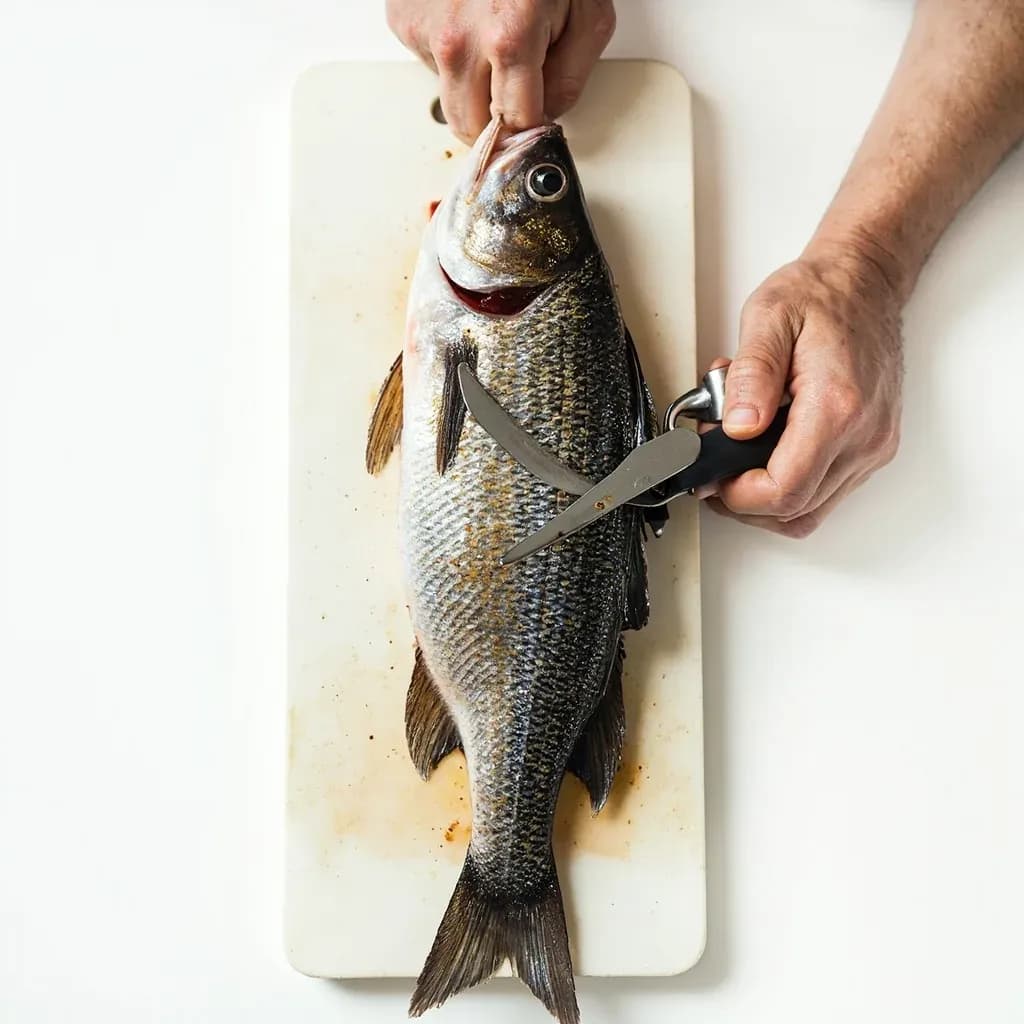
Scaling, gutting, and gilling a whole fish to ready it for cooking.
Cleaning a fish means scraping off the scales, slitting the belly to remove the guts, and pulling the gills, then rinsing the cavity clean. It is the first step in cooking a whole fish and prevents bitterness and spoilage from the organs and gills. Working from tail to head with the scaler, and bleeding the fish promptly, keeps the flesh firm and the flavor clean.
Fish cleaning — also called dressing — is the sequence that takes a whole fish from the market or the boat to a state ready for cooking: removing the scales, fins, and viscera, and (usually) the gills, leaving the flesh clean and the belly cavity free of the blood and organs that would otherwise turn bitter or muddy under heat. The work is fast, often under fifteen minutes for a fish a family will actually eat, but it rewards attention because the failures are loud: a burst gall bladder ruins an entire fish, a missed kidney strip makes a beautiful roast taste of pond, and a torn belly lets guts smear the flesh. The same basic technique scales from a six-inch smelt to a thirty-pound salmon; only the knife size and the force applied change.
Beyond the edible payoff, cleaning well gives the cook a second harvest. The head, frame, skin, and trim go straight into the freezer for stock; the roe, the liver, and the milt become their own ingredients; and the cleaned belly can be stuffed, butterflied, or left whole depending on what the kitchen has in mind. Treating cleaning as the first step of cooking — rather than a chore to delegate to the fishmonger — is what separates cooks who feel they are working with fish from cooks who feel they are working around it.
- Difficulty
- Medium
Types & varieties
Used for trout, bass, snapper, salmon, mackerel, and most cylindrical species; belly opened from vent to throat in one stroke.
Plaice, flounder, halibut, sole; gutted through a short crosswise cut behind the head, then skinned from the dark side.
Viscera pulled through the gill opening after snipping behind the pectoral fin; keeps the belly intact for stuffing or whole presentation.
Default for whole-fish roasting, grilling, or poaching, where the skin protects the flesh and crisps over the heat.
For dishes where skin is not desired — escabeche, certain Asian preparations, or when the fillets will later be served skin-side up.
For stews, curries, chowders, and stocks where whole-fish presentation is not the point.
Fish split along the backbone and laid flat like an open book; common in Pacific Rim and Caribbean cooking for fast grilling.
Skin removed rather than scaled; the fish is pegged to a board and the skin pulled off with pliers or a knife grip.
How to do it
- 1
Set up and chill the fish
Rinse the whole fish under cold water, pat dry, and lay it on a damp, non-slip cutting board. Have a flexible fillet or fish knife, a scaler (or the back of a heavy knife), kitchen shears, and a bowl of cold water within reach. If the fish is soft from sitting warm, rest it on ice for 10 minutes — firmer flesh scales and guts more cleanly. If the fish is very fresh and stiff with rigor mortis, let it rest 10–15 minutes at room temperature so the flesh relaxes; cleaning a fully rigor-set fish ice-cold is harder and can split the skin.
- 2
Remove the fins
With kitchen shears, snip off the dorsal fin along its base, then the anal fin, the two pelvic fins, and both pectoral fins close to the body. Leave the tail (caudal) fin unless the recipe calls for it off. Cutting fins first prevents them from snagging on skin later and avoids finger pricks from sharp spines — a real hazard on catfish, rockfish, and scorpionfish.
- 3
Scale the fish
Hold the fish firmly by the tail and, working inside a sink or over newspaper, drag the scaler or the back edge of a knife from tail toward head, against the direction the scales lie. Work one small section at a time, rinsing periodically so you can see what remains. Pay extra attention around the belly, under the gill covers, and at the base of the fins, where scales hide. Scale both sides and the head if it is being kept. Scales travel far and stick to everything; doing this over a sink keeps the kitchen sane.
- 4
Open the belly (round fish)
Insert the tip of a flexible knife into the fish's vent, just in front of the anal fin, angling slightly upward so you cut only through the belly wall and not into the guts. Slice forward to the base of the pectoral fin, opening the belly in one clean stroke. For flatfish, make a short crosswise cut just behind the head on the dark side and a small nick across the belly to the vent.
- 5
Remove the viscera
Reach in and pull the innards out in one piece, working from the head end toward the vent — pulling, not pushing, since pushing can rupture the stomach and foul the flesh. For small fish, you can instead reach through the gill opening after freeing the gills. Once the cavity is empty, run a thumb or the back of a spoon along the inside of the backbone to scrape out the dark kidney tissue; this is the single biggest source of off-flavors in home-cooked whole fish.
- 6
Remove the gills
Lift the gill cover (operculum) and, with shears or the knife, cut the gills free where they attach at the top and bottom of the cavity. Pull them out together with any attached membrane. Gills hold a surprising amount of blood and can give a metallic, bitter note if left in during cooking; removing them is one of the clearest differences between a fishmonger-cleaned fish and a properly dressed one.
- 7
Inspect, rinse, and dry
Look for any remaining bits of gut, membrane, or dark bloodline and scrape or trim them out. Check the belly cavity and the skin for stray scales. Rinse the fish thoroughly inside and out under cold running water, then pat completely dry with paper towels. The fish is now dressed and ready for stuffing, marinating, or cooking whole — or for filleting into portions. Wrap tightly and refrigerate if not cooking immediately.
The things home cooks miss
Most complaints about whole fish — muddy flavor, bitterness, grit, and unexpected bones — trace back to a few structures the standard rinse doesn't reach.
- The kidney: a dark reddish strip running along the inside of the backbone inside the body cavity. It is intensely flavored and tastes of mud or blood if left in. Scrape it out firmly with a spoon or your thumb after the viscera are removed.
- The gall bladder: a small greenish sac tucked into the liver near the head end of the cavity. If it bursts while you are pulling the guts out, it stains the flesh bright green with bile that no amount of rinsing will cure. The local remedy is to rub the area hard with coarse salt, then rinse; in practice, the safest move is to cut a thin layer of flesh away with it.
- Pin bones, encountered while cleaning or portioning, are a third concern; pull them with needle-nose pliers or dedicated fish tweezers, working against the direction they lie.
How flatfish and eels break the rules
Round fish follow one geometry; a few species need a different approach because their shape, skin, or skeleton refuses to behave.
- Flatfish (plaice, sole, flounder, halibut): gutted through a short crosswise slit just behind the head on the dark (eyed) side, then skinned by gripping the dark skin with pliers at the tail and pulling the fish away from the skin toward the head. The white skin is left on for protection during cooking and removed afterward if the recipe calls for it.
- Eels: never scaled. The skin is full of slime and is removed by making a small cut behind the gills, gripping the skin with pliers or a cloth, and pulling the eel body through the grip while the skin stays anchored behind. A nailed board or a sink stopper makes a useful anchor.
- Catfish and other smooth-skinned fish: the skin is often left on (it crisps beautifully when fried) or removed with pliers in the same way as an eel.
Very small fish
Sardines, anchovies, smelts, and other fish under six inches are often cleaned with nothing but a thumbnail and cold water. The cook pinches the belly open from vent to gill, hooks a thumbnail under the viscera, and pulls the gut out in one stroke through the throat, leaving the belly wall intact so the fish holds together on the grill.
Common uses
Tips & pitfalls
- Scale under running cold water or in a sink full of cold water; scales travel far and stick to everything in the kitchen.
- Always scale against the grain — drag the scaler or knife from tail toward head, opposite to the way the scales lie.
- When gutting, start the belly cut at the vent (just in front of the anal fin) and slice forward to the base of the pectoral fin, cutting only as deep as the belly wall to avoid nicking the guts and spilling their contents.
- If the gall bladder bursts, rub the stained area hard with coarse salt and rinse, or trim off a thin layer of flesh; the bile is intensely bitter and ruins everything it touches.
- Always scrape out the dark kidney tissue that runs along the spine inside the body cavity with a spoon or your thumb; it is the most common source of muddy, off-putting flavor in whole-fish cookery.
- Pull, don't push, the viscera out — pushing can rupture the stomach and smear gut contents across the flesh.
- A dull knife tears the skin and crushes the flesh; sharpen the fillet knife just before starting, and re-hone if the board dulls the edge mid-job.
- Keep the fish on a bed of crushed ice while you work in warm kitchens; warmth softens the flesh and makes scaling messy.
- Save the head, bones, skin, and trim in a labeled freezer bag for stock day — they are the foundation of fumet, bisque, and cioppino.
Good to know
- Also known as
- Dressing a fish; sometimes called breaking down
- Primary tools
- Flexible fillet or fish knife, fish scaler (or back of a heavy knife), cutting board, kitchen shears; tweezers or pliers for pin bones and eel skin
- Difficulty
- Moderate; requires a sharp, thin blade and a steady hand
- Typical time
- 5–15 minutes for a 1–3 lb (450 g–1.4 kg) whole fish
- When to do it
- As soon after purchase or catch as possible; do not let a cleaned fish sit uncovered in the refrigerator
- Yield
- Cleaning removes roughly 15–25% of whole weight (scales, viscera, gills, head if removed)
- Storage after cleaning
- Rinse, pat dry, wrap tightly; use within 24 hours refrigerated, or freeze up to 3 months at 0 °F (−18 °C)
- Water temperature
- Cold running water keeps the flesh firm and washes away scales and blood
- Safety
- Always cut away from the body and away from the spine; a slip-resistant board is essential
Also called
Scaling & Gutting Fish · Fish Scaling & Cleaning · Gutting · Gilling
Related

Chop
Cut into rough, irregular pieces — the everyday workhorse cut

Dice
Cut into uniform cubes for even cooking and a tidy look

Mince
Cut as fine as possible so flavor melts evenly into the dish

Slice
Cut into even, flat pieces for consistent cooking and presentation

Julienne
Cut into thin matchsticks for fast cooking and elegant garnish

Brunoise
Cut into tiny, precise cubes — the finest dice in the kitchen

Chiffonade
Roll and slice leafy greens into delicate ribbons

Batonnet
Cut into tidy sticks, thicker than julienne — think classic fries