Water & Steam
Honey-Water Bagel Boiling
Boiling shaped bagels in honey- or malt-sweetened water to set the crust and create their chewy sheen.
Bagel boiling drops shaped, proofed dough rings into simmering water sweetened with honey, barley malt or sometimes baking soda before baking. The brief bath gelatinizes the surface starch, setting a glossy, chewy crust and giving bagels their dense interior. Sweetener adds color and a subtle flavor; longer boils yield a thicker, chewier crust.
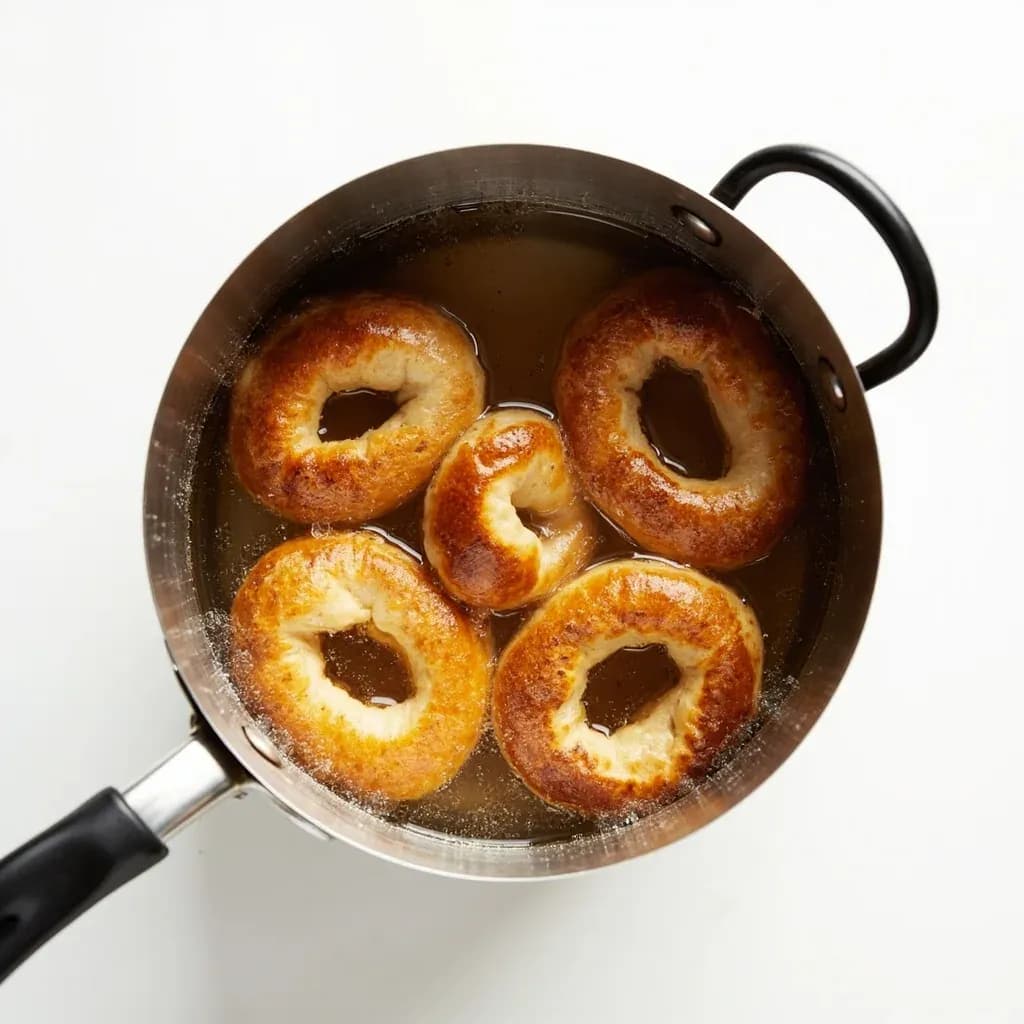
Honey-water bagel boiling is the defining step that turns a plain ring of enriched dough into a bagel. The shaped rings are lowered, briefly, into a pot of water sweetened with honey or malt and held at a full rolling boil. Two things happen in those 60–120 seconds: the surface starch gelatinizes to form a thin, dense, glassy skin, and the dissolved sugars in the kettle coat that skin and set up a substrate for aggressive Maillard browning in the oven. The result is the chewy, glossy, slightly blistered crust that distinguishes a bagel from any other bread roll.
The sweetener is not flavoring so much as it is fuel. A tablespoon or two of honey or barley malt per gallon is enough to feed the browning reaction without making the crust sweet on the tongue. The traditional alternative — a lye dip — works on the same principle but leans on alkalinity rather than sugar to push color and chew; a baking-soda boost is the safe home approximation of that lye bath.
What matters most in practice is heat and timing. A true rolling boil is non-negotiable; tepid water produces slack, wrinkled crusts that pull away from the crumb in the oven. A short boil (20–30 seconds per side) gives a lighter, more breadlike bagel; a longer one (45–60 seconds per side) tightens the crust and intensifies the chew. The kettle step is short, but it is the step that decides whether the bake delivers a bagel or a bread roll with a hole.
- Difficulty
- Easy
Types & varieties
The classic Eastern European and New York-style method, using barley malt syrup or diastatic malt powder; produces deep mahogany color and a faintly malty, savory crust.
Hallmark of Montreal-style bagels; gives a slightly sweeter, glossier, thinner crust than malt, with more pronounced surface blistering.
A home-baker substitute for a lye bath; baking soda raises the pH of the kettle and darkens the crust without caustic handling.
The historical Central European method shared with pretzels; yields a deep-brown, almost lacquered crust and pronounced chew, but requires gloves, eye protection, and food-grade lye.
Rare; yields a paler, blander crust and is generally avoided by serious bagel makers.
How to do it
- 1
Bring the kettle water to a rolling boil
Fill a wide, shallow pot about halfway with water and bring it to a sustained rolling boil. A wide surface area makes flipping and skimming far easier than working in a tall stockpot, and the boil recovers faster between batches.
- 2
Add sweetener (and optional alkali)
Stir in roughly 1–2 tablespoons of honey or barley malt syrup per gallon of water. For a darker, more pretzel-like crust, whisk in 1–2 tablespoons of baking soda; add it gradually, since it will foam up. Keep the pot at a rolling boil throughout.
- 3
Proof and shape the bagels
After the dough has been divided, shaped into rings, and finished its final proof, work quickly. The bagels should enter the kettle as soon as they are shaped so the surface is taut and slightly damp, not dried out — a dry surface resists gelatinization and gives a wrinkled crust.
- 4
Lower the bagels into the water
Drop 3–4 bagels at a time, seam-side down if visible. They will sink at first; do not stir or agitate them. Skim any foam that builds on the surface so it does not coat the bagels or weigh them down.
- 5
Boil, flipping once
Boil 30–60 seconds on the first side, flip with a spider or slotted spoon, then boil a matching 30–60 seconds on the second side. Montreal-style leans longer; New York-style shorter. The bagels should float and feel firm-set on the surface by the time you flip them.
- 6
Drain briefly
Lift each bagel out with the skimmer and let excess water drip off for just a few seconds over the pot. The surface should be glossy and damp, not dripping.
- 7
Top and transfer to the oven
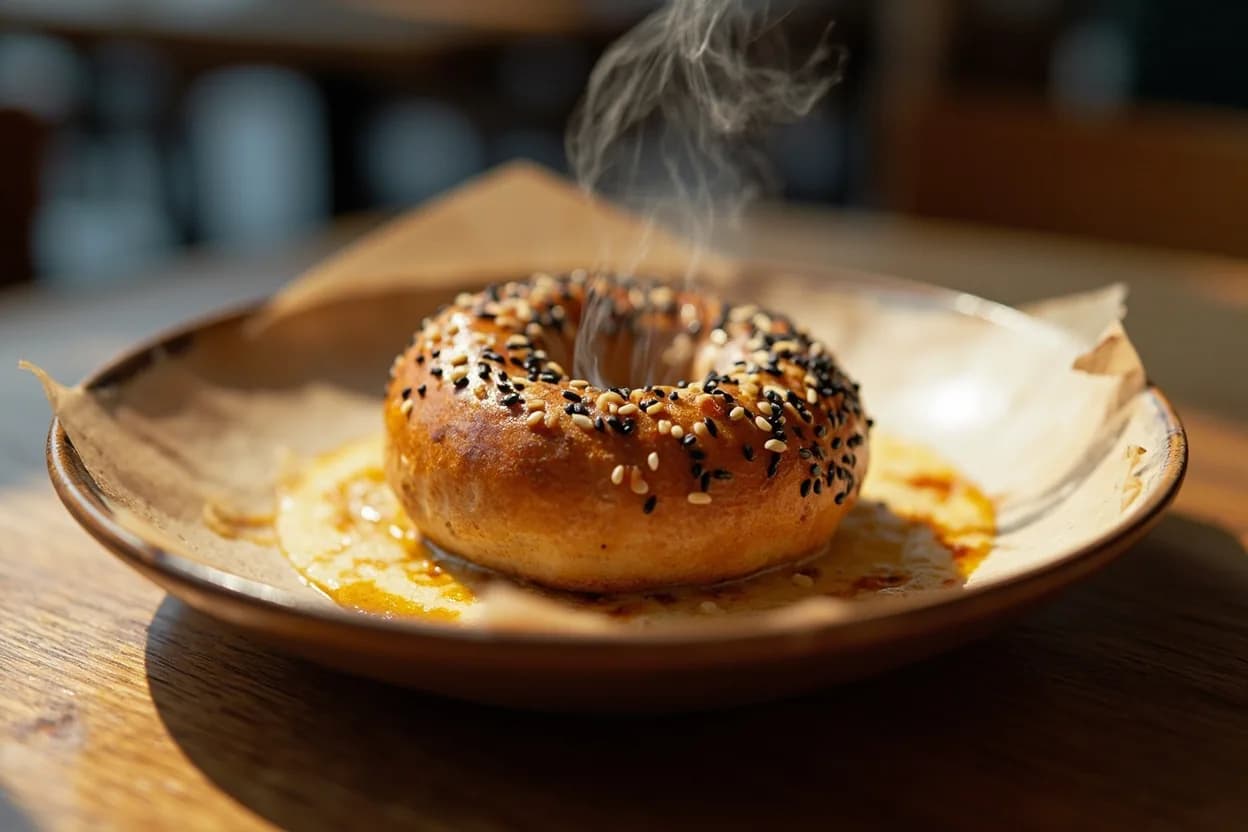
If using seeds, salt, or other toppings, press them onto the damp surface within about 30 seconds of lifting. Place the bagels directly on a parchment-lined sheet, a preheated baking stone, or a wood peel, and bake immediately at about 425–475 °F (220–250 °C) until deeply browned, 15–25 minutes. Do not let boiled bagels rest on a towel — trapped steam will separate the crust from the crumb and undo the work the kettle just did.
The chemistry in 60 seconds
Two reactions do the work. First, surface starch gelatinizes: as the dough hits near-boiling water, the outer layer of starch absorbs water, swells, and sets into a thin, dense skin as it cools toward oven temperature. That skin is what gives the bagel its snap and chew, and it is also the barrier that slows oven-spring, so the crumb bakes tight rather than airy. Second, the sweetener in the kettle — honey, malt, or a sugar from an alkaline bath — coats the gelatinized surface and gives the Maillard reaction something to react with once the bagel hits oven heat. Without that sugar coat, the crust browns poorly and tastes flat.
- Gelatinization happens fast; even 30 seconds per side is enough to set a working skin.
- Malt and honey brown at slightly different rates — malt deeper, honey a touch glossier.
- Alkali (baking soda or lye) pushes the same Maillard pathway harder, which is why pretzels and lye-bagels share that dark, glossy finish.
Regional styles and what the kettle reveals
A New York bagel and a Montreal bagel leave the same kind of kettle with visibly different results. New York makers lean on malt, shorter boils, and high oven heat; the crust comes out chewy, deeply browned, and relatively thick. Montreal makers lean on honey, longer boils, and very hot wood-fired ovens with shorter bake times; the crust comes out thinner, sweeter, glossier, and noticeably more blistered. A lye-dipped bagel, common in parts of Poland and still made by some traditionalists, sits at the dark end of the spectrum — almost pretzel-like in color, with a surface that cracks when you bite it.
- Malt → New York: chewy, mahogany, faintly savory.
- Honey → Montreal: glossy, blistered, faintly sweet.
- Lye → Central European tradition: deep brown, lacquered, very chewy.
- Baking soda is the home cook's pragmatic stand-in for lye.
Common uses
Tips & pitfalls
- Maintain a true rolling boil — dropping bagels into water that is not hot enough produces pale, wrinkled, slack crusts that will not crisp properly in the oven.
- Skim foam as it builds; it coats the bagels and can weigh the rings down so they do not set evenly.
- Flip each bagel exactly once at the halfway mark. Bagels typically sink at first and float once a crust has set — float time is your doneness cue, not the clock.
- Boil in small batches of 3–4 so the water stays at a rolling boil; a stalled pot costs more time than working small.
- Transfer boiled bagels directly to the baking surface. Never set them on a towel — the trapped steam lifts the crust off the crumb and you will get a hollow shell.
- Apply seeds, salt, or everything seasoning within about 30 seconds of lifting from the water, while the surface is still tacky enough to grab them.
- For a thicker chew, extend the per-side time toward 60 seconds; for a lighter, more breadlike bagel, lean toward 20–30 seconds.
- Use a wide, shallow pot rather than a tall stockpot — flipping is far easier, the boil recovers faster between batches, and you are less likely to crowd the bagels.
Good to know
- Primary function
- Gelatinizes the surface starch of shaped bagel dough to set a dense, chewy crust and lay down sugars for Maillard browning.
- Water temperature
- A full rolling boil, roughly 100 °C / 212 °F; lower temperatures give pale, slack crusts.
- Sweetener ratio
- About 1–2 tablespoons of honey or barley malt syrup per gallon (≈4 L) of water; enough to drive browning, not enough to taste overtly sweet.
- Per-side boil time
- Typically 30–60 seconds per side, 1–2 minutes total; some Montreal-style makers push to 2–3 minutes total.
- Batch size
- 3–4 bagels at a time in a wide pot, so the boil never stalls.
- Optional alkali
- 1–2 tablespoons of baking soda per gallon raises pH and darkens the crust, approximating a lye bath without the handling hazard.
- Tool of choice
- A flat wire skimmer (a 'spider') lifts the bagels out cleanly and lets excess water drain fast.
- Oven follow-up
- Bagels go straight from the kettle to a hot sheet or stone at 220–250 °C / 425–475 °F for 15–25 minutes.
Also called
bagel boiling · malt-water boiling
Dishes that rely on it
Related

Boil
Cook in vigorously bubbling liquid at full rolling heat

Simmer
Hold liquid at a gentle shimmer for tender, unhurried cooking

Poach
Cook gently in barely-trembling liquid for silky, tender results

Steam
Cook in rising vapor to keep color, nutrients, and shape intact

Blanch
Plunge briefly in boiling water, then shock cold to lock color

Braise
Sear, then cook slow in a little liquid until fall-apart tender

Stew
Simmer bite-sized pieces fully submerged into a rich, unified pot

Sous-Vide
Seal and cook in precise warm water for edge-to-edge doneness