Prep & Assembly
Hulling Berries
Removing the leafy green caps and stems from berries, or husks from grains and seeds.
Hulling removes the green leafy cap and white core from strawberries, or the outer husk from grains and seeds. For berries it is done with a paring knife, a special huller, or a straw pushed through the base. Hulling leaves clean fruit ready to slice, macerate, or serve. With grains and seeds, dehulling strips the inedible outer layer to reveal the edible kernel within.
Hulling is the small but essential prep step of pulling the leafy green cap (the calyx) off a berry along with its tough white core plug. For strawberries — the berry that matters most in the home kitchen — the calyx is fibrous, mildly bitter, and unpleasant in any preparation where you'd actually bite into the fruit whole: shortcakes, tarts, macerated salads, coulis. A quick hull leaves a clean, conical cavity and roughly 5–10% less weight, but more importantly lets the berry's flavor and texture carry the dish. The same logic extends to a handful of close cousins: gooseberries are "topped and tailed" at both ends, while tomatillos and cape gooseberries have papery husks peeled away rather than cored.
The skill matters because most of what goes wrong with fresh berries happens before they hit the pan. Hull after washing, never before — an open cavity soaks up rinse water and turns the flesh limp and bruised. Chill the fruit first so it cores cleanly instead of crushing. And resist the urge to throw those caps in the trash: they carry the same aromatic compounds as the fruit and will perfume simple syrup, vinegar, or cream for almost no effort.
The word itself comes from Old English hulu, meaning husk or shell, which is why you'll also hear "hulling" used for stripping the inedible outer coat from grains and seeds at the mill. That industrial meaning — brown rice, pearled barley, oat groats — is a different operation done at scale, not something the home cook performs, but it's worth recognizing the term when you see it on a bag.
- Difficulty
- Easy
Types & varieties
Plastic-handled tool with a serrated metal scoop. Push into the tip, twist, pull out the core in one motion. The classic choice for firm, ripe-not-soft berries.
Insert a small sharp blade at an inward angle around the stem and rotate to cut a cone. More control and the only reliable option for very ripe, very small, or oddly shaped fruit.
Push a sturdy straw or wooden skewer up through the tip of the berry to eject the hull out the top. Almost zero flesh loss, but only works on medium, evenly conical strawberries.
Snip the woody stem end with scissors and pinch or nip off the dried blossom end. A related, slightly more thorough prep than straight hulling.
Peel away the papery lantern-like calyx by hand and rinse off the sticky residue beneath before using.
Industrial process that strips the inedible husk from rice, oats, barley, sunflower seeds, and the like. Produces brown rice, pearled barley, oat groats, hulled sunflower kernels. Done at the mill, not at home.
How to do it
- 1
Wash, dry, and chill the berries
Rinse the strawberries (or other berries) gently in cool water, pat them thoroughly dry on a clean kitchen towel, and chill for 10–15 minutes. Cold, dry, firm fruit hulls cleanly; warm or wet fruit crushes or slips under the tool.
- 2
Choose your tool
Use a spring-loaded strawberry huller for firm, average-sized berries. Use a paring knife for very ripe, very small, or irregularly shaped fruit. Reach for a sturdy drinking straw or wooden skewer when you want almost zero flesh loss and the berries are medium and evenly conical.
- 3
Hull with a strawberry huller
Hold the berry by its sides. Press the serrated scoop of the huller into the tip, just off-center, push about three-quarters of the way in, give a quarter-turn, and pull straight out. The calyx, stem, and white core plug should come away attached to the scoop.
- 4
Hull with a paring knife
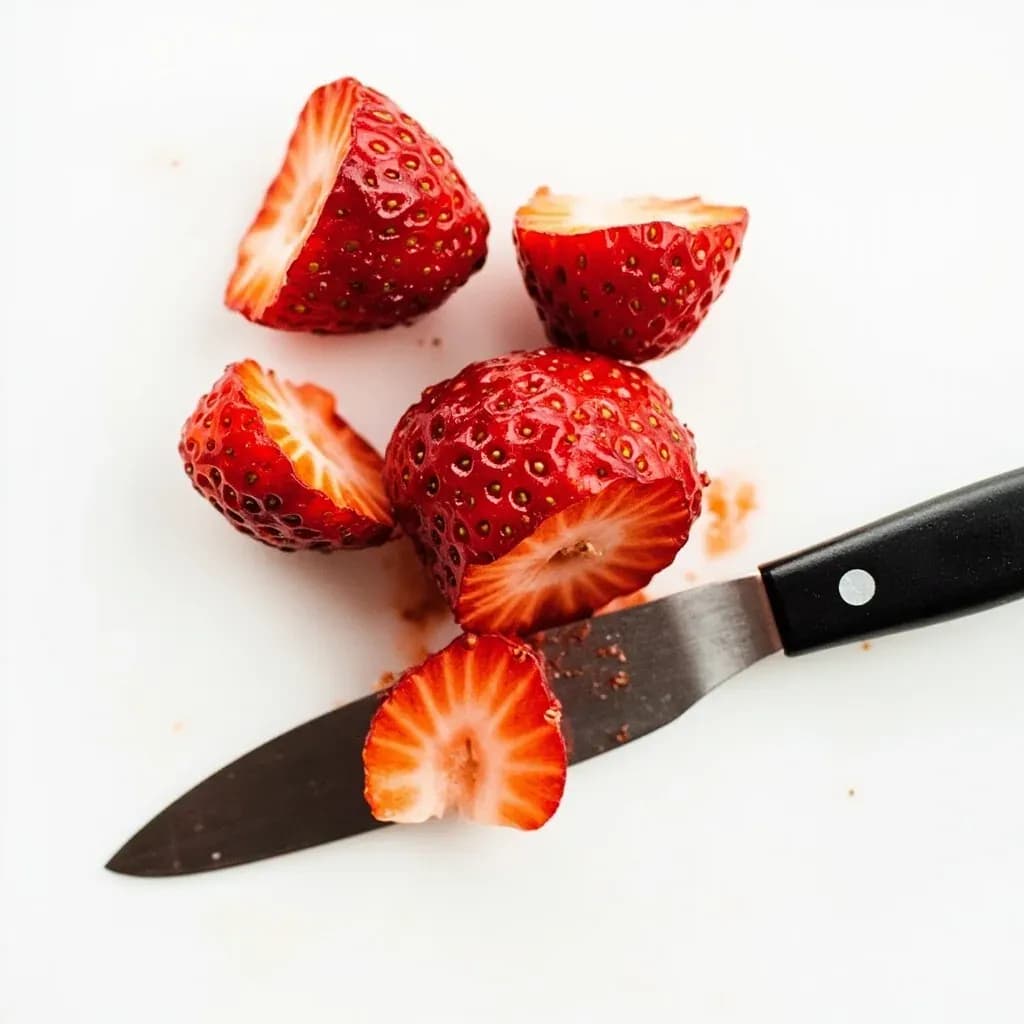
Hold the berry stem-up. Insert the tip of a small sharp knife just outside the stem at roughly a 30-degree angle pointing toward the center. Rotate the berry (not the knife) to cut a cone around and beneath the stem, then lift the hull out. The cavity should be small and symmetrical.
- 5
Hull with a straw or skewer
Hold the berry tip-up. Push a straw or wooden skewer straight up through the center of the tip until it ejects the stem and calyx out the top. Works best on medium, conical strawberries; very small or very wide berries will jam or crush.
- 6
Top and tail gooseberries
Snip the woody stem end with kitchen scissors, then nip off the dried brown blossom end with your fingernails or the scissors. Rinse again — gooseberries often hide grit under the calyx.
- 7
Husk tomatillos or cape gooseberries
Pull back the papery husk by hand and discard it. Rinse the sticky, slightly bitter residue from the fruit under cool water and pat dry before cutting.
- 8
Use or store immediately
Hulled berries should be used within a day or two. Keep them in a single layer on a paper-towel-lined tray, loosely covered, in the refrigerator. Drop the green hulls into a jar and freeze them — they're a free flavor reserve for syrup, vinegar, or cream.
Don't toss the caps
The green hulls and white core plugs you pull out of a strawberry are not waste — they are concentrated aroma. Steep a handful in warm simple syrup (about 200 g sugar to 200 ml water) for 20 minutes, strain, and you have a dessert sauce that tastes unmistakably of strawberry. The same trick works with white vinegar for salad dressings or with warm cream (then chill and whip) for a faintly pink, perfumed topping. Keep a jar of caps in the freezer and add to it whenever you hull; it will keep for months and gives you a free flavor boost whenever you need one.
- Simple syrup infusion: 200 g sugar + 200 ml water + a generous handful of caps, simmered 5 minutes and steeped 20.
- Strawberry vinegar: cover caps with white wine or champagne vinegar, steep 3–5 days, strain.
- Strawberry cream: warm cream with caps, steep covered in the fridge overnight, strain, whip.
Common uses
Tips & pitfalls
- Wash and dry berries before hulling, never after — the open cavity soaks up water and turns the flesh mushy. This is the single most common home-cook mistake.
- For very ripe, soft strawberries, switch from a huller to a paring knife. The scoop's serrated edge will crush anything that gives easily under a thumb.
- Chill firm berries in the freezer for 10–15 minutes before hulling. Cold, taut flesh cores cleanly; room-temperature flesh tears and bruises.
- Reserve the hulls. Steep them in vinegar, simple syrup, or warm cream and you get a real, surprisingly vivid strawberry note for almost no work — the caps carry the same aromatics as the fruit.
- Hold the berry by its sides, not the tip, when using a huller. Pressing on the pointed end is what crushes the most visible part of the fruit.
- If you're working with a paring knife, angle the blade inward toward the center as you rotate to cut a small cone rather than a wide flat cap — less waste and a prettier result.
- For uniform presentation in tarts and pastries, hull all the berries from the same side so they sit flat and level.
- Hulled berries oxidize quickly. If you must hold them before serving, toss gently with a little lemon juice to slow browning.
Good to know
- Definition
- Removal of a berry's calyx (the leafy green cap) together with the attached stem and the small white fibrous core plug beneath it. Also used for stripping the outer husk from grains and seeds.
- Hulling vs. capping
- Hulling pulls out a conical core and leaves a cavity; capping slices the cap off flat with a knife and leaves the core inside. They are not interchangeable — capping wastes less flesh but leaves tough white tissue in the berry.
- Berries that need it
- Strawberries are the classic case. Gooseberries are "topped and tailed" (both ends snipped). Tomatillos and cape gooseberries (physalis) are husked — their papery lantern calyx is peeled away by hand. Raspberries and blackberries have a tiny dry core that is usually left in place.
- Primary tools
- Spring-loaded strawberry huller, paring knife, sturdy drinking straw or wooden skewer, channel knife, or a small melon baller.
- Order of operations
- Always wash and dry the berries first, then hull. Hulling before washing lets water enter the cavity and turns the flesh soggy and bruise-prone.
- Yield
- A hulled strawberry loses roughly 5–10% of its weight to the cap and core plug.
- Speed
- About 2–5 seconds per berry with a huller; 5–10 seconds with a paring knife.
- Storage after hulling
- Refrigerate and use within 1–2 days; the exposed flesh oxidizes and softens faster than an intact berry.
Also called
Hulling Berries · Dehulling
Related

Whisk
Beat ingredients smooth and aerated with a looping wire motion

Sift
Pass dry ingredients through mesh to aerate and remove lumps

Strain
Pour through mesh to separate solids from liquid for a smooth result

Filter
Pass liquid through fine material to clarify out the smallest particles

Rice
Press cooked potatoes through small holes for fluffy, lump-free texture

Mash
Crush soft cooked food into a rustic, creamy purée

Grind
Crush food into a coarse to fine texture, from spices to meat

Grate
Shred food into fine bits against a sharp-toothed surface