Water & Steam
In Umido (Tomato Stewing)
Italian method of slow-stewing meat, fish or vegetables in a tomato-based sauce until tender.
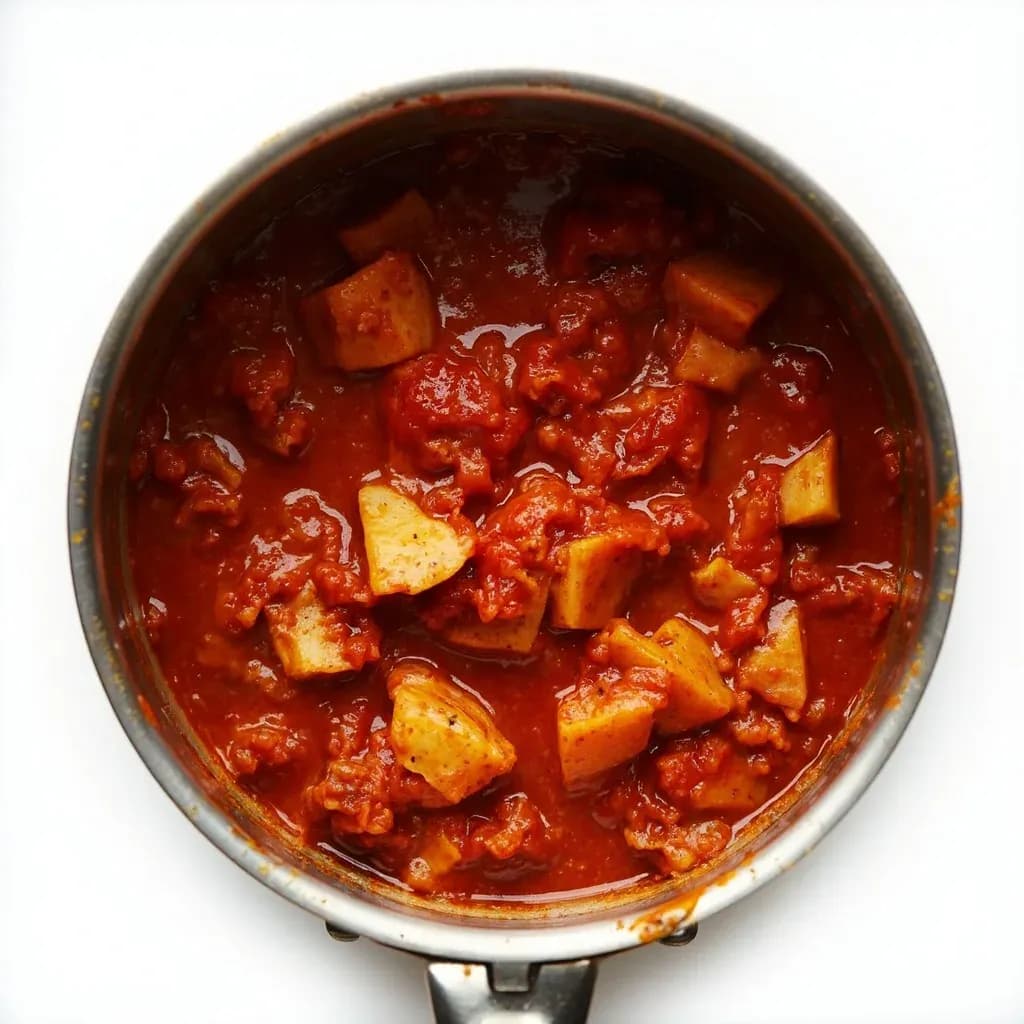
In umido is the Italian technique of stewing ingredients — meat, fish, beans or vegetables — in a wet, tomato-rich braising liquid with aromatics until tender and flavorful. The food simmers partly submerged, releasing and absorbing flavor into the sauce. It is the basis of countless rustic Italian dishes, from seppie in umido to fagioli all'uccelletto.
In umido — literally "in moisture" — is the Italian umbrella for slow, lidded simmering in a small amount of seasoned liquid. It belongs to the same family as French braising and Spanish estofado, but its personality is distinctly Italian: a tight pot, a base of soffritto (onion, carrot, and celery gently sweated in oil), tomato or wine as the braising medium, and a heat so low the liquid barely trembles. Where stews in other cuisines sometimes drown their ingredients, an umido keeps the food close to the surface, where it both steams in its own condensation and reduces the sauce around it. That dual action is what gives the finished dish its characteristic glossy, concentrated character.
What the technique does, biologically and culinarily, is as important as how it tastes. The long, gentle heat coaxes collagen from tough cuts — beef chuck, pork shoulder, veal breast, oxtail — into gelatin, which both silken the sauce and give the meat a quivering, almost unctuous texture. Tomato adds acidity that softens connective tissue further and brightens what would otherwise be a heavy dish; wine and aromatics build complexity in the steam that condenses back onto the food. For fish and vegetables the same logic applies at a fraction of the time: the lid conserves moisture, the sauce coats, and the food yields to the spoon rather than to the knife.
A properly cooked umido announces itself in three ways. The protein pulls cleanly with a fork and offers no resistance; the sauce has reduced to a consistency that "writes" on a wooden spoon — a brief trail that closes back in on itself; and the surface carries a sheen of fat or oil emulsified into the liquid. Italian cooks describe the target simmer as sobbollire — a soft, lazy bubbling rather than a rolling boil — because violent heat tightens muscle fibers, splits emulsions, and dulls the tomato's brightness. Get that part right, and the rest is patience.
- Difficulty
- Easy
Types & varieties
The classic tomato version using passata, pelati, or diluted concentrato. The home base for spezzatino, polpette, trippa, seppie in umido, and braised fennel.
Same technique without tomato, using white wine and broth. Used for delicate meats, white fish stews, and offal such as fegato alla veneziana.
A looser, more broth-forward relative, traditionally for fish and seafood; often omits tomato or uses only a light touch of it.
"Hunter-style" umido with tomato, wine, olives, mushrooms, and assertive herbs such as rosemary and sage.
Tomato sharpened with olives, capers, anchovy, and garlic, applied to a fish or meat braise.
Roman register featuring guanciale, pecorino, white wine, and sometimes tomato; seen in the pan-sauce finish on saltimbocca alla romana and in slow-braised lamb (abbacchio) preparations.
Coastal variant for whole fish or cephalopods (seppie, calamari, polpo), finished with parsley and a generous splash of raw olive oil.
How to do it
- 1
Prepare the soffritto and aromatics
Dice onion, carrot, and celery finely — a true brunoise, not a rough chop. Warm olive oil (and optionally a knob of butter or a little lard) in a heavy lidded pot over low heat. Add the soffritto and a small pinch of salt; cook gently for 8–10 minutes until soft, sweet, and translucent. Stir in minced garlic and, for meat dishes, a small amount of diced pancetta or guanciale, and cook another minute.
- 2
Sear the main ingredient
Pat the protein dry. Raise the heat to medium-high and brown in small batches — meat on all sides until a deep crust forms, or fish just until the skin sets. Remove and reserve. For vegetables, sauté until the edges begin to color; for legumes that have been pre-soaked or par-cooked, add them once the soffritto has built flavor.
- 3
Deglaze and build the liquid
Pour off excess fat if needed. Add wine (white for fish, light meats, and in bianco preparations; red for beef and lamb) and scrape the fond; let it reduce by half. Add tomato — passata for a clean sauce, pelati roughly torn for a rustic one, or concentrato diluted in a little water and cooked for a minute to lose its raw edge. Top up with broth or water so the liquid comes roughly halfway up the ingredients (less for fish, more for a long meat braise).
- 4
Season and add herbs
Salt in modest amounts, add black pepper, and choose herbs to suit the dish: bay and rosemary for red meat and game; sage for poultry and pork; parsley stems for fish and seafood; thyme for rabbit. Return the seared protein to the pot.
- 5
Cover and simmer low
Bring just to a bare simmer. Cover, leaving the lid slightly ajar so excess steam can escape. Maintain a gentle sobbollire — a lazy bubble every few seconds. Cook undisturbed for the right window: 2–3 hours for beef, 1.5–2 hours for veal or pork, 45–60 minutes for poultry, 15–25 minutes for fish, 25–45 minutes for vegetables. Stir only occasionally, to avoid breaking the protein.
- 6
Adjust and finish
Uncover for the final 10–15 minutes if the sauce is thin and you want it to coat the back of a spoon. Taste and correct seasoning — a pinch of sugar if the tomato is sharp, a squeeze of lemon if the sauce tastes flat. Off the heat, finish with chopped parsley, a drizzle of raw extra-virgin olive oil, and, for meat dishes, a knob of cold butter or a grating of parmigiano or pecorino.
- 7
Rest and serve
Let the dish rest 10–15 minutes off the heat so the sauce tightens around the protein and the flavors settle. Serve with crusty bread, polenta, or mashed potato, or — for meat-based versions — toss the sauce through fresh pasta such as pappardelle or rigatoni.
The Sobbollire — and Why It Matters
The single biggest variable in any umido is not the recipe but the simmer. A true sobbollire is barely a simmer at all: small bubbles break the surface at long intervals, the lid fogs and drips, and the sauce moves with the slow confidence of warm honey. Anything more aggressive tightens muscle fibers, drives off the aromatics before they can flavor the food, and reduces the tomato's sugars into a dull, jammy flatness. Cooks who fight this instinct — turning the heat up to "speed things along" — usually end up with dry meat and a thin, acidic sauce that needs rescuing. Patience, not temperature, is the cook here.
Building the Sauce Body
The glossy, emulsified finish of a great umido is not luck; it is layered. It starts with a properly cooked soffritto, which contributes both flavor and a small amount of vegetable pectin that helps the sauce cling. It continues with the fond from browning the protein, lifted by wine and reduced before the tomato goes in. The final layer is mantecatura — a knob of cold butter or a thread of raw extra-virgin olive oil swirled in off the heat, which emulsifies the surface fat into the liquid and gives the sauce its characteristic sheen. Skip any of those steps and the dish is still edible; do all of them and the sauce will coat the meat like a glaze.
Common uses
Tips & pitfalls
- Cook the soffritto slowly and thoroughly: 8–10 minutes over low heat until truly soft and translucent. This is the flavor base of the entire dish; rushed soffritto tastes raw and grassy.
- Brown the protein in small batches. Crowding the pot steams rather than sears, and you lose the Maillard depth that both flavors and colors the sauce.
- If using concentrato di pomodoro, bloom it in the oil with the soffritto for 1–2 minutes before adding water. It loses raw acidity and gains sweetness.
- Keep the lid on but slightly ajar, and chase the sobbollire. A hard boil toughens proteins, splits the sauce, and dulls the tomato.
- Salt in layers — a pinch with the soffritto, more with the protein, then adjust only at the end once the tomato and reduction have concentrated. Underseasoning early and overcorrecting late is the usual mistake.
- For fish, add salt and tomato later in the cook. Salt and acid drawn out early can break the delicate flesh; finish uncovered if the liquid is thin.
- Finish off the heat with a mantecatura — a knob of cold butter or a thread of raw olive oil swirled in — for a glossy, emulsified sauce.
- Resist lifting the lid to peek. Every peek drops the pot temperature and lengthens the cook; trust the process.
- Let the dish rest 10–15 minutes off the heat before serving so the sauce sets and the flavors marry.
- Save the cooking juices. They are the seasoning for the next day's pasta, risotto, or frittata.
Good to know
- Italian term
- "In umido" — literally "in moisture" or "in humidity"
- Family
- Moist-heat braising (umido), contrasted with "in bianco" (no tomato) and "asciutto" (dry)
- Standard vessel
- Heavy lidded pot: casseruola, terracotta pignatta, or low wide tegame
- Aromatic base
- Soffritto of onion, carrot, and celery in olive oil; often garlic, sometimes pancetta or guanciale
- Braising liquid
- Tomato (passata, pelati, or diluted concentrato), sometimes combined with wine and broth
- Target simmer
- Sobbollire — a gentle tremble; the liquid should never boil hard
- Lid management
- On for most of the cook, slightly ajar in the final third to concentrate the sauce
- Timing guide
- Beef 2–3 h; veal or pork 1.5–2 h; poultry ~1 h; fish 15–25 min; vegetables 25–45 min
- Texture goal
- Fork-tender protein in a thick, glossy sauce that lightly coats and "writes" on a spoon
Also called
in umido · tomato stewing
Related

Boil
Cook in vigorously bubbling liquid at full rolling heat

Simmer
Hold liquid at a gentle shimmer for tender, unhurried cooking

Poach
Cook gently in barely-trembling liquid for silky, tender results

Steam
Cook in rising vapor to keep color, nutrients, and shape intact

Blanch
Plunge briefly in boiling water, then shock cold to lock color

Braise
Sear, then cook slow in a little liquid until fall-apart tender

Stew
Simmer bite-sized pieces fully submerged into a rich, unified pot

Sous-Vide
Seal and cook in precise warm water for edge-to-edge doneness