Heat & Fire
Layered Baking (Parmigiana / Timballo)
Building alternating layers of sauce, cheese and ingredients in a dish and baking until set and bubbling.
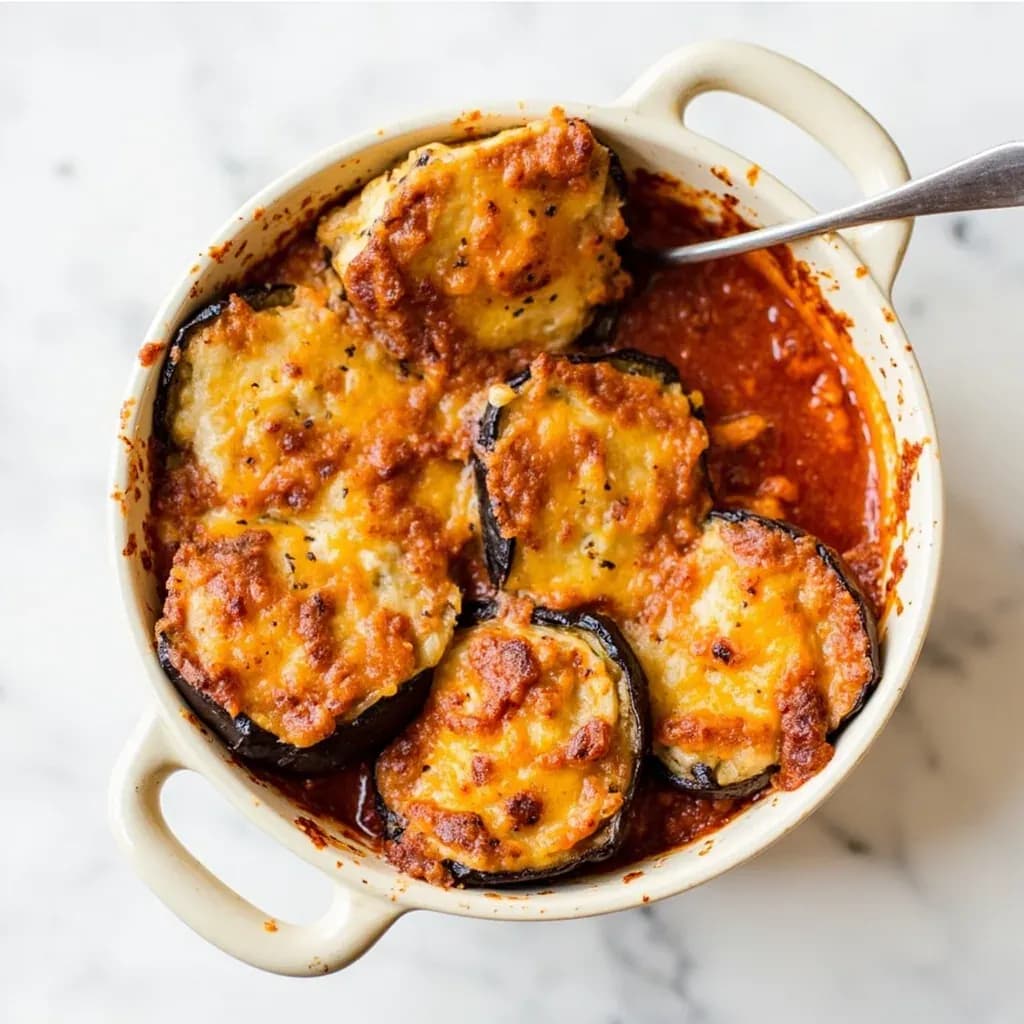
Layered baking assembles a casserole in distinct strata, such as eggplant, tomato sauce and cheese for parmigiana or pasta, ragu and filling for timballo, then bakes it until the layers meld and the top browns. The oven heat sets the structure so the dish can be cut into clean portions while staying cohesive. Resting after baking helps the layers firm up before serving.
Layered baking is the Italian technique of stacking a base ingredient (vegetable, pasta, rice, or occasionally meat) with a binding sauce and cheese, then cooking it in the oven until the whole dish sets into a single, sliceable construction. The category covers everything from a humble parmigiana di melanzane in a shallow earthenware dish to a domed timballo di maccheroni turned out onto a platter like a savory cake. What unifies the family is moisture control: every layer that goes in should be either dry or fully cooked, every sauce should be reduced enough to coat a spoon, and the finished bake should rest long enough for the interior to firm up before the knife goes in.
The technique matters because it transforms modest ingredients — a glut of summer zucchini, day-old pasta, a single eggplant — into something that can feed a crowd from one pan, improve overnight in the fridge, and travel well to a potluck. It also stretches expensive elements: a little good ragù and a handful of aged cheese can anchor five layers and eight servings. The oven does the final work, marrying the components, driving off excess liquid, and producing the browned, bubbling crust that signals a properly finished bake.
Parmigiana and timballo sit at opposite ends of the same spectrum. A parmigiana is an open-faced, shallow bake of vegetables (almost always involving tomato sauce and cheese) eaten from the dish. A timballo is a deep, molded construction — pasta, rice, or meat bound with sauce and cheese — that is unmolded and presented as a centerpiece. Both rely on the same layering logic, but the timballo demands a tighter, more structural result and usually an interior starch to hold the dome together.
- Difficulty
- Easy
Types & varieties
The classic Southern Italian version: fried eggplant layered with tomato sauce, mozzarella, basil, and Parmigiano
Zucchini version; slices usually grilled to limit moisture
Thin potato slices layered with tomato and cheese; lighter, no frying required
Summer-only version of thick tomato slices layered with basil and cheese, no frying
Pasta timbale with ragù, small meatballs, mozzarella, peas, and hard-boiled eggs, baked in a mold and turned out
Renaissance court dish: pasta, ragù, mushrooms, sweetbreads, and truffles, encased in a pastry shell
Italian rice timbale, molded and unmolded; behaves like a savory rice cake
Greek cousin: fried eggplant and/or potato layered with lamb ragù and topped with béchamel
Greek pasta bake with bucatini, meat ragù, and a béchamel topping
French potato bake layered with cream and garlic; traditionally no cheese
British versions: minced lamb (shepherd's) or beef (cottage) under a layer of mashed potato
French equivalent of shepherd's pie, often with grated cheese gratinéed on top
How to do it
- 1
Plan and pre-cook every component
Decide on 3–5 layers. Fry, grill, or roast vegetables until fully done and dry; cook pasta or rice 1–2 minutes under al dente; prepare and reduce the sauce; grate the cheese. Nothing going into the dish should be raw or watery.
- 2
Make and reduce the sauce
For a parmigiana, simmer a simple tomato sauce (garlic, olive oil, tomato, basil, salt) for 15–25 minutes until thick enough to coat a spoon. For a timballo, prepare a ragù or a béchamel to the same consistency. Thin sauce is the most common cause of a loose, soupy bake.
- 3
Prepare the dish
Choose a baking dish about 6–8 cm deep for parmigiana, or a 1.5–2 L mold for a timballo. Brush with olive oil (or butter for béchamel-based dishes). For an unmolded timballo, line the mold with parchment or film.
- 4
Build the layers
Start with a thin film of sauce on the bottom so the first layer does not stick or burn. Add a layer of the base ingredient, then a scattering of cheese and any aromatics (basil, herbs, peas). Repeat, finishing with sauce and a generous top layer of grated cheese and a drizzle of olive oil.
- 5
Bake until bubbling and browned
Bake at 180–200 °C / 350–400 °F until the top is deeply golden, the sauce is bubbling at the edges, and the center is piping hot: 25–45 minutes for a parmigiana, 45–90 minutes for a dense timballo. If the top darkens before the interior is hot, tent loosely with foil and uncover in the last 5–10 minutes to re-crisp.
- 6
Rest and serve
Let the dish rest at room temperature for 10–15 minutes. Resting lets the layers set so the bake cuts cleanly; slice with a sharp knife and lift with a spatula. Timballi are unmolded onto a platter by inverting the mold.
The unifying principle: moisture control
Every failed layered bake comes back to water. Eggplant, zucchini, and tomatoes are sponges; pasta and rice absorb as they sit; cheese releases fat as it melts. A good bake manages all of it.
- Salt sliced eggplant and zucchini for 30–60 minutes, then pat dry before frying or grilling; this is the single biggest fix for a watery parmigiana
- Pre-cook vegetables until they are fully done and any released liquid has evaporated in the pan, not in the bake
- Reduce sauces until they coat the back of a spoon; thin sauce turns into thin layers
- Drain fried or grilled slices on a paper-towel-lined tray to absorb surface oil before assembling
- Slightly undercook pasta and rice (1–2 minutes shy of al dente) since they will finish absorbing liquid in the oven
Cheese strategy
The best layered bakes use two cheeses: a melting cheese for stretch and a hard grating cheese for flavor and browning. Mixing them gives both the gooey pull of mozzarella and the savory punch of an aged cheese.
- Melting cheeses: mozzarella (drained well), fior di latte, scamorza, provolone dolce, fontina
- Grating cheeses: Parmigiano-Reggiano, Pecorino Romano, aged provolone, Grana Padano
- Always finish the top layer with grated cheese and a thin drizzle of olive oil; this is what browns and crisps
- Salt-cured cheeses (Pecorino) are powerful — use them as accent, not bulk, or the dish turns briny
Parmigiana vs. timballo
Parmigiana is forgiving. It is served from the dish, the layers do not need to hold a shape, and a generous, bubbly top is the goal. Timballo is structural. It is built in a deep mold, often lined with pasta or pastry, and unmolded onto a platter, so every layer has to support the ones above it.
- For parmigiana: a 6–8 cm earthenware or ceramic dish, lightly oiled, no lining needed
- For timballo: a 1.5–2 L mold (Bundt, charlotte, or springform), lined with parchment or film for clean release
- Parmigiana tolerates rustic, uneven layers; timballo rewards tidy, even ones
- Both rest 10–15 minutes before serving, but timballo benefits from a longer rest to firm up for unmolding
Common uses
Tips & pitfalls
- Salt and drain eggplant and zucchini for 30–60 minutes before cooking — skipping this is the single most common reason a parmigiana turns watery
- Pre-cook every layer component so nothing releases steam into the dish during baking
- Drain fried or grilled slices on paper towels before assembling to absorb surface oil
- Always start with a thin layer of sauce on the bottom of the dish so the first layer of starch or vegetable does not stick and scorch
- Use two cheeses: a melting cheese (mozzarella, scamorza, fior di latte) for stretch, plus a hard grating cheese (Parmigiano, Pecorino) for flavor and browning
- Finish the top with grated cheese and a drizzle of olive oil — that is what creates the golden, crisp crust
- If the top browns before the interior is bubbling hot, tent with foil; remove the foil in the last 5–10 minutes to recrisp
- Always rest the bake 10–15 minutes before slicing — hot layers collapse and the sauce runs onto the plate
- For timballi, slightly undercook the pasta or rice (1–2 minutes under al dente) since it will continue cooking in the oven
- Line a timballo mold with parchment or film so the dish unmolds cleanly without tearing the outer layer
Good to know
- Technique family
- Layered assembly plus oven baking; 'al forno' in Italian cooking
- Core components
- A base ingredient (vegetable, pasta, rice, or meat), a binding sauce (tomato, béchamel, or ragù), and a cheese topping
- Typical oven temperature
- 180–200 °C / 350–400 °F (drop 10 °C / 18 °F for convection)
- Typical bake time
- 25–60 minutes for shallow bakes; up to 90 minutes for dense, deep timballi
- Number of layers
- Usually 3–5; thin, even layers cook more uniformly than thick ones
- Resting time
- 10–15 minutes minimum before slicing, so layers set and sauce stops running
- Dish depth
- 6–8 cm for parmigiana; 10+ cm molds for timballi that will be unmolded
- Origin of parmigiana
- Generally attributed to Southern Italy (Sicily, Campania, or Calabria), not Parma
- Origin of the name 'parmigiana'
- Disputed; one theory links it to the Sicilian 'parmiciana' (the wooden slats of a window shutter, evoking layered fried eggplant), another to the use of Parmigiano cheese
- Origin of timballo
- Italian; timballo alla Ferrara is a Renaissance-era pie from the Este court, encased in pastry
- Make-ahead behavior
- Most layered bakes improve after a night in the fridge; reheat covered at 160 °C / 325 °F
- Difficulty
- Beginner for parmigiana; intermediate to advanced for timballi that must hold their shape when unmolded
Also called
casserole layering · parmigiana method
Related

Sear
Blast the surface hot for a deep-browned, savory crust

Sauté
Cook quickly in a little fat over lively heat, tossing as you go

Stir-Fry
Toss bite-sized pieces over roaring heat for fast, smoky cooking

Pan-Fry
Crisp food in a shallow layer of hot fat, turning once or twice

Deep-Fry
Submerge in hot oil for an all-over crackling crust

Roast
Cook uncovered in dry oven heat for browned edges and tender centers

Bake
Cook with steady, surrounding oven heat — the soul of bread and pastry

Broil
Hit food from directly above with fierce overhead heat