Heat & Fire
Leoparding (Cornicione Charring)
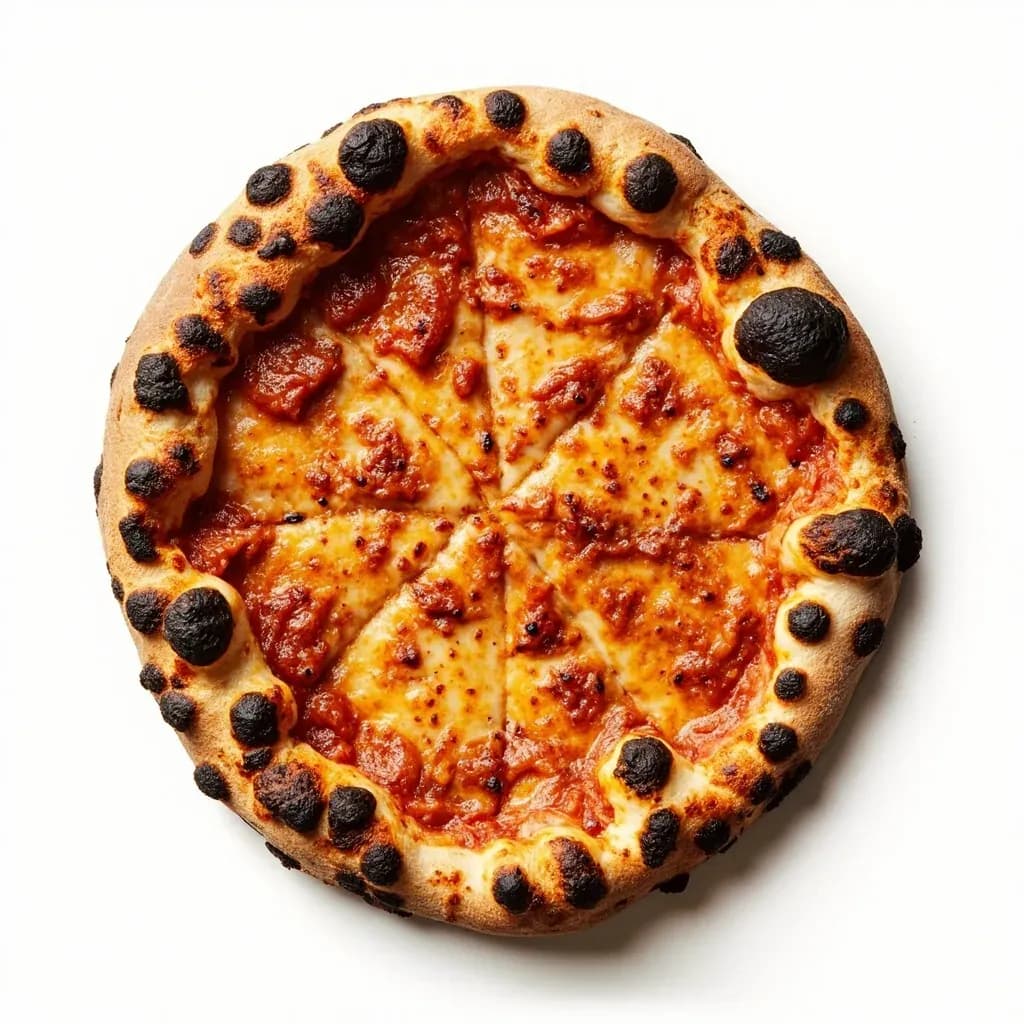
Blistering a pizza crust at high heat to produce the spotted, charred leopard-print rim.
Leoparding is the prized pattern of dark char spots on the puffed rim (cornicione) of a Neapolitan-style pizza, formed by very high oven heat hitting a well-fermented, high-hydration dough. The bursts of leftover sugars and gas in the dough scorch unevenly, creating the contrast spots without making the crust taste burnt. Achieving it depends on a hot deck, a brief bake and a properly proofed dough.
Leoparding is the blistering of a pizza's cornicione — the puffy outer rim of dough — under intense radiant heat, producing the dark, scattered spots that read like a leopard's coat (or, in streakier versions, tiger stripes). The phenomenon is the visible record of a specific chain of events: a wet, well-fermented dough with a dry outer skin meets a surface in the 430–500 °C range, the thinnest, driest points of starch and sugar scorch faster than the rest, and the result is pale-golden crumb punctuated by small black macules. It remains the single most reliable visual signal that a Neapolitan-style pie was baked hot and fast enough.
Beyond aesthetics, the spots carry real flavor. The light carbonization that darkens the surface adds a toasted, faintly bitter note that cuts through sweet tomato and rich cheese — a balance an evenly golden crust cannot match. Leoparding is also a diagnostic: the size, density, and color of the spots tell the cook whether the dough was properly fermented, whether the oven was hot enough, and whether the bake was timed right. A cornicione that has gone uniformly black has crossed from leopard to burnt, losing both the flavor and the elastic, tender crumb that defines a well-made pie.
- Difficulty
- Hard
Types & varieties
Small to medium black spots on a pale-golden cornicione after 60–90 seconds in a 900 °F wood oven; the canonical look.
Longer, streakier char marks produced by slightly cooler ovens or longer bakes; common on pan and tavern-style pies.
Faint speckling from a home oven at 500–550 °F; considered acceptable when true Neapolitan temperatures are not available.
A mostly black cornicione; treated as over-baked and bitter, not the goal.
How to do it
- 1
Build a high-hydration, well-fermented dough
Mix a 62–68% hydration dough with high-protein flour (12–14%), salt, yeast, and water. Cold-ferment in bulk or as balls at 3–4 °C (38–40 °F) for 24–72 hours so the gluten relaxes and flavor matures — the gas retention from a long cold ferment is what lets the cornicione puff and blister.
- 2
Preheat the oven to its maximum temperature
Bring a wood- or coal-fired oven to 430–500 °C at the dome with a stable floor around 400 °C. In a home oven, run it on its highest setting with the broiler on for at least 45–60 minutes, with a 1.5–2 cm pizza steel or 2.5–3 cm stone on the top rack; the floor must radiate heat back into the bottom of the crust.
- 3
Shape the dough gently
Bring a cold-fermented ball to room temperature and shape by hand from the center outward, leaving a thicker outer rim. Do not roll flat with a pin; preserve the air pockets that will become the charred bubbles.
- 4
Top lightly and leave the cornicione bare
Add sauce, cheese, and toppings only inside the rim. Brush the cornicione lightly with olive oil or leave it dry; heavy toppings or sauce on the rim trap steam and suppress spotting.
- 5
Launch and bake hot and fast
Transfer the pizza to the oven floor, or onto the preheated steel or stone. In a wood oven, bake 60–90 seconds. In a home oven, bake 4–7 minutes, finishing with 30–60 seconds under the broiler if you need additional top color.
- 6
Rotate for even spotting
Turn the pizza every 15–20 seconds in a wood oven, every 60–90 seconds in a home oven, so no single area sits in the hottest spot long enough to turn fully black.
- 7
Pull at the first sign of full leoparding
Remove the pizza when the cornicione shows scattered small-to-medium dark spots on a pale-golden background and the bottom is lightly blistered. Another 20–40 seconds in a wood oven moves you from leopard to burnt.
The chemistry of the spots
Leoparding is essentially a race between two reactions. Maillard browning acts on the surface proteins and sugars, building the pale-golden base; localized carbonization acts faster wherever the dough is thinnest, driest, or most exposed to direct radiant heat. Those thinnest points are the bubbles that rise at the outer edge of the cornicione where the dough has stretched taut — exactly the spots the eye reads as leopard print. Hydration, fermentation, and shaping all determine how dry and how bubbly that rim becomes, which is why dough conditions matter as much as oven temperature.
- A wetter rim produces bigger, glossier bubbles that char into larger macules; a drier rim produces finer, denser spotting.
- Reducing sugars developed during fermentation lower the threshold at which Maillard browning begins on the surface.
- Steam escaping the dough at the moment of bake carries away surface moisture, leaving the very top dry and ready to scorch within seconds.
Reading the spots as a diagnostic
The pattern of the cornicione is a report card. Pale, absent spots usually mean the oven was cool or the bake was long and gentle; that produces a sandy-gold crust without the toasted complexity. Tiny, dense, evenly scattered spots on a pale background are the goal — they indicate a hot, fast bake on a properly fermented dough. Large, blotchy black patches mean the pizza lingered in one hot spot; a fully black cornicione means the bake ran 20–40 seconds past the window in a wood oven, or the broiler ran too long at home.
- Pale cornicione → oven not hot enough, or dough over-floured and insulated.
- Even fine spots on pale gold → textbook leoparding, balanced bake.
- Streaky long marks → slightly cooler oven or pan-style bake, the tigrato look.
- Solid black rim → over-baked; flavor turns acrid and the crumb dries out.
Common uses
Tips & pitfalls
- Use high-protein flour (Type 00 or a strong bread flour at 12–14% protein) so the dough can hold steam and blister without collapsing at the rim.
- Keep hydration in the 62–68% range — too wet and the cornicione slumps before it can char; too dry and the rim won't blister at all.
- Cold-ferment at 3–4 °C for at least 24 hours, ideally 48–72, for flavor and for the gas retention the bubbles need.
- Shape by hand and resist the rolling pin; aggressive rolling destroys the air pockets that become the charred bubbles.
- Leave the cornicione bare or brush it only with a thin film of oil — sauce or cheese on the rim suppresses spotting and steams the surface instead of scorching it.
- Preheat the steel or stone for at least 45–60 minutes at full temperature; a lukewarm floor gives you a pale, evenly golden crust with no leoparding at all.
- Rotate frequently, but pull the pizza at the first sign of full spotting — a few seconds past the window flips leoparding into outright burning and acrid bitterness.
- Don't flour the peel heavily — burnt flour on the steel deposits bitter, smoky compounds onto the bottom of the cornicione and ruins the flavor balance.
Good to know
- Also called
- Tiger spotting, leoparded cornicione, maculato
- Required oven temperature
- 430–500 °C (800–930 °F) at the dome of a wood- or coal-fired oven; 260–290 °C (500–550 °F) at the ceiling of a home oven with a steel or stone
- Typical bake time
- 60–90 seconds in a Neapolitan wood-fired oven; 4–7 minutes in a maxed-out home oven
- Dough hydration range
- 60–75% (most pizzerias work in the 62–68% band for strong leoparding)
- Cornicione height target
- Roughly 2–3 cm in modern Neapolitan practice, with an airy, open crumb
- AVPN reference
- The Verace Pizza Napoletana standard specifies small dark spots on the cornicione and a height of 1–2 cm, soft and elastic
- Underlying chemistry
- Maillard browning plus localized carbonization of starches and sugars on the thinnest, driest points of the crust surface
- Difficulty
- Intermediate to advanced — controlled by oven, dough handling, and rotation timing
Also called
leopard spotting · cornicione charring
Related

Sear
Blast the surface hot for a deep-browned, savory crust

Sauté
Cook quickly in a little fat over lively heat, tossing as you go

Stir-Fry
Toss bite-sized pieces over roaring heat for fast, smoky cooking

Pan-Fry
Crisp food in a shallow layer of hot fat, turning once or twice

Deep-Fry
Submerge in hot oil for an all-over crackling crust

Roast
Cook uncovered in dry oven heat for browned edges and tender centers

Bake
Cook with steady, surrounding oven heat — the soul of bread and pastry

Broil
Hit food from directly above with fierce overhead heat