Water & Steam
Open-Kettle Cooking
Cooking food in an uncovered pot to reduce and concentrate it, also an old canning method.
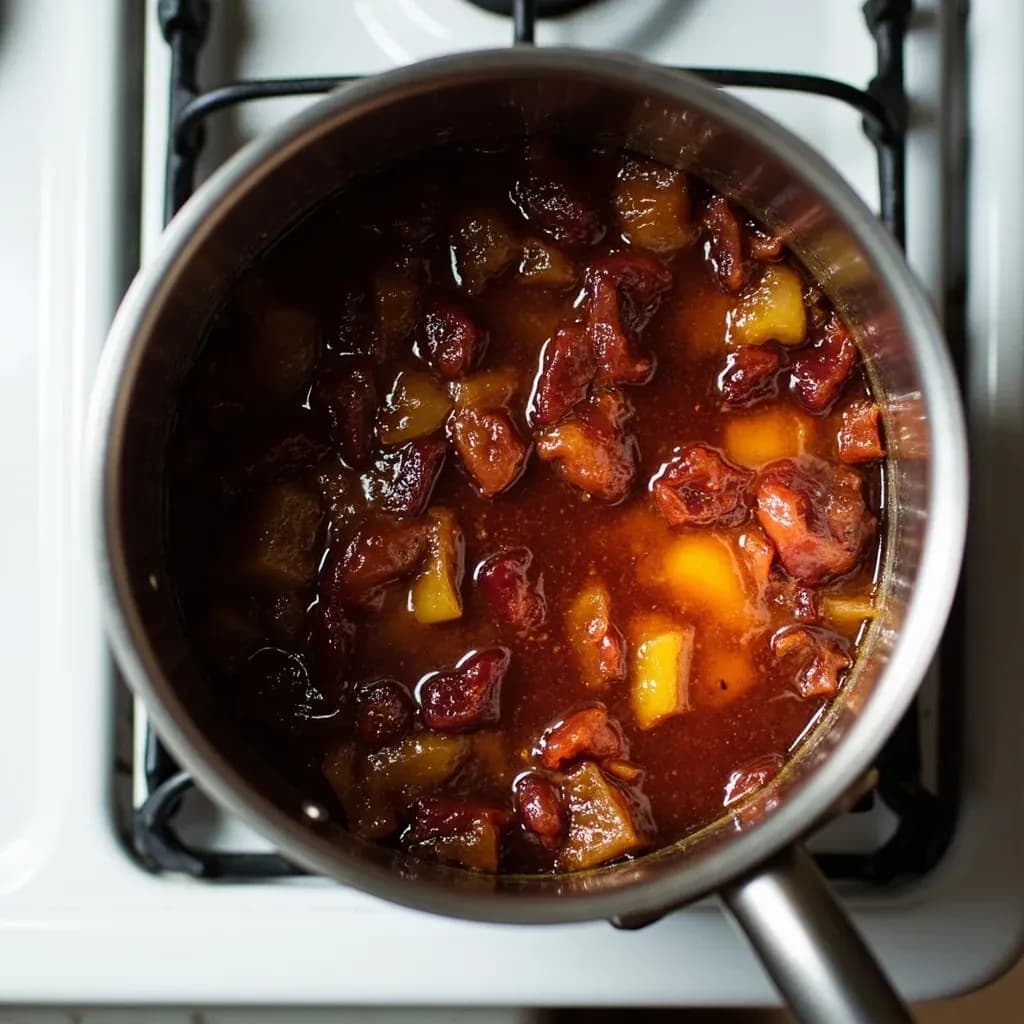
Open-kettle cooking simmers or boils food in an uncovered pot, allowing steam to escape so liquids reduce and flavors concentrate, as in jams, preserves and reductions. In old-style canning it referred to filling hot jars straight from the kettle without a water-bath process. That canning use is now considered unsafe by food authorities, which recommend a proper processing step, but the open-pot reduction itself remains a basic everyday method.
Open-kettle cooking refers to two distinct practices that share the same simple setup: a pot with no lid on it, working over direct heat. In the modern kitchen — restaurant or home — the term almost always means an uncovered simmer used to drive off water and concentrate flavor. Stocks, sauces, braising liquids, fruit purées, and jams all pass through some version of an open-kettle reduction as they thicken, deepen in color, and intensify in taste. Evaporation does the work that a lid would prevent, and the cook's job is to manage heat, skimming, and stirring as the volume drops.
The second sense is historical: open-kettle canning, also called the overflow method, was the standard way American households put up fruit, jam, and sometimes tomatoes and vegetables through the late 19th and early 20th centuries. Food was cooked to completion in the kettle, ladled into jars, and sealed with paraffin wax, cloth covers, or zinc lids, relying on steam and the cooling jar to pull a partial vacuum. The technique was eventually displaced by water-bath and pressure canning because it could not reliably destroy Clostridium botulinum spores in low-acid foods.
Today, open-kettle reduction is a foundational technique taught in every professional kitchen, while open-kettle canning is a relic best left on the shelf — except for high-acid, high-sugar preserves, where the food's acidity and sugar content provide their own safety margin. Both meanings still surface in older cookbooks, so it is worth knowing which one a recipe intends before you start.
- Difficulty
- Easy
Types & varieties
Uncovered simmer to thicken and concentrate a liquid such as a sauce, stock, soup, glaze, or pan jus. This is the everyday kitchen meaning.
Old-fashioned preserve method: food is cooked fully in the kettle, ladled hot into jars, and sealed — historically with wax, cloth, or zinc lids, later with two-piece metal lids. Considered obsolete for low-acid foods.
A subtype of open-kettle canning in which melted paraffin wax is poured over the hot jam or jelly in the jar to seal it. Predates widespread use of two-piece metal lids.
Industrial cousin: open steam kettles in jam and preserve factories, where the same principle of cooking uncovered in a single large vessel is scaled up.
How to do it
- 1
Choose the right vessel
Select a heavy-bottomed pot or preserving kettle wide enough to allow evaporation but deep enough to prevent dangerous boil-overs. Copper, enameled cast iron, or tri-ply stainless all conduct heat evenly and resist scorching.
- 2
Bring to a controlled heat
Start the liquid cold or at a simmer, then bring it to the target temperature — a bare simmer for stocks and long reductions, a steady boil for sauces and jam-making. Avoid a hard, unattended rolling boil.
- 3
Skim and monitor
Skim foam, fat, or scum from the surface during the early stages for clarity (stocks) or surface cleanliness (jams). Track volume visually or with a ruler-marked pot.
- 4
Stir with increasing frequency
Stir occasionally at first, then constantly as the liquid thickens. Sugars and milk proteins are the most prone to catching on the bottom.
- 5
Test for doneness
Use the appropriate test: a spoon-coating nappé for sauces, a candy thermometer reading for jams (typically 220°F / 104°C at sea level), or a measured volume reduction for stocks.
- 6
For preservation: prepare jars and lids
Wash glass jars in hot, soapy water and keep them hot (in simmering water or a 200°F oven). Have clean two-piece metal lids ready; do not reuse flat lids.
- 7
Ladle and seal at the boil
Ladle the boiling-hot food into hot jars, leaving the headspace called for in the recipe (usually 1/4 inch for jams, 1/2 inch for fruit). Wipe rims, apply lids and bands, and tighten fingertip-tight.
- 8
Cool, test seals, and store
Let jars cool undisturbed 12–24 hours. Press the lid center — it should not flex. Remove bands, wipe jars, label, and store sealed jars in a cool, dark place. Refrigerate any that failed to seal.
How an Open-Kettle Reduction Works
What is actually happening as a liquid reduces is a steady trade between heat input and water leaving the pot. A few practical observations help a cook predict and control the process.
- Evaporation rate is driven by surface area, not depth — a wide, shallow pot reduces a given volume noticeably faster than a tall, narrow one of the same capacity.
- As sugars and salts concentrate, the boiling point climbs and evaporation slows, so the last stretch of a reduction takes disproportionately longer than the first.
- Protein-rich liquids (stocks, milk, pan juices from seared meat) scorch more easily as the liquid concentrates; stir frequency should rise as volume falls.
- Acidic liquids such as tomato, wine, and vinegar concentrate both flavor and acidity together, so taste and adjust seasoning late rather than early.
- A lid briefly placed on the pot (or a splash of cool water) will not stop reduction meaningfully; once a lid comes off, evaporation resumes within seconds.
Common uses
Tips & pitfalls
- Use a wider, shallower pan to speed reduction — more surface area means faster evaporation.
- Never fill a reduction pot more than two-thirds full; foaming liquids climb quickly and a boil-over is a real safety hazard.
- Stir more often as the liquid thickens; sugars and proteins scorch easily once volume drops.
- For sauces, finish by mounting with cold butter off the heat for a glossy, emulsified texture.
- Skim impurities from the surface of stocks early in the reduction; once the liquid is concentrated, those particles are very hard to remove.
- For preservation, only use the open-kettle method with high-acid (pH 4.6 or below), high-sugar foods such as jams, jellies, and fruit butters — never for vegetables, meats, or seafood.
- If attempting open-kettle preservation today, use brand-new two-piece metal lids, sterilize jars in boiling water, and invert or rest jars to test the seal; discard anything that does not seal and refrigerate for immediate use.
- Ladle preserves into jars right at the boil and seal promptly so steam pushes air out and a partial vacuum forms on cooling.
Good to know
- Definition
- Cooking food in an uncovered (open) kettle either to reduce and concentrate a liquid, or as a traditional preservation method in which hot food is ladled into jars and sealed without further processing.
- Two main senses
- (1) A reduction and thickening technique for sauces, stocks, soups, and braises. (2) A historical 19th- and early 20th-century home canning method, sometimes called open-kettle canning or the overflow method.
- Historical use (preservation)
- Common in 19th- and early 20th-century American kitchens; appeared in early USDA Farmer's Bulletins and pre-WWII editions of Fannie Farmer, Joy of Cooking, and Ball canning literature.
- Modern safety status (preservation)
- The National Center for Home Food Preservation and the USDA no longer recommend open-kettle canning for vegetables, meats, or other low-acid foods because the seal is not reliable and botulism spores can survive. It is still occasionally used for high-acid, high-sugar preserves.
- Equipment
- Heavy-bottomed pot or preserving kettle (copper, enameled cast iron, or stainless), long-handled wooden spoon, ladle, wide-mouth funnel, glass canning jars, lids, and historically paraffin wax or cloth covers.
- Heat control
- A gentle simmer is typical for reductions; a rolling boil is used when filling jars for preservation to drive out air and help form a vacuum seal on cooling.
- Yield
- A reduction to nappé (coats the back of a spoon) usually means losing 50–80% of starting volume; long simmers such as demi-glace lose 75–90%.
- Difficulty
- Easy for simple reductions; moderate for the preservation method, where timing, jar sterility, and seal quality all matter.
Also called
open-pot cooking · uncovered simmering
Dishes that rely on it
Related

Boil
Cook in vigorously bubbling liquid at full rolling heat

Simmer
Hold liquid at a gentle shimmer for tender, unhurried cooking

Poach
Cook gently in barely-trembling liquid for silky, tender results

Steam
Cook in rising vapor to keep color, nutrients, and shape intact

Blanch
Plunge briefly in boiling water, then shock cold to lock color

Braise
Sear, then cook slow in a little liquid until fall-apart tender

Stew
Simmer bite-sized pieces fully submerged into a rich, unified pot

Sous-Vide
Seal and cook in precise warm water for edge-to-edge doneness