Prep & Assembly
Pounding Grain / Groundnuts
Using a mortar or pestle to crush grain, nuts, or roots into flour or paste.
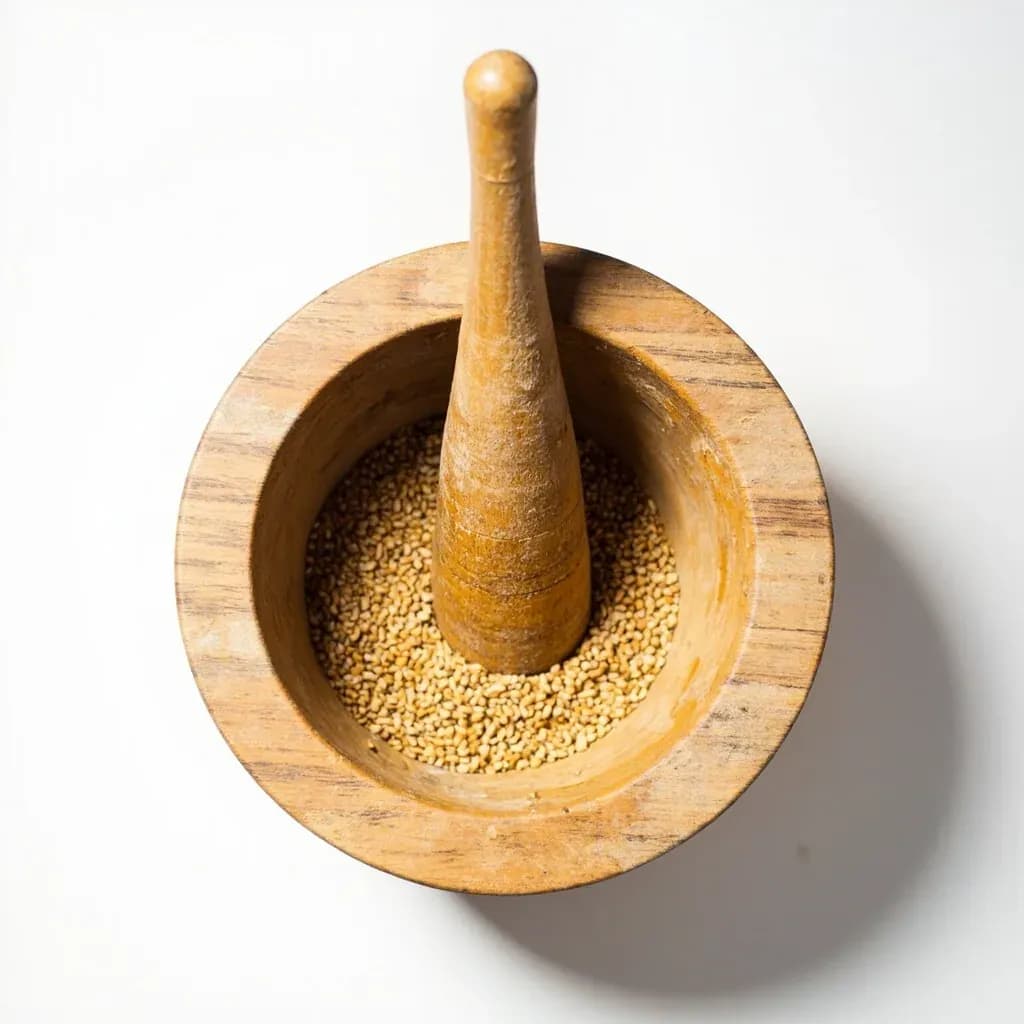
Pounding grain and groundnuts uses a large mortar and pestle to break cereals, peanuts, or roots like taro into flour, paste, or pounded staples such as fufu and poi. The rhythmic pounding controls texture from coarse meal to smooth paste. It is a foundational milling method across West African, Pacific, and many traditional kitchens.
Pounding grain and groundnuts is the oldest controlled size-reduction technique in the kitchen: a heavy vessel (the mortar) holds the material while a club-shaped tool (the pestle) breaks it down by impact and shearing. The motion is deceptively simple — a firm downward strike to crack, followed by a tilted, circular drag against the curved wall to grind. That combination is what distinguishes hand pounding from blade chopping or hammer milling, and it is the reason the technique has survived thirty millennia of kitchen evolution.
The practical advantage over an electric mill is twofold. First, almost no heat is generated, so the volatile oils in nuts and the aromatics in toasted spices survive intact. Second, the shearing action ruptures more oil-bearing cells than a cutting blade does, deepening nuttiness and producing a glossier paste. The trade-off is throughput: a hand mortar works one-third of a bowl at a time, and stone-grind fineness is reached only by sieving between rounds and returning the coarse fraction. Match hard stone to dry, hard material; wood or rough ceramic to wet pastes; and keep batches small enough to control.
- Difficulty
- Medium
Types & varieties
Mexican volcanic-stone mortar with a rough basalt interior that seasons with use; ideal for salsas, guacamole, and ground chile.
Japanese ridged ceramic mortar with wooden pestle; the grooves are designed to shear toasted sesame and small seeds rather than crush them flat.
Indian stone mortar with wooden pestle; the standard tool for chutneys, ginger-garlic paste, and freshly ground wet spice blends.
Thai and Lao clay or wooden mortar, deep and heavy, built for pounding curry pastes, nahm prik, and larb spice mixes.
Ghanaian floor-standing wooden mortar used to pound fufu, banku dough, and to crack maize, millet, and sorghum.
West and Central African wooden mortar paired with a tall wooden pestle for shea, egusi, and groundnut processing.
Ethiopian wooden mortar for crushing coffee beans, roasted barley, and spices for shai and tihlo.
Middle Eastern and South Asian; heavy vessel favored for small-seed spices, dried herbs, and coffee; can react with acidic foods and leave a metallic note.
Modern Western general-purpose workhorse with smooth walls for nuts, salt, and dried herbs.
How to do it
- 1
Choose the right mortar and pestle
Match the tool to the job: a heavy stone mortar (granite, basalt, or molcajete) for dry grain, nuts, and spices; a wooden or unglazed ceramic one for wet pastes and herbs. The pestle should fit comfortably so its face rides the wall with each stroke.
- 2
Prepare the material
Toast grains or nuts in a dry pan over medium heat just until fragrant (1–4 minutes depending on size), then cool fully. Roasting dries the surface, deepens flavor, and makes the hull brittle so it shatters cleanly under the pestle. Remove papery skins from nuts if a smoother result is wanted.
- 3
Charge the mortar
Add only enough material to cover the bottom by roughly 3–4 cm, or fill the bowl one-third. Too much at once traps coarse fragments in the center where the pestle cannot reach them.
- 4
Initial break — vertical strikes
Begin with firm, direct downward strikes, no twisting. The aim is to crack every kernel. Listen for the crisp shatter sound; when the strikes go dull, the material is already fragmenting and it is time to switch motion.
- 5
Shear and grind against the wall
Tilt the pestle and press it in a slow, continuous circle against the inside of the mortar, applying body weight. This is where the real reduction happens. Pause every 15–20 seconds to scrape the sides and base back into the working zone.
- 6
Sieve and return the coarse fraction
Tip the contents into a mesh sieve held over a bowl. For cracked grain, use a coarse screen; for flour, a fine one. Return anything that does not pass through to the mortar and repeat the shearing step. Two or three passes usually yield a uniform flour.
- 7
Adjust moisture for a paste (optional)
If the goal is a paste (nut butter, tahini, curry paste), switch to wet material or drizzle in 1–2 teaspoons of water or neutral oil. Work in long, slow circles; the released oils will bind the meal into a glossy paste within a few minutes.
- 8
Store or use immediately
Use fresh-ground flour and nut pastes the same day when possible. If storing, pack airtight, label with the date, and refrigerate nut flours and pastes; grain flours keep 1–3 months in a cool, dark cupboard.
Why pounding beats the blade
A food processor chops; a mortar shears. That distinction matters most in nut and spice work, where flavor lives inside fragile oil cells. When a blade whirs at high speed it cuts and heats, volatilizing the very compounds that make freshly toasted nuts and seeds aromatic. The pestle, by contrast, opens those cells slowly against a rough wall, releasing the oil as a free liquid that binds the meal into a paste on its own. This is why a hand-pounded peanut sauce tastes deeper than a blended one, and why a molcajete salsa carries an aroma a food processor cannot match.
- Low heat preserves volatile aromatics in spices and toasted nuts.
- Shearing ruptures more oil cells than a cutting blade, deepening flavor and body.
- Released oils bind the meal into a paste without added liquid.
Stone, wood, or ceramic: matching the tool to the job
Material choice is functional, not aesthetic. Hard stone (granite, basalt) handles dry, abrasive work — cracking grain, crushing peppercorns, pounding roasted nuts. Wood absorbs impact and resists slipping, making it the right call for wet, sticky pounding such as curry paste or fufu. Rough unglazed ceramic (a suribachi) sits in between, its grooves designed specifically to shear rather than crush, which is the key to releasing sesame oil. A smooth marble mortar is a generalist; a brass mortar is heavy and cool but can react with acidic foods.
Common uses
Tips & pitfalls
- Fill the mortar only one-third full; overfilling wastes energy and traps coarse pieces in the center where the pestle cannot reach them.
- Lead with a firm downward strike, then drag the pestle around the wall in a slow circle; the shearing motion does most of the work, not the pounding.
- For nuts, work in a steady pulse-pulse-pulse rhythm; constant pounding heats the oils and turns the batch into a greasy paste before it is fully broken down.
- Sieve between rounds and return the coarse fraction for further pounding; this repeated sifting is how traditional stone-grind flour was actually made.
- Season a new stone mortar before use: grind dry rice, then salt, then a little oil, discarding each batch, to knock off loose grit and tighten the surface.
- Drizzle in a teaspoon of water or oil when pounding very dry material into flour to tame dust and help the meal bind.
- Common mistake: using a glass or glazed ceramic mortar for hard grain, which chips; reserve hard stone for grain and wood for wet pastes.
- Common mistake: expecting a smooth paste from dry grain without sieving; repeated sifting is the difference between coarse meal and true flour.
Good to know
- Technique Type
- Mechanical size reduction by combined impact and shearing
- Primary Equipment
- Mortar (vessel) and pestle (pounder)
- Mortar Materials
- Granite, basalt/volcanic stone, unglazed ceramic, wood, brass, marble, clay
- Earliest Evidence
- Ground stone mortars from the Upper Paleolithic, roughly 30,000+ years ago
- Key Motion
- Downward impact to crack, then circular shearing against the wall to grind
- Heat Buildup
- Low; preserves volatile oils and aromatics better than high-speed electric grinding
- Working Batch
- Fills the mortar one-third to one-half full for best control
- Flavor Effect
- Cell rupture by shearing releases more oils and aromatics than blade chopping
Also called
Pounding Groundnuts into Flour · Taro Pounding
Related

Whisk
Beat ingredients smooth and aerated with a looping wire motion

Sift
Pass dry ingredients through mesh to aerate and remove lumps

Strain
Pour through mesh to separate solids from liquid for a smooth result

Filter
Pass liquid through fine material to clarify out the smallest particles

Rice
Press cooked potatoes through small holes for fluffy, lump-free texture

Mash
Crush soft cooked food into a rustic, creamy purée

Grind
Crush food into a coarse to fine texture, from spices to meat

Grate
Shred food into fine bits against a sharp-toothed surface