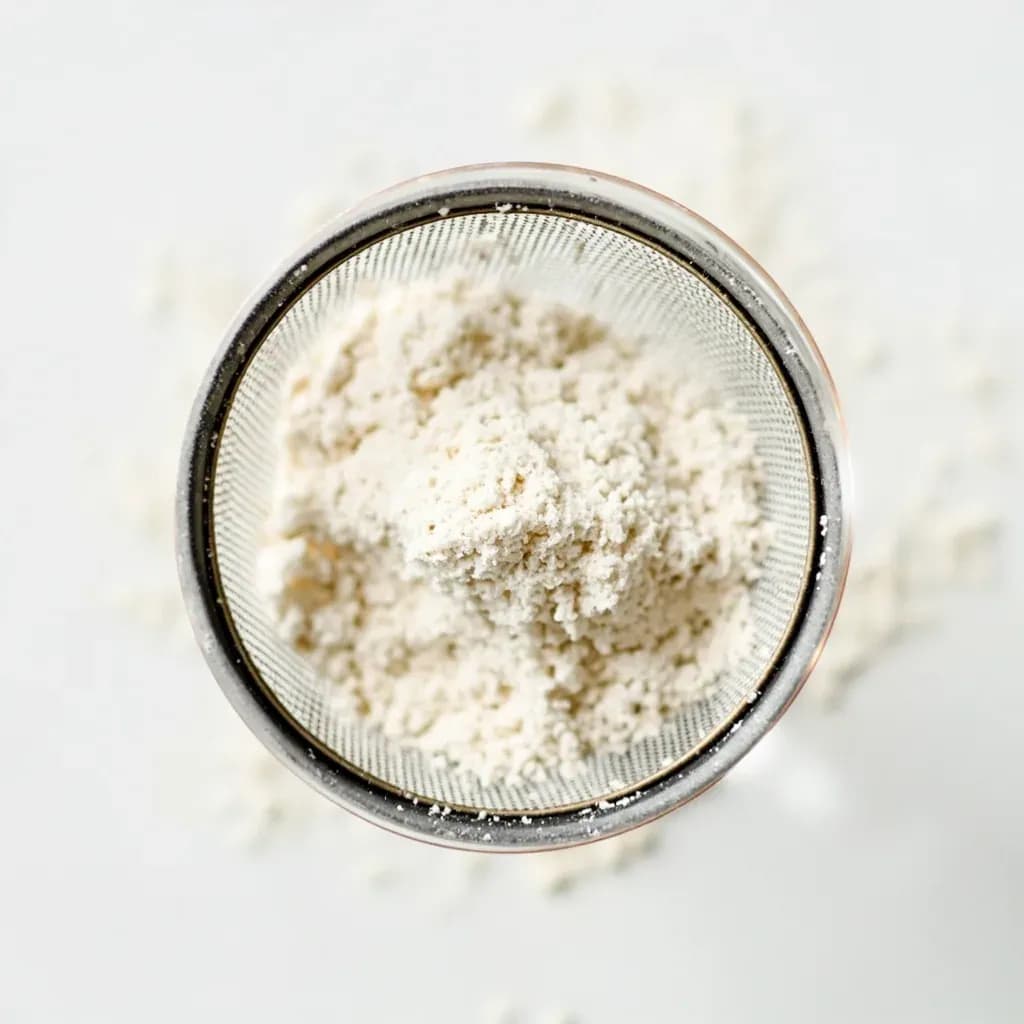
Prep & Assembly
Sieving
Passing dry ingredients through a mesh to aerate and remove lumps.
Sieving shakes dry ingredients like flour, sugar, or cocoa through a fine mesh to break up lumps, remove impurities, and add air. Aerated, lump-free flour blends more evenly into batters and produces a lighter crumb. Sieving also combines and evenly distributes leaveners and spices through flour before mixing.
Sieving is the act of passing a dry or semi-wet ingredient through a woven mesh to separate fine particles from coarse ones, to aerate, or to combine dry ingredients evenly. It is among the oldest food-prep techniques on record — Roman and medieval mills used woven silk called bolting cloth to grade flour, and the modern kitchen sieve descends directly from that tradition. In contemporary cooking, sieving does three jobs at once: it breaks up and removes lumps, it lightens the texture of dense powders like flour and cocoa, and it disperses tiny amounts of leavening and salt uniformly through a larger volume of dry mix.
The technique looks trivial but carries real consequences in baking. A cup of sifted all-purpose flour weighs roughly 120 g, while a cup scooped and leveled straight from the bag can weigh 140–150 g — a 20–25% gap that will dry out a cake or toughen a cookie if the recipe assumed sifted weight. Sieving also introduces air into flour in a way whisking cannot replicate, which is why a properly sifted génoise has a more open crumb and why pastry recipes for shortbread, financiers, and macarons call for sifting dry ingredients together two or three times. Beyond dry work, a fine-mesh sieve (or its conical cousin, the chinois) is the standard tool for refining purées, stocks, consommés, and pan sauces.
Modern recipes use 'sift' and 'sieve' interchangeably, but the tools and motions differ. Sifting historically referred to a dedicated vessel with a mechanical agitator — the squeeze-handle or rotary drum sifter that pushed flour through mesh as it was cranked. Sieving implies a flat or hoop-mounted mesh that you tap or shake by hand. For most cooks the practical distinction barely matters: a fine-mesh sieve and a squeeze-handle sifter produce nearly identical results. What does matter is the mesh count, the cleanliness of the tool, and the habit of measuring correctly.
- Difficulty
- Easy
Types & varieties
Standard household sieve, ~40–60 mesh; the workhorse for flour, cocoa, powdered sugar, and cornstarch.
Larger openings; for draining pasta, rinsing grains, and removing debris from stocks and reductions.
French drum- or hoop-mounted fine mesh (often 80–100+); used in professional pastry to press purées, almond paste, and soft doughs to an ultra-fine texture.
Conical fine-mesh strainer; technically a strainer but performs fine sieving on sauces, consommés, and fruit purées.
Hand-cranked drum with an internal agitator; historical bakery equipment for bolting large volumes of flour.
A sifter rather than a sieve — mechanically pushes flour through mesh via a wire agitator. Functionally similar to sieving but a distinct tool.
Light and flexible, gentler on delicate ingredients; preferred for dusting finished desserts with powdered sugar or cocoa.
Stacked sieves used in pastry for very fine cocoa, almond flour, or confectioners' sugar without losing volume.
How to do it
- 1
Choose the appropriate mesh
Select a fine-mesh sieve (~40–60 mesh) for flour, cocoa, and powdered sugar. Reach for a coarse mesh only when texture in the liquid is acceptable (rinsing grains, draining pasta). For ultra-fine pastry work, use a tamis or a nylon-over-metal double-sieve.
- 2
Set up the station
Position the sieve over a bowl, sheet pan, or directly over the mixing bowl, leaving clearance to tap the rim. The receiving vessel must be dry — moisture clumps freshly sifted flour and undoes the work.
- 3
Load the ingredient
Add the dry ingredient to the sieve in batches of no more than about 2 cups at a time. Overloading the mesh slows the work and lets fine material bridge over lumps instead of passing through.
- 4
Agitate through the mesh
Tap the side of the sieve firmly with the heel of your hand, a wooden spoon, or a whisk in a circular motion. Let gravity and momentum do the work — resist the urge to push through with your fingers, which presses lumps back through and introduces skin oils.
- 5
Handle leftover coarse material
Discard obvious debris, or process it further if the recipe needs the full yield — pulse stubborn brown sugar in a spice grinder, or press soft material through with the back of a spoon. Don't force visible lumps through; that defeats the purpose.
- 6
Repeat or combine as needed
For delicate baking (sponge, génoise, financiers) or stubborn ingredients, sift a second time. To blend dry ingredients evenly, sift them together rather than whisking in a bowl — this is the most reliable way to distribute small amounts of leavening and salt.
- 7
Clean immediately
Tap out residue, rinse with warm water, and brush the mesh from underneath with a soft brush. Dry thoroughly — standing water promotes rust on steel and stains on brass, and dried batter or egg white sets hard in the mesh and is tedious to remove later.
The weight trap: sifted versus scooped flour
The single biggest source of error in home baking is the confusion between 'sifted before measuring' and 'sifted after measuring.' Modern recipes from King Arthur, Cook's Illustrated, Modernist Cuisine, and most contemporary pastry writers assume the first convention: sift the flour to aerate, then spoon it lightly into the cup and level. A cup measured that way weighs around 120 g. Older American recipes that say '1 cup flour, sifted' technically mean the opposite — measure first, then sift — and a cup measured by dipping and leveling straight from the bag can weigh 140–150 g. If you sift an already-scooped cup, you lose roughly 20–25% of the flour's mass and the resulting batter will be noticeably drier and tougher than the recipe intended. When in doubt, treat the recipe as sifted-before-measured; it is the safer convention for today's baking.
- Sifted-then-measured: 1 cup AP flour ≈ 120 g — the modern convention.
- Scooped-then-leveled: 1 cup AP flour ≈ 140–150 g — what happens if you dip the cup into the bag.
- Do not sift twice. Choose the convention the recipe implies and stop.
- For repeatability, weigh flour in grams whenever the recipe gives a weight; volume sieving becomes irrelevant.
Reading mesh count
Mesh count is the number of openings per linear inch, so a higher number means a finer screen. The 40–60 mesh of a standard fine-mesh sieve is fine enough to catch the worst cocoa and confectioners' sugar lumps while still moving a cup of flour in under a minute. A true tamis or bolting cloth runs 80–100 mesh, and confectioners' standards can reach 200 — too fine for routine dry work, but the right call for almond flour, pistachio flour, and ultra-smooth sugar decorations. The corollary is that a coarse-mesh sieve (8–20 mesh) is the wrong tool for dry ingredient work; reserve it for draining, rinsing, and rough straining where texture in the liquid is acceptable.
- 40–60 mesh: flour, cocoa, confectioners' sugar, cornstarch, dry spice blends.
- 80–100 mesh: tamis-grade work — almond flour, macaron dry mixes, very fine cocoa.
- 150–200 mesh: confectioners' standards, dusting sugar through a drum.
- 8–20 mesh: draining pasta, rinsing rice, removing herb stems from a stock.
Common uses
Tips & pitfalls
- Sift before measuring when a modern recipe specifies '1 cup sifted flour'; sifting after measuring reduces the volume and skews the ratio.
- Sift first, then spoon lightly into the measuring cup and level with a straight edge — never pack or scoop directly into the cup.
- Keep the sieve scrupulously dry and clean: moisture makes flour clump and clog the mesh, and residue from a previous job can contaminate the next.
- Tap the side of the sieve with the heel of your hand, a wooden spoon, or a whisk rather than pushing through with your fingers.
- For stubborn lumps in cocoa or brown sugar, break them up against the mesh with a fork first, or sift twice.
- To combine dry ingredients evenly, sift them together rather than whisking in a bowl — more reliable for distributing small amounts of leavening and salt.
- A double-sift through two stacked sieves gives the finest, most aerated result for delicate sponges, dacquoise, and financiers.
- Don't over-sift high-protein bread flour — the aeration benefit is minimal and you will just lose volume you need for hydration calculations.
- For dusting desserts, use a small fine-mesh dredger or a dedicated sugar shaker to control flow and avoid heavy-handed clumps.
- Clean sieves immediately after use: stainless sieves are dishwasher-safe; brass and nylon should be hand-washed and dried to prevent corrosion and warping.
Good to know
- Type
- Mechanical dry-and-wet preparation technique
- Primary tool
- Mesh sieve — stainless steel, brass, or nylon
- Common mesh sizes
- 40–60 mesh for general dry work; 80–200 mesh for fine bolting and tamis work
- Origin
- Among the oldest food-prep techniques; bolting cloth used in Roman and medieval flour mills
- Related terms
- Sifting, bolting, straining, tamisage, winnowing
- Etymology
- From Old English 'sife' (to sift); 'tamis' from Old French, from Vulgar Latin *tamisium
- Effect on flour weight
- A cup of sifted AP flour weighs ~120 g vs. ~140–150 g for an unsifted scooped cup — roughly a 20–25% difference
- Typical time
- 30 seconds to 2 minutes per cup of dry ingredient
Also called
Sieving Flour · Sifting
Dishes that rely on it



Related

Whisk
Beat ingredients smooth and aerated with a looping wire motion

Sift
Pass dry ingredients through mesh to aerate and remove lumps

Strain
Pour through mesh to separate solids from liquid for a smooth result

Filter
Pass liquid through fine material to clarify out the smallest particles

Rice
Press cooked potatoes through small holes for fluffy, lump-free texture

Mash
Crush soft cooked food into a rustic, creamy purée

Grind
Crush food into a coarse to fine texture, from spices to meat

Grate
Shred food into fine bits against a sharp-toothed surface