Prep & Assembly
Purging Shellfish
Soaking live clams or mussels in salted water so they expel sand and grit.
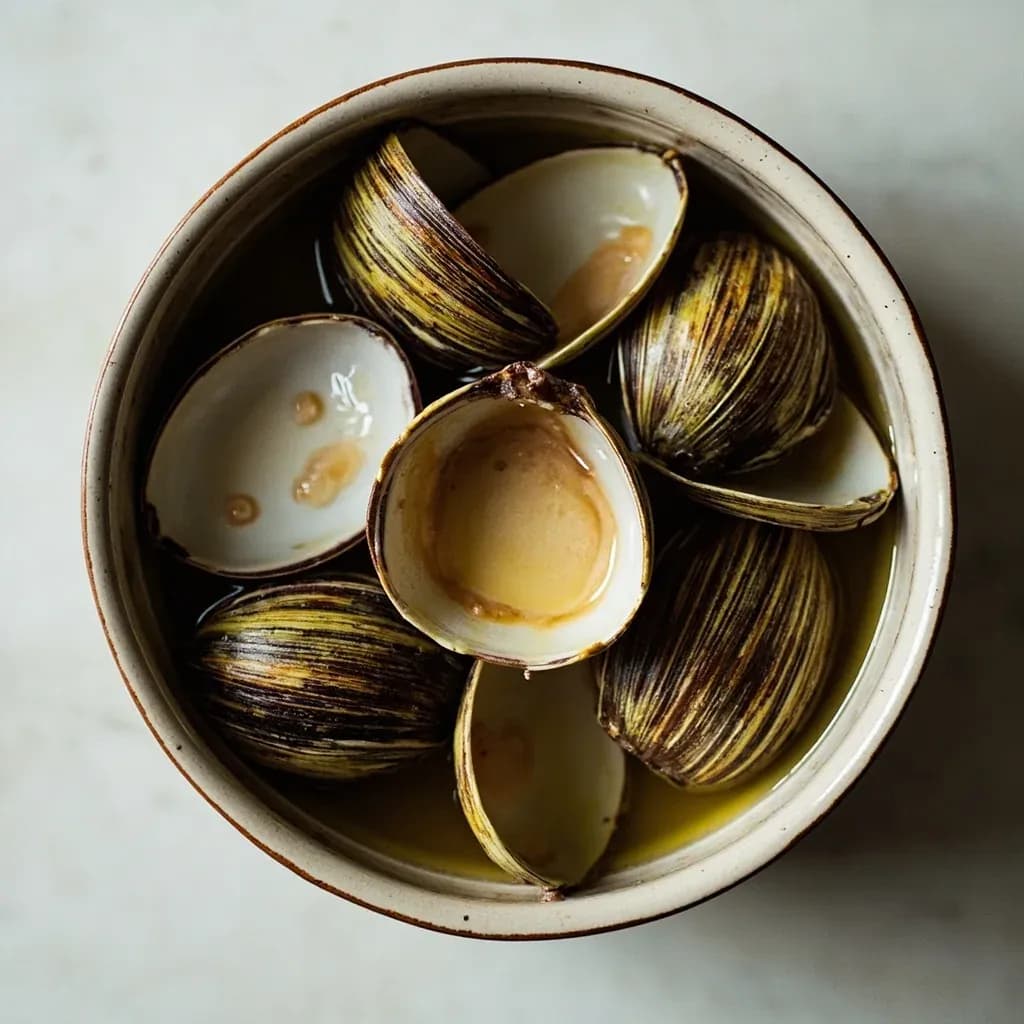
Purging shellfish keeps live clams, mussels, or cockles in cool salted water for a half hour to several hours so they filter-feed and spit out trapped sand and grit. The salinity should mimic seawater to keep the shellfish alive and active, and a sprinkle of cornmeal or flour is sometimes added to encourage them to flush. Skipping this step leaves a gritty, ruined dish, so it is essential before steaming or stewing wild-harvested bivalves.
Purging is the simple but essential step of soaking live bivalves in cold, clean, salt-matched water so they filter out the sand and grit they hold inside their shells. Any cook who has cracked open a chowder clam only to bite into gravel knows why this matters — sand hides in the mantle cavity and digestive tract of wild-dug shellfish, and no amount of exterior rinsing fixes it. The good news is that the animals do the work themselves. Bivalves feed by drawing water over their gills and trapping particles; given a clean bath, they keep filtering and continue to void the sediment they swallowed in the wild, leaving you with sweet, clean meat.
How aggressively you purge — or whether you purge at all — depends on provenance. Rope-grown mussels and tumbled farm clams have been raised on clean lines or in sand-free tanks and need little more than a quick rinse and a de-bearding. Wild Atlantic quahogs dug from a tidal flat, by contrast, can be stubbornly sandy and benefit from hours in the bath. Razor clams from certain beaches are the most notorious. Treat purging as a variable, not a ritual: match the soak to the animal and to how it was harvested.
Two environmental mistakes kill a purge faster than anything else. Fresh water, which is hypotonic to bivalve tissue, shuts their valves and halts filtration within minutes. Warm water accelerates metabolism, exhausts the animal's glycogen reserves, and kills it mid-soak. Keep the bath genuinely cold, genuinely salty (near seawater, around 3.5% salinity), and in the dark, and the shellfish will do the rest.
- Difficulty
- Easy
Types & varieties
Used for hard-shell clams (quahogs, littlenecks, topnecks, cherrystones), Manila clams, and razor clams. Wild Atlantic quahogs are the sandiest; Manila and farmed clams often need little or no purging.
Used for blue mussels (Mytilus edulis) and Mediterranean/Galician mussels. Cultivated rope-grown mussels are usually clean within 30 minutes; wild bottom mussels need longer.
Less common — most marketed oysters are already tumbled and clean, but cupped or wild oysters can be purged similarly to reduce grit before shucking.
Traditional home method of adding cornmeal or flour to the saltwater, claimed to 'feed' the shellfish and displace grit. Effectiveness is debated — grit clearance comes mainly from re-filtering clean water, not from eating the meal.
How to do it
- 1
Inspect and discard
Spread the shellfish on a sheet pan in a single layer. Throw out any with cracked, broken, or chipped shells, and any that are open and do not snap shut when rapped firmly on the counter — these are dead and unsafe.
- 2
Make the saltwater bath
Fill a large non-reactive bowl or bucket with cold water (around 40°F / 4°C). Stir in non-iodized salt at roughly 1/3 cup per gallon (≈ 35 g per liter) and mix until dissolved. If using chlorinated tap water, prepare it 24 hours ahead and leave uncovered, or treat with aquarium dechlorinator.
- 3
Submerge the shellfish
Place the clams or mussels in the saltwater, ensuring they are fully covered. Set a clean plate or weighted colander on top to keep them submerged — animals above the waterline won't filter and purge.
- 4
Soak in darkness and cold
Move the container to a dark, cool spot — a refrigerator, cold cellar, or shaded back porch. Allow 30–60 minutes for mussels and cultivated clams, 1–2 hours for most wild hard clams, and up to 4–8 hours (or overnight) for notoriously sandy species like razor clams or wild quahogs.
- 5
Skim, change, and check
Skim any foam or floating debris from the surface. If a thick layer of grit collects on the bottom, gently lift the shellfish out with a slotted spoon, pour off the water, rinse the container, and start a fresh batch. Many cooks skip the change for short purges; sandy wild clams benefit from a water swap after the first hour.
- 6
Drain, scrub, and re-check
Lift the shellfish into a colander and drain. Scrub each shell with a stiff brush under cool running water to remove mud, barnacles, and loosened sand. Pull off the beard (the fibrous threads) from mussels by pulling firmly toward the hinge. Give each shell one last tap; discard any that remain open.
- 7
Cook promptly or chill
Cook purged shellfish within a few hours for best quality, or store them uncovered on a tray over ice in the refrigerator (with a damp towel, not sealed) for up to one day. Drain off any liquid released in storage — it is not seawater, it is purge water.
The biology behind the soak
Purging works because of how bivalves eat. A clam or mussel draws water in through an incurrent siphon, passes it over gills that trap phytoplankton and particles, and pushes the cleaned water back out the excurrent siphon. The digestive tract processes those trapped particles; any heavy sediment swallowed in the wild is eventually excreted. In a fresh, cold, oxygenated bath the animal keeps doing all of this. That is why purging is not about soaking dirt off the outside of the shell — it is about giving the animal time to clean its own interior.
- Salinity near seawater (~3.5%) keeps tissues in osmotic balance so the animal stays alive and filtering.
- Cold water slows metabolism so the animal does not burn through its glycogen reserves during a long soak.
- Darkness and stillness matter because vibration and bright light trigger the shells to clamp shut, halting filtration.
- Cornmeal or flour added to the water does not meaningfully feed the animal — grit clearance is driven by the filtration of clean water, not by what is suspended in it.
Common uses
Tips & pitfalls
- Use non-iodized salt — sea salt, kosher, or pickling salt; iodine irritates the animals.
- Keep the water genuinely cold; shellfish that warm up exhaust themselves, gape, and die mid-purge.
- Toss dead shellfish at the start — one cracked or unresponsive clam will spoil the entire bath.
- Change the water once if it becomes very cloudy, especially with wild clams releasing heavy grit.
- Don't purge for more than ~12 hours — beyond that, the animals deplete reserves and begin to die.
- Scrub shells after purging, not before — the soak loosens mud and barnacles that dry brushing won't shift.
- Recheck liveness right before cooking — shellfish that survived purging can still die in storage.
- Skip purging for clearly labeled 'farm-raised' or 'tumbled' shellfish — the grower has already done it, and you will only add stress.
Good to know
- Primary subjects
- Live bivalves — hard-shell clams (littlenecks, topnecks, cherrystones, quahogs, Manila, razor) and mussels (blue/PEI, Mediterranean, green-lipped)
- Salinity target
- About 30–35 g sea salt per liter of cold water (roughly 1/3 cup non-iodized salt per gallon), near natural seawater
- Water temperature
- Cold, 38–45°F / 3–7°C; refrigerate the bath or add ice as it warms
- Typical soak time
- 30–60 minutes for mussels; 1–2 hours for most clams; up to overnight for very sandy wild clams
- Environment
- Dark, cool, undisturbed — light and vibration keep shells clamped shut and halt filtration
- Tap-water note
- Let chlorinated tap water sit uncovered for 24 hours or treat with aquarium dechlorinator; chlorine kills shellfish quickly and aborts the purge
- Difficulty
- Beginner; forgiving if salinity and temperature stay in range
- Maximum safe soak
- Roughly 12 hours — beyond that, animals deplete reserves and begin to die
Also called
Purging Clams · Degritting Shellfish
Dishes that rely on it
Related

Whisk
Beat ingredients smooth and aerated with a looping wire motion

Sift
Pass dry ingredients through mesh to aerate and remove lumps

Strain
Pour through mesh to separate solids from liquid for a smooth result

Filter
Pass liquid through fine material to clarify out the smallest particles

Rice
Press cooked potatoes through small holes for fluffy, lump-free texture

Mash
Crush soft cooked food into a rustic, creamy purée

Grind
Crush food into a coarse to fine texture, from spices to meat

Grate
Shred food into fine bits against a sharp-toothed surface