Prep & Assembly
Shucking
Prying open shellfish like oysters and clams to release the meat while keeping the liquor.
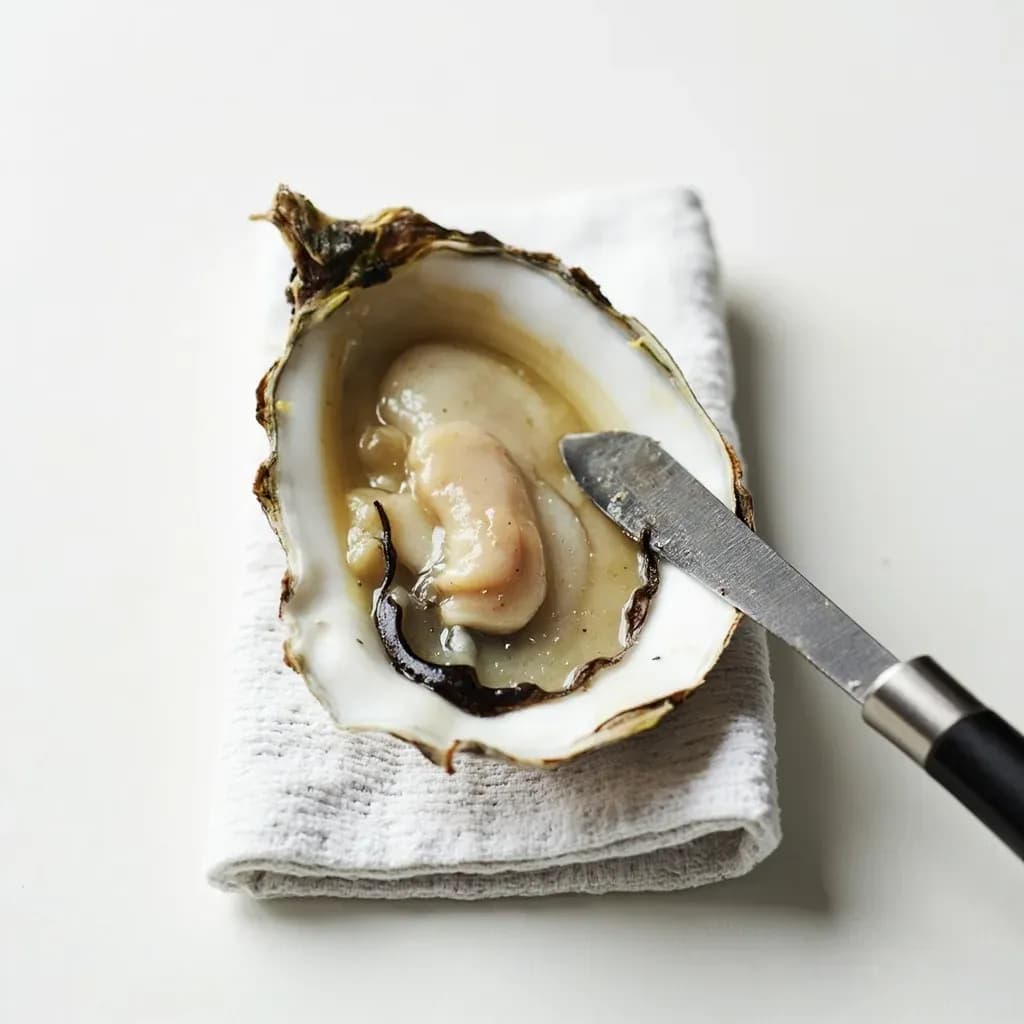
Shucking opens bivalves such as oysters and clams by working a knife into the hinge and severing the muscle. It is done to serve them raw on the half shell or to free the meat for cooking, ideally saving the briny liquor inside. A folded towel and a stubby shucking knife protect the hand and give leverage. The goal is a clean shell with intact, unbroken meat.
Shucking is the controlled opening of a bivalve mollusk — oysters, clams, mussels — with a short, rigid knife so the meat and its briny liquor can be released without being chopped, punctured, or rinsed away. It is one of the rare kitchen tasks where the dedicated tool is genuinely non-negotiable: a flexible chef's knife or paring knife will skate across the shell and into your holding hand. The oyster knife is short, stiff, and blunt-tipped by design, and that blunt tip is what lets the blade wedge into the hinge and stay there once you start to twist.
A live bivalve is held shut by two adductor muscles — one anchored to each shell. Shucking is the process of finding the hinge, popping it open, severing the top adductor against the flat upper shell, then slipping under the meat to release the bottom adductor so the oyster settles intact into its cupped shell. The lower muscle is what keeps the oyster from tumbling out of the cup on the way to the table, which is why severing top first, then bottom, in that order is what distinguishes a clean shuck from a mangled one.
The work matters because a freshly shucked raw oyster or clam is at its most flavorful the moment the shell is opened: cold, briny liquor intact, no oxidation, no rinse-water dilution. Done well, it is a ten-to-thirty-second task per oyster. Done badly, it is the most common way cooks lose a fingertip at the raw bar.
- Difficulty
- Medium
Types & varieties
The standard raw-bar oyster. The hinge gives relatively easily to a stiff oyster knife, and most are shucked live to order.
Deeper cups and thicker shells; often sold pre-shucked, but the same hinge technique applies when shucked to order.
Small, round, deep-cupped, and prized; identical shucking method, just a smaller target, so they are a good oyster to practice on.
Littleneck, topneck, cherrystone, and chowder grades. Shucked with a longer, thinner clam knife; littlenecks are tender enough to eat raw, chowders are not.
Brittle shells with a black siphon; opened with a paring knife by cutting the meat free rather than popping a hinge, then the dark siphon tip is removed.
Most often pulled apart after steaming; raw shucking severs the single adductor and the beard. Less commonly shucked raw for service than clams or oysters.
How to do it
- 1
Chill and inspect the shellfish
Keep oysters or clams on ice or in the refrigerator (34–40°F / 1–4°C) until you are ready. Tap any open ones; discard those that don't snap shut. Rinse the outside under cold running water to knock off loose mud and grit.
- 2
Set up with the right grip
Place the oyster cup-side down on a folded kitchen towel. Hold it firmly with your non-dominant hand, also wrapped in the towel or wearing a chain-mail oyster glove, so the knife cannot reach your palm if it slips. The hinge should face you.
- 3
Find and puncture the hinge
Identify the pointed hinge end (the umbo). Wedge the tip of the oyster knife into the slight gap there. You are not cutting — you are working the tip into a notch that is already there.
- 4
Pop the hinge
With firm downward pressure, twist the knife handle from side to side like turning a key. The hinge will give with a small pop and you will feel the shells relax in your hand.
- 5
Sever the top adductor muscle
Keep the blade horizontal and slide it along the inside of the top (flat) shell, just under the shell surface, all the way to the far edge. The top adductor will release and the lid will lift free. Set the lid aside.
- 6
Release the bottom adductor
Slide the knife gently under the oyster meat, staying close to the inside of the cupped bottom shell, and cut through the lower adductor. Let the oyster settle back into its own liquor.
- 7
Check and present
Run your finger or the knife tip around the cup to dislodge any shell fragments. Confirm the oyster is intact and sitting in clear liquor. Serve on the half shell over crushed ice, or proceed with the recipe. Strain and reserve the liquor.
- 8
Shucking a hard-shell clam (quahog)
Same hinge approach, but with a longer, thinner clam knife. After popping the hinge, run the blade around the inside of both shells to release the two adductors and the foot. Pour off the dark belly liquor before serving raw — it is gritty and strong.
- 9
Cleaning a soft-shell clam (steamer)
Soak in salted cold water for 30 minutes or more to purge sand. Shuck raw with a paring knife by slicing the meat free of the fragile shells, then pull off the dark leathery siphon tip and the tough membrane along the neck — both are gritty and unpleasant to eat.
The two-muscle rule
Every bivalve shucked on the half shell is held in its cup by one muscle, the lower adductor, after the hinge is popped. The order of cuts is not optional. Cut the bottom muscle first and the oyster is loose meat floating in a shell — it slides around, tips over, and loses its presentation. Cut the top muscle first, sweep the lid away, then slip the blade under the meat and release the bottom adductor, and the oyster drops back into its own liquor like it never moved. That single sequence — top, then bottom — is what raw bars drill into new shuckers, and it is the difference between a clean plate of half shells and a cup of oyster soup.
Raw shucking vs. cooked prep
Shucking for raw service is the most demanding version because the meat, the liquor, and the presentation all have to survive intact. Shucking for cooked dishes — chowders, grilled oysters, broiled oysters Rockefeller, pasta alle vongole, cioppino — is more forgiving: the meat can be looser, the shells may be discarded, and a little extra liquor in the pan is a bonus, not a problem. For cooked work many cooks steam the bivalves just until they open, then finish the shucking by slipping the knife along the shell to release the meat cleanly without fighting a live hinge. Knowing which version the recipe calls for changes how careful you need to be with the liquor and the muscle order.
Common uses
Tips & pitfalls
- Chill the shellfish thoroughly before shucking — cold oysters are firmer, the muscle contracts slightly, and the shells are easier to slip the knife into.
- Always protect the holding hand with a folded kitchen towel or a chain-mail oyster glove; the knife can slip suddenly the instant the hinge gives.
- Work with the hinge pointing toward you and the cup (concave) side down so the liquor does not spill out the moment the top shell comes off.
- Insert the tip, then twist the knife like a key — do not pry. Prying bends the blade and is the usual cause of slips and broken knives.
- After the hinge pops, slide the blade flat along the inside of the top shell to sever the top adductor in one pass rather than sawing the meat.
- Let the oyster settle back into its own liquor after the bottom cut — never rinse a freshly shucked raw oyster, you will wash away the flavor.
- Save the liquor that drains during shucking; it is briny and full of flavor. Strain it into chowders, pan sauces, or a mignonette base.
- Practice on cupped, smaller varieties (Kumamotos, Olympias, small Pacifics) before moving to large Easterns — easier target, less wasted oyster if you butcher the first few.
- For quahogs, score the foot muscle against the cup before cooking if you are sautéing; it relaxes the meat so the clam lays flat rather than curling into a ball.
Good to know
- Definition
- Opening bivalve mollusks with a rigid, blunt-tipped knife to release the meat and its liquor from the shell.
- Primary tool
- An oyster knife — short (about 2.5–3 in / 6–8 cm), stout, rigid, blunt-tipped. Clam knives are longer and thinner for hard-shell clams.
- Time per oyster
- 10–30 seconds for a practiced hand; considerably longer for the first dozen.
- Anatomy to know
- Two adductor muscles hold the shells closed — one on the flat (top) shell, one on the cupped (bottom) shell. The bottom muscle is what keeps a shucked oyster resting in its liquor.
- Yield rule of thumb
- An oyster yields about 1 tablespoon of meat and liquor; a chowder-size quahog yields 2–3 oz (55–85 g) of meat.
- Pre-shuck check
- Live bivalves snap shut when tapped; discard any that stay open and do not close.
- Storage before shucking
- Cup-side down, 34–40°F / 1–4°C, covered with a damp towel — never sealed airtight, never submerged in fresh water.
- Serving term
- A freshly shucked raw oyster is served "on the half shell" — cupped bottom shell, liquor intact.
Also called
Oyster Shucking · Shucking (Oysters/Clams)
Dishes that rely on it
Related

Whisk
Beat ingredients smooth and aerated with a looping wire motion

Sift
Pass dry ingredients through mesh to aerate and remove lumps

Strain
Pour through mesh to separate solids from liquid for a smooth result

Filter
Pass liquid through fine material to clarify out the smallest particles

Rice
Press cooked potatoes through small holes for fluffy, lump-free texture

Mash
Crush soft cooked food into a rustic, creamy purée

Grind
Crush food into a coarse to fine texture, from spices to meat

Grate
Shred food into fine bits against a sharp-toothed surface