Knife Skills
Seam Butchery
Separating a carcass along its natural muscle seams to free whole, intact muscles.
Seam butchery is the practice of working a knife along the connective-tissue seams between individual muscles rather than sawing straight through the bone and meat. It yields cleaner, more uniform cuts and lets the butcher trim and direct each muscle to its best use. The technique relies on feel and an understanding of anatomy more than brute force, often using the knife tip and fingers to find the membrane.
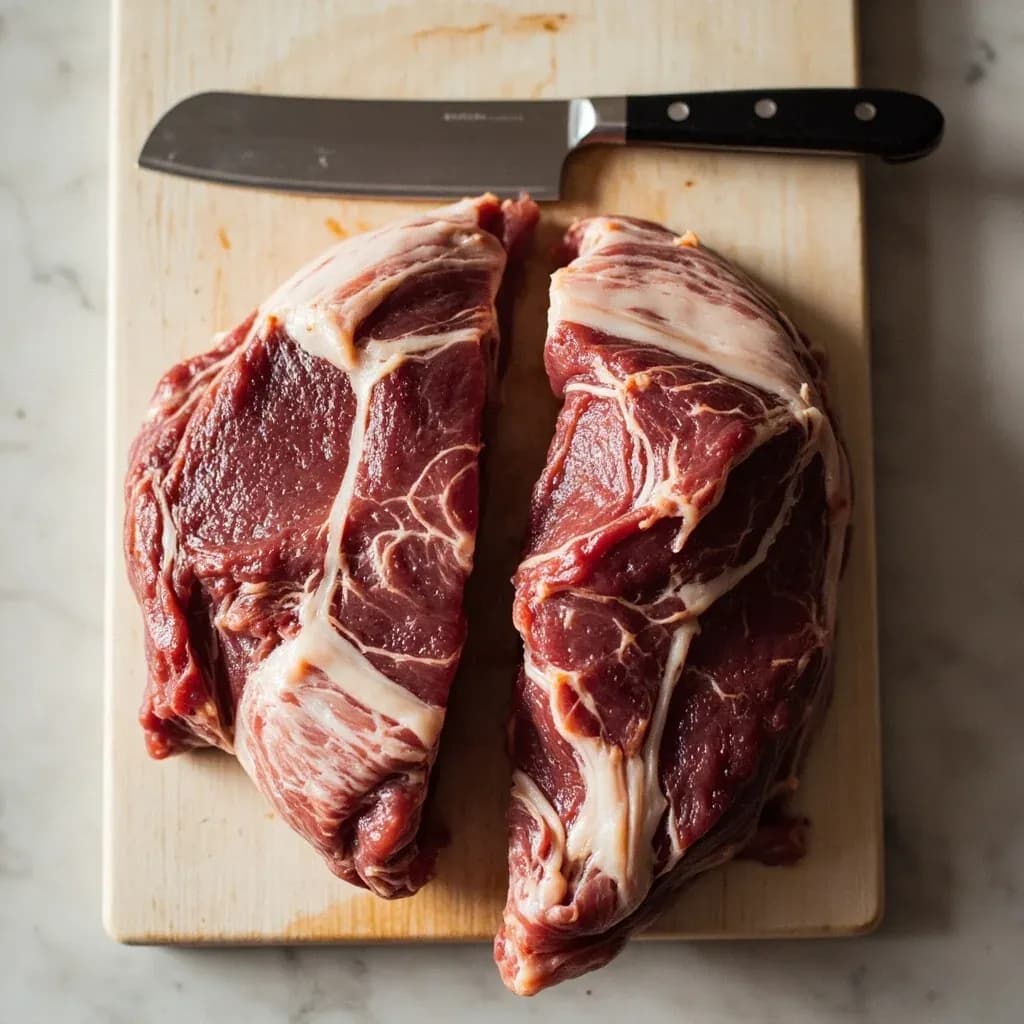
Seam butchery is the practice of separating a carcass or primal along the natural fascial planes that divide one muscle from another, rather than sawing through bone or cutting across a muscle belly. Every functional muscle group is wrapped in its own sheath of connective tissue, and where two muscles meet that sheath forms a slick, well-defined boundary. A cook who can read those boundaries can free whole, intact muscles — each one a distinct ingredient with its own grain, texture, and ideal cooking method.
This approach underpins modern steakhouse trim programs and the nose-to-tail ethos alike. Where traditional butchery often leaves muscles attached to bone for presentation and yield, seam work exposes the hidden architecture of a shoulder or leg: the flat-iron, Denver cut, bavette, and individual lamb shoulder muscles all exist because someone learned to follow the seams rather than the skeleton. The payoff is meat that cooks more evenly, slices more cleanly, and can be portioned to a precise weight without bone dust or torn fibers.
The technique demands little equipment — a sharp, flexible boning knife is the main tool — but it asks for anatomical literacy, a keen edge, and patience. Beginners tend to push with force; experienced seam butchers know the work is mostly tactile, with fingers mapping the seams before the knife ever enters.
- Difficulty
- Hard
Types & varieties
The classic teaching example — a shoulder breaks cleanly into four to six distinct muscles (infraspinatus, supraspinatus, teres major, triceps brachii, and others) along well-defined seams, each suited to a different cooking method.
The Boston butt and picnic separate along clear planes; the freed muscles are ideal for braising or grilling depending on connective tissue content.
Used in modern steakhouse programs to extract flat-iron, Denver cut, and chuck eye from the shoulder clod without cleaver work.
Removing the suprême and legs by following the seams around the oyster, wing bone, and thigh-back junction, yielding boneless portions ready for pan-roasting or sauté.
Small carcasses where bone-in portioning yields too little meat; seam work gives clean saddles, loins, and hind legs from animals as small as a hare.
How to do it
- 1
Set up and chill
Place the primal on a stable board with a damp towel underneath to prevent slipping. If the meat feels pliable or warm, refrigerate it uncovered for 30–45 minutes to firm up — cold meat separates more cleanly than soft, floppy meat. Have a freshly honed boning knife, a short stiff boner, a clean towel, and a tray for finished muscles within reach.
- 2
Map the seams by hand
Before cutting, probe the surface with your fingers. Press gently to feel where one muscle ends and the next begins; seams read as shallow valleys or slick lines of connective tissue. Mentally trace each line and decide where to enter the knife.
- 3
Open a seam at its natural edge
Begin where the seam is already exposed — usually a corner where a muscle has been partially released, or the edge nearest a bone. Lay the blade flat against the silver skin and make a short opening cut, just breaking through the connective tissue.
- 4
Work along the seam with the blade flat
Lay the blade nearly parallel to the carcass surface. Use long, smooth strokes, keeping the cutting edge on the silver skin and the spine of the knife riding against the stationary muscle. Let the knife do the work — never saw or force the blade through.
- 5
Use the free hand to tension the muscle
Pull the freed muscle gently away from the carcass and slightly upward. Tension opens the seam ahead of the blade and immediately reveals if the cut has wandered off-line into belly.
- 6
Free the muscle completely
Continue until the muscle releases cleanly. Trim any clinging silver skin or fat with the tip of the knife, taking care not to score the flesh. Set the muscle aside on a tray and note the grain direction for the cook.
- 7
Move to the next muscle
Return to the carcass, re-hone if needed, and map the next seam. Repeat until the primal is fully broken down into its constituent muscles, trim, and bone (if any).
Reading the anatomy
Before any knife work, a seam butcher studies the primal with the eyes and then the fingers. Muscles read as distinct bulges separated by shallow valleys or thin, glistening lines of silver skin. Those lines are the seams — connective-tissue boundaries where the knife wants to travel. The most common mistake is to start cutting where the seam is deepest; experienced butchers start where it is already exposed, often at a corner where one muscle has been partially released or near a bone end. Once a seam opens, it will telegraph itself: the freed muscle will roll away under its own weight and the silver skin will shine under the light. From that point on, the work is to keep the blade on the seam, not in either belly.
- Probe with the fingers before each cut; seams curve more than they run straight.
- Start at a corner or bone end rather than in the middle of a long seam.
- Let the freed muscle's weight help you — gravity reveals where the boundary lies.
- A seam that resists the blade has probably wandered into belly; back out and find the line.
Common uses
Tips & pitfalls
- Run your thumb or forefinger into the seam first to confirm its direction before committing the knife — seams curve more than they run straight.
- Keep the blade angled slightly upward against the muscle belly you are removing so it glides along silver skin rather than digging into flesh.
- Pull the muscle away from the carcass with your free hand as you cut; tension reveals the seam and keeps the slice thin.
- Re-hone between muscles; silver skin dulls a fine edge faster than almost any other work.
- If a seam stalls, do not power through — work from the other end of the muscle and meet in the middle.
- Leave a thin layer of silver skin on muscles destined for long braises (it dissolves and bastes); remove it entirely on muscles destined for quick, high-heat cooking.
- Chill the carcass briefly in the fridge before butchery; firm meat separates cleanly while warm meat tears and smears.
- Mark the grain direction of each muscle as you remove it so the cook can slice across it later.
Good to know
- Also known as
- Seam butchering, French seam cutting, muscle-seam separation
- Primary tool
- 5–7 inch flexible or semi-stiff boning knife
- Difficulty
- Intermediate; requires anatomical knowledge and a keen edge
- Typical applications
- Lamb shoulder, pork shoulder, beef chuck, poultry, rabbit, venison
- Anatomical feature exploited
- Fascia and intermuscular connective tissue separating functional muscle groups
- Yield/quality advantage
- Produces intact muscles that retain moisture and cook evenly, with no dry edges from sawing bone or scoring belly
- Knife maintenance
- Blade honed and stropped before every session; silverskin rapidly dulls a fine edge
- Tradition
- Rooted in classical French boucher training; popularized in modern cooking by Fergus Henderson's nose-to-tail ethos at St. John, London
Also called
Seam Cutting · Muscle Seaming
Related

Chop
Cut into rough, irregular pieces — the everyday workhorse cut

Dice
Cut into uniform cubes for even cooking and a tidy look

Mince
Cut as fine as possible so flavor melts evenly into the dish

Slice
Cut into even, flat pieces for consistent cooking and presentation

Julienne
Cut into thin matchsticks for fast cooking and elegant garnish

Brunoise
Cut into tiny, precise cubes — the finest dice in the kitchen

Chiffonade
Roll and slice leafy greens into delicate ribbons

Batonnet
Cut into tidy sticks, thicker than julienne — think classic fries