Water & Steam
Shallow Poaching
Gently cooking delicate food in a shallow bath of flavored liquid, then reducing it into a sauce.
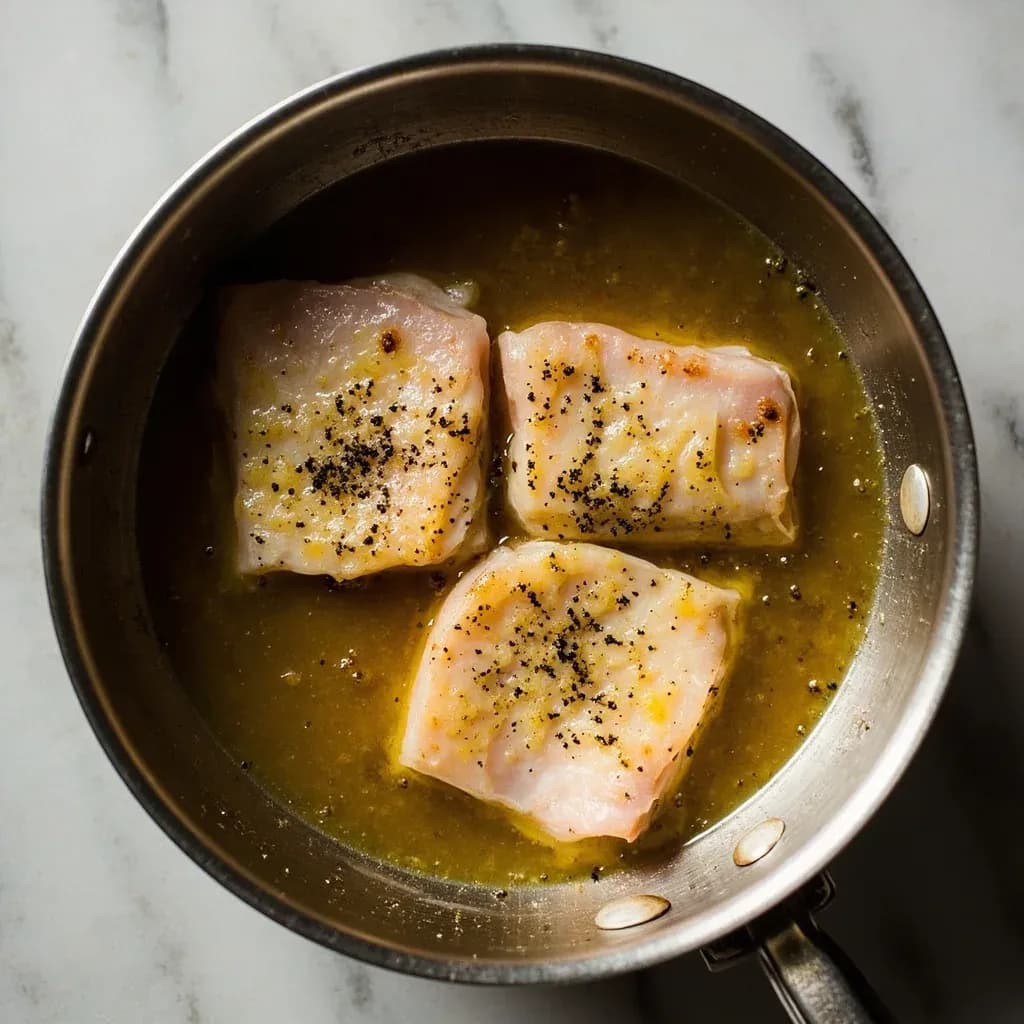
Shallow poaching half-submerges delicate items like fish fillets in a small amount of flavorful liquid such as wine, stock, and aromatics, often covered with parchment so steam cooks the exposed top. The food cooks gently below a simmer to stay tender, and the leftover poaching liquid is then reduced into a sauce. It is a classic restaurant method that cooks the protein and builds its accompanying sauce in one pan.
Shallow poaching is the moist-heat technique in which delicate food cooks in just enough flavored liquid to come roughly halfway up its sides — typically 2.5 to 5 cm (1 to 2 in) deep. Unlike deep poaching, where the food swims fully submerged, the upper surface is bathed by steam and by occasional bastes of the simmering liquid. Unlike braising tough cuts, there is no oven and no multi-hour cook; instead the cook skims, bastes, and watches. The defining promise of the method is dual: the food emerges tender and perfumed, and the same pan liquid, reduced at the end, becomes the sauce.
The technique sits at the heart of classical French fish cookery — sole bonne femme, sole normande, sole vin blanc — and extends naturally to chicken supremes, pork medallions, veal scallops, eggs, shellfish, and certain vegetables. Its appeal is efficiency married to finesse: one pan, one liquid, one finished sauce. A cook who masters shallow poaching has, in effect, mastered the architecture of an entire family of restaurant dishes, because the reduced liquid is the canvas on which beurre blanc, sauce normande, or a simple herb butter is mounted.
The behavior is straightforward but unforgiving. The liquid must hover at a bare simmer — 70 to 82 °C (160 to 180 °F), a tremble rather than a boil — because violent bubbling toughens protein, emulsifies fat into the sauce base, and drives off aromatic volatiles you wanted in the pan. The shallow depth means the liquid both cooks and reduces at the same time, so a splash more wine or stock goes in if it threatens to dry out. Finished correctly, the food is just cooked through, still moist, and the sauce coats the back of a spoon with a glossy, nappé body.
- Difficulty
- Medium
Types & varieties
Classical French shallow poach in butter and stock, often under a buttered-paper lid (carton); finished by glazing or reducing the pan jus.
Shellfish or small fish poached in a lightly acidulated court-bouillon and served in that same broth, often cooled.
Fish or chicken cooked in a reduction of dry white wine, shallot, and stock — the base for sauces vin blanc, beurre blanc, and normande.
Acidulated water with wine, onion, bouquet garni, and peppercorns; the workhorse liquid for sole, turbot, salmon, and trout.
A gentle shallow poach used for delicate fish, prized for keeping the flesh pristine white.
Eggs or fish poached in a slow-cooked tomato concassée seasoned with garlic, basil, and olive oil.
White-fleshed fish poached in a saffron-and-garlic fish broth, then the broth is thickened with aioli to finish.
How to do it
- 1
Select the pan and prepare the food
Use a wide, heavy-based pan (sautoir, sautéuse, or poissonnière) just large enough to hold the portions in a single layer. Pat the food dry and season lightly with salt. Thin fillets can be folded thick-side under, or rolled into paupiettes when a stuffed presentation is intended, so the thin tail and the thicker middle cook at the same rate.
- 2
Build the cooking liquid
Sweat sliced shallots in a little butter until soft and translucent. Deglaze with dry white wine and reduce by two-thirds. Add cold fish or chicken stock, a bouquet garni, a few peppercorns, and (for white fish) a generous squeeze of lemon. The finished liquid should cover about one-third to one-half of the food's height once it reaches a simmer.
- 3
Bring to a bare simmer
Heat the liquid gently to 70–82 °C (160–180 °F). Skim any foam or surface fat with a slotted spoon. The surface should shiver, not boil — a boil toughens proteins and emulsifies the fat you want to keep clear for the sauce.
- 4
Add the food and cover
Lay the items in the pan presentation-side up, in a single layer, with a little space between them. Cover with the lid, or with a round of buttered parchment (carton) tucked around the food. Baste the exposed tops with the hot liquid.
- 5
Cook gently and baste
Maintain the bare simmer, basting every 2–3 minutes so the upper surface cooks by steam and absorbs the aromatics. Expect 4–6 minutes for a 2 cm-thick fillet, 8–12 minutes for a suprême or thick steak. Test at the thickest point: fish should flake with gentle pressure, chicken should read 63 °C (145 °F) and rest.
- 6
Remove and hold warm
Lift the food out with a slotted spatula or fish spatula onto a warm plate. Cover loosely with foil or set over a bain-marie. Strain the cooking liquid through a fine chinois into a clean saucepan, pressing gently on the aromatics.
- 7
Reduce the sauce base
Simmer the strained liquid to the desired intensity — typically reducing it by about half, or to roughly ½ cup (120 ml) per 4 portions, so it lightly coats the back of a spoon (nappé).
- 8
Finish and serve
Mount the reduced sauce off the heat with cold butter cubes whisked in gradually, or finish with cold cream. Adjust salt, acid (lemon juice or verjuice), and a pinch of cayenne or white pepper. Spoon the sauce around (not over) the food and serve immediately.
The Sauce Connection
Shallow poaching is unique among moist-heat methods in that the cooking liquid is treated as a sauce from the moment it goes into the pan. The shallots sweated in butter, the wine reduced by two-thirds, the stock, the lemon — each is chosen because it will, after the food comes out, be reduced to a nappé and mounted. A cook should taste the raw liquid with this in mind: if it does not taste good before the food goes in, no amount of butter at the end will rescue the sauce.
- Strain the liquid through a fine chinois before reducing; pressing the aromatics releases bitterness.
- Reduce only to the intensity you want — over-reduction concentrates salt and tannin.
- Mount the sauce off the heat with cold, cubed butter (monter au beurre) for gloss, or with cold cream for stability.
Why a Bare Simmer
A rolling boil is the enemy of shallow poaching. It drives albumin out of fish and chicken in ugly white ribbons, emulsifies fat into the liquid so the sauce turns cloudy and greasy, and toughens the protein fibers you are trying to keep tender. The right visual cue is the French sourire — a 'smile' of small bubbles around the edge of the pan, with the center merely trembling. If you are unsure, use an instant-read thermometer: 70–82 °C is the band.
Common uses
Tips & pitfalls
- Keep the liquid at a 'smiling' simmer — small bubbles around the edge, the center merely trembling. A rolling boil toughens proteins and breaks any emulsion in the finishing sauce.
- Acidulate the liquid (a splash of wine vinegar, lemon juice, or dry white wine) when poaching white fish to keep the flesh bright and to discourage albumin from leaching out.
- Choose a pan where the food lies in a single layer with a little space around each piece; crowded food steams unevenly and the liquid will not reduce properly.
- Baste the top of the food every 2–3 minutes, or cover with a buttered parchment lid (carton) so the upper surface cooks by steam.
- Pull fish from the heat when still slightly translucent at the center — carryover heat finishes the job and prevents the dry, chalky texture of overcooked fillets.
- Strain and skim the cooking liquid before reducing for the sauce; a fine chinois plus a ladle of cold stock helps lift impurities from the surface.
- Reduce the liquid only to the nappé consistency you want before mounting — over-reduction concentrates salt and tannin and cannot be undone.
- Finish the sauce with cold, cubed butter whisked off the heat (monter au beurre) for gloss and body, or with cold cream for a more stable emulsion that holds on the plate.
- Keep cooked items warm on an overturned plate over a bain-marie; do not let them sit in the cooling liquid or they will overcook and leach flavor back into the sauce.
- Common mistakes: boiling the liquid, overcooking, using too much liquid (you end up with broth, not sauce), and skipping the strain — leading to a cloudy, greasy pan sauce.
Good to know
- Category
- Moist-heat cooking, poaching family
- Liquid depth
- 2.5–5 cm (1–2 in); enough to baste and steam, not enough to submerge
- Target temperature
- 70–82 °C (160–180 °F) — a bare simmer, surface trembling rather than boiling
- Classic vessels
- Fish poacher (poissonnière), oval sautéuse, sauté pan, or shallow braising pan with a tight lid
- Typical cook times
- Thin fillets 4–6 min; thick steaks or supremes 8–12 min; whole small fish 10–15 min
- Sauce yield
- Roughly 1 cup (240 ml) of liquid reduces to about ½ cup (120 ml) glaze or ¾ cup (180 ml) finished sauce for 4 portions
- Origin
- Codified in classical French cuisine (Escoffier, Le Répertoire de la Cuisine, 1914); rooted in court-bouillon cookery of the medieval and Renaissance kitchens
- Related French terms
- Poêlage (buttered-paper-lid braise), à la nage (served in the broth), pochouse (Burgundian fish stew)
Also called
a la nage · shallow poach
Related

Boil
Cook in vigorously bubbling liquid at full rolling heat

Simmer
Hold liquid at a gentle shimmer for tender, unhurried cooking

Poach
Cook gently in barely-trembling liquid for silky, tender results

Steam
Cook in rising vapor to keep color, nutrients, and shape intact

Blanch
Plunge briefly in boiling water, then shock cold to lock color

Braise
Sear, then cook slow in a little liquid until fall-apart tender

Stew
Simmer bite-sized pieces fully submerged into a rich, unified pot

Sous-Vide
Seal and cook in precise warm water for edge-to-edge doneness