Prep & Assembly
Starch Slurry Thickening
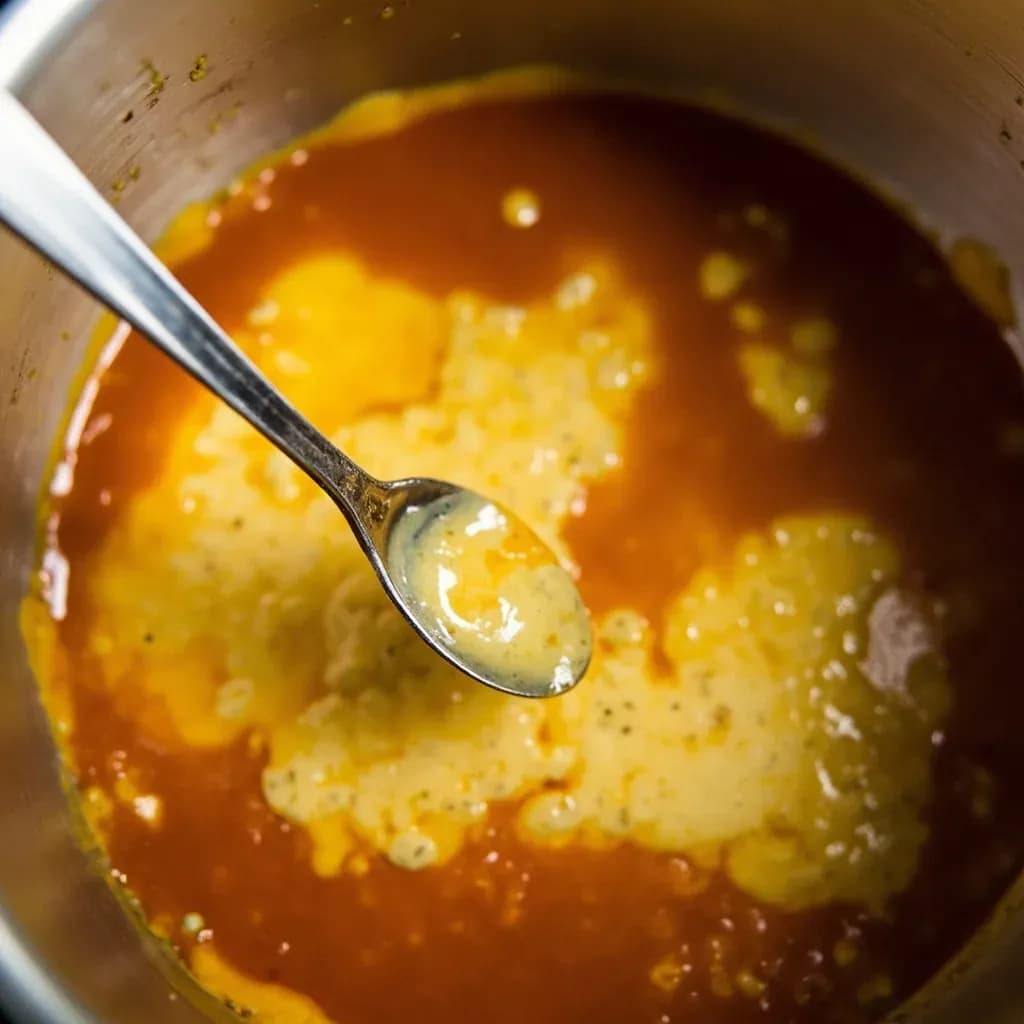
Stirring a cornstarch-water mix into a sauce for a glossy, clingy finish.
Starch slurry thickening blends cornstarch or another starch with cold water, then stirs it into a simmering sauce where it rapidly thickens to a glossy, velvety body. Known as gou qian in Chinese cooking, it coats stir-fries so seasonings cling to the ingredients. The slurry must be added to hot liquid and brought to a boil to activate, and prolonged boiling can thin it back out.
Starch slurry thickening is the fastest route from a thin pan liquid to a glossy, spoon-coating sauce. A slurry is simply raw starch suspended in a cool liquid — most often cornstarch and cold water — whisked into a simmering base at the end of cooking. Within seconds of contact with heat, the starch granules absorb liquid, swell, and burst in a process called gelatinization, releasing amylose and amylopectin that trap water and give the sauce body. Because the starch is never pre-cooked, the result is brighter, clearer, and glossier than a flour-thickened sauce, with none of the starchy aftertaste a rushed roux can leave behind.
The trade-off is stability. Starch gels are thixotropic — they thin under agitation and re-set when left alone, which is why a sauce that looked perfect on the stove can run loose after a few seconds of stirring. They are also sensitive to acid (a tomato or citrus-heavy sauce will resist thickening with cornstarch) and break down under prolonged simmering. The technique rewards cooks who work in small increments, taste as they go, and remember that a slurry is a finishing move, not a structural one.
- Difficulty
- Easy
Types & varieties
The everyday workhorse. Neutral flavor, opaque gloss, strong thickening power. The default for gravies, stir-fry sauces, and fruit pies.
Clearer and glossier than cornstarch with noticeably more thickening power per gram. Favored in German and Ashkenazi Jewish kitchens for light, glossy sauces and clear fruit preparations.
Very glossy with a faintly chewy finish. The most freeze-tolerant of the common starches, making it a smart choice for pies and puddings meant to be stored.
The clearest, most delicate gel — ideal for acidic fruit sauces, Asian-style clear glazes, and any sauce where you want the underlying color to show. Breaks down with prolonged heat; add at the very end.
Mild thickening with a slightly grainier mouthfeel than cornstarch. Common in Japanese and Chinese cooking, particularly in light broths and teriyaki-style glazes.
Commercial waxy or modified starches engineered for acid stability, freeze-thaw resistance, or extra clarity — the thickeners behind most jarred gravies and frozen sauces.
How to do it
- 1
Choose the starch and measure
Select cornstarch for general use, potato or tapioca starch for a clearer gloss, or arrowroot for acidic or delicate sauces. Measure roughly 1 tablespoon (8 g) starch per 1 cup (240 ml) of finished liquid for medium body — less for a light glaze, more for a heavy sauce.
- 2
Mix with cold liquid
Put the starch in a small bowl. Add an equal measure of cold water, stock, wine, or other cool liquid — never warm or hot. Stir with a fork or small whisk until completely smooth, with no visible dry pockets or lumps clinging to the bowl.
- 3
Bring the base to a simmer
Heat the sauce, gravy, or cooking liquid to a steady, gentle simmer. Season and balance the base before thickening, because salt and acid both influence how the gel sets and how the finished sauce tastes.
- 4
Rewisk and stream in
Give the slurry another quick stir — starch settles to the bottom within seconds. Whisking the simmering base constantly, drizzle the slurry in a thin, steady stream. Start with about two-thirds of the slurry; you can always add more but cannot take it back.
- 5
Simmer to finish
Return the liquid to a simmer and cook 1–2 minutes, whisking, until the sauce turns translucent and glossy and coats the back of a spoon. Taste and adjust seasoning. If it is still too thin, repeat with a fresh spoonful of slurry; if too thick, whisk in a little of the unthickened base liquid.
Slurry versus other thickeners
A slurry is one of three quick approaches a cook reaches for, and it helps to know where it sits among them. A roux cooks flour into fat before any liquid is added, giving a stable, opaque sauce that can simmer for an hour and still hold — the right choice for béchamel, gumbo, and long-braised stews. A beurre manié is raw flour kneaded into soft butter and whisked in at the end, sitting halfway between roux and slurry: more body than a slurry, faster than a roux, with a slightly cloudy finish. A starch slurry is the fastest and glossiest of the three, but the least forgiving — it cannot carry a sauce through long cooking, heavy acid, or the freezer.
- Roux: cooked fat + flour → opaque, very stable, ideal for long simmers and dairy sauces.
- Beurre manié: raw butter + flour → medium body, slightly cloudy, whisked in near the end.
- Starch slurry: raw starch + cold liquid → glossy, clear, added at the end, least stable.
The science in brief
Starch granules are insoluble in cold water; they simply sink. Once the liquid crosses roughly 60–70°C / 140–160°F, water slips into the granule, it swells to several times its original size, and the cell wall ruptures. The released starch molecules tangle into a mesh that holds water in place — that mesh is the gel. Different starches gel at different temperatures, hold different amounts of water, and tolerate different conditions, which is why a cook reaches for arrowroot in a lemon sauce and tapioca in a pie destined for the freezer.
- Gelatinization begins around 60°C / 140°F for most starches, with the full range landing between 60 and 75°C depending on the source.
- Acid and sugar compete with starch for water and can hydrolyze the granules, weakening the gel — the reason lemon curd sets with eggs rather than cornstarch.
- Constant stirring physically breaks the gel network, thinning the sauce; resting lets it re-set.
Cultural notes
The technique travels under different names but shows up wherever cooks need a fast, glossy finish. In Chinese kitchens the same cornstarch slurry used to thicken a sauce is called gōu qiàn, and a related mixture — cornstarch blended with soy sauce, wine, and sometimes egg white — is used as a marinade called shàng jiāng to velvet meat before stir-frying, keeping it tender against the wok's fierce heat.
- Chinese cuisine: gōu qiàn for sauce-thickening, shàng jiāng for velveting proteins.
- German and Ashkenazi Jewish cooking: often potato starch for a clearer, glossier sauce.
Common uses
Tips & pitfalls
- Always mix starch into cold liquid — never the other way around. Adding liquid to a mound of starch creates instant lumps that are nearly impossible to whisk out.
- Rewisk the slurry the moment you reach for it. Starch settles out of suspension in under a minute, and the last spoonful from the bowl is almost pure starch.
- Pour the slurry in a thin, steady stream while whisking the hot base. A big dump into a rolling boil can foam, lump, or break the sauce apart.
- Simmer the thickened sauce for at least a minute after it sets. Under-cooked starch leaves a chalky, raw flavor that no amount of seasoning hides.
- For highly acidic sauces — tomato, citrus, wine-heavy reductions — use tapioca or arrowroot, not cornstarch. The acid keeps cornstarch granules from swelling fully.
- Add the slurry near the end of cooking. Long simmers and vigorous stirring physically shred the gel and the sauce thins back out in front of you.
- If the sauce tightens up too much, thin it with more of the unthickened cooking liquid, not plain water, which dilutes flavor and seasoning.
- Do not plan to freeze a starch-thickened sauce if you want it to look right on thawing — it will weep and turn spongy. Choose a roux or a modified starch if the freezer is in the sauce's future.
Good to know
- Typical ratio
- 1 part starch to 1–2 parts cold liquid by volume; about 1 tablespoon (8 g) cornstarch per 1 cup (240 ml) of liquid for medium thickness.
- Slurry liquid temperature
- Cold or room temperature only — hot liquid gelatinizes the starch on contact and forms lumps.
- Cook time after adding
- Simmer 1–2 minutes to fully gelatinize the starch and cook out its raw flavor.
- Effect on appearance
- Glossy, translucent, slightly clingy finish — clearer than a roux-thickened sauce.
- Shear sensitivity
- Starch gels thin under prolonged stirring or extended simmering, then re-set at rest.
- Acid sensitivity
- Cornstarch loses thickening power below about pH 4.0; arrowroot is even less acid-stable; tapioca and modified starches hold up better.
- Freeze-thaw stability
- Poor — frozen starch-thickened sauces weep and turn spongy when thawed.
- Difficulty
- Beginner-friendly; reliable when proportions, liquid temperature, and simmer time are respected.
Also called
starch-slurry-thickening · cornstarch-slurry-thickening · thickening-with-slurry · gou qian
Related

Whisk
Beat ingredients smooth and aerated with a looping wire motion

Sift
Pass dry ingredients through mesh to aerate and remove lumps

Strain
Pour through mesh to separate solids from liquid for a smooth result

Filter
Pass liquid through fine material to clarify out the smallest particles

Rice
Press cooked potatoes through small holes for fluffy, lump-free texture

Mash
Crush soft cooked food into a rustic, creamy purée

Grind
Crush food into a coarse to fine texture, from spices to meat

Grate
Shred food into fine bits against a sharp-toothed surface