Prep & Assembly
Slurry Thickening
Stirring a cold starch-and-water mix into hot liquid to thicken a sauce, soup, or gravy.
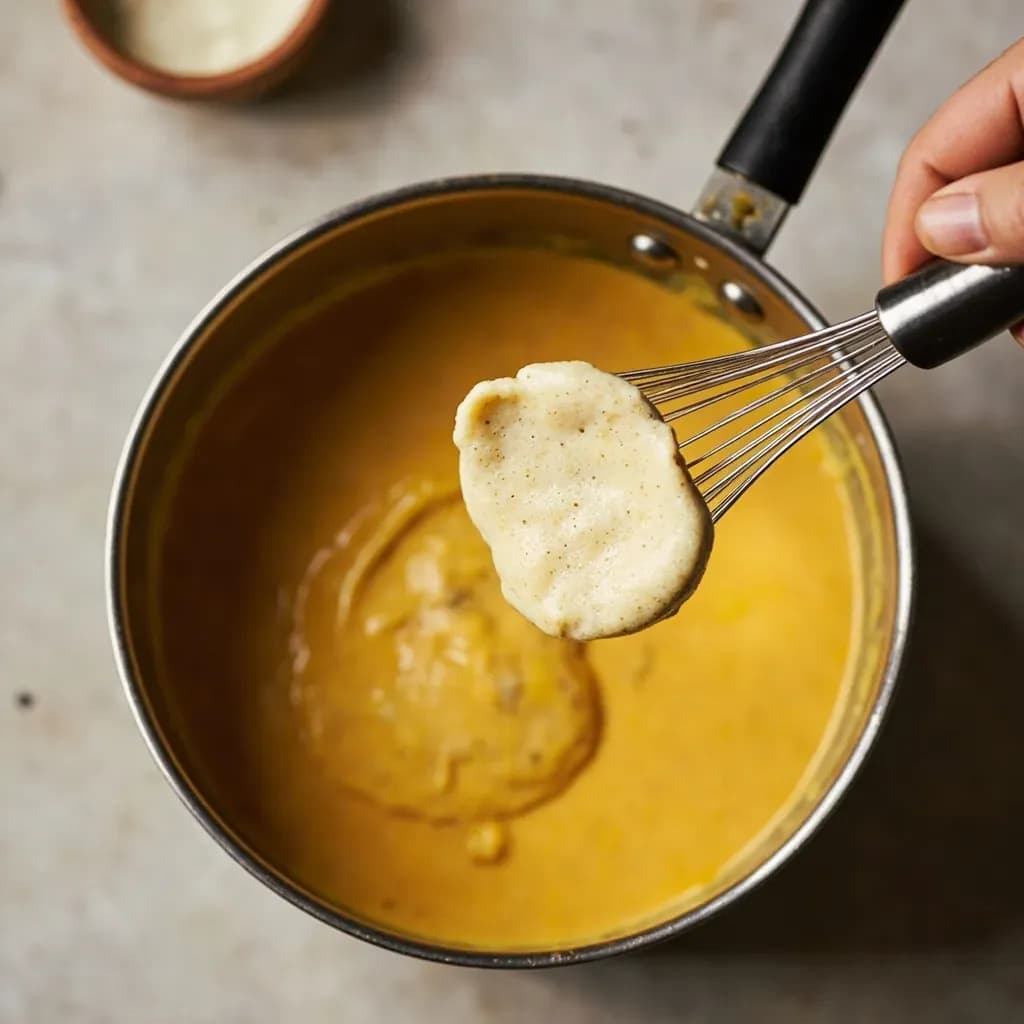
A slurry blends a starch such as cornstarch or flour with cold liquid into a smooth suspension, then whisks it into a simmering sauce. As the mixture heats the starch granules swell and gelatinize, thickening the liquid into a glossy sauce or gravy. Mixing the starch with cold liquid first is essential to prevent lumps, and the sauce must be brought back to a boil to fully activate the thickening.
A slurry is the cook's shortcut for thickening a hot liquid without making a roux or committing to a long reduction. You whisk raw starch into cold water and stream that cloudy liquid into a simmering sauce; within a minute or two, the starch granules swell, absorb water, and lock into a gel that turns thin broth into a glossy, spoon-coating sauce. The technique matters because it is fast, lean (no butter or flour cooked in fat), and forgiving enough to adjust at the very end of cooking, which is why it shows up everywhere from weeknight pan gravies to restaurant stir-fry sauces and Chinese-style braises.
What a slurry does is gelatinize starch on contact with hot liquid, and the texture you get depends entirely on which starch you choose and how you treat it afterward. Cornstarch, tapioca, arrowroot, and potato starch all produce a glossy, slightly translucent finish; flour gives a matte, opaque sauce with a faintly starchy backbone. A slurry is also a brittle thickener compared with a roux — held at a hard boil for too long, or frozen and thawed, the gel thins out as the swollen starch molecules unwind and leak water. Understanding that fragility is what separates a sauce that holds on the plate from one that mysteriously loosens between the stove and the table.
- Difficulty
- Easy
Types & varieties
The most common modern slurry, made 1:1 with cold water by volume. Glossy, slightly translucent finish; fragile against long cooking, hard boiling, and freezing.
Twice the volume of flour versus cornstarch, whisked with 2–4 parts cold water. Opaque, matte finish and needs a minute or two of simmering to lose the raw flour taste.
About 1 teaspoon per cup of sauce, whisked 1:1 with cold water. Very glossy and clear. Sensitive to prolonged heat and acid — add off heat or at the very end, and never reboil hard.
1 tablespoon per cup, whisked 1:1 with cold water. Glossy finish, notably freeze-thaw friendly, and gives a faintly chewier body that is welcome in some pie fillings and dumpling fillings.
1 tablespoon per cup, whisked 1:1 with cold water. Clear, glossy finish; standard in Chinese and Ashkenazi Jewish cooking. Do not boil hard or it can turn stringy.
Common in Chinese, Japanese, and Korean cooking. Slightly less glossy and a touch more opaque than cornstarch; gluten-free.
Pre-dispersed flour that can often be shaken straight into hot liquid from a shaker, skipping the cold-water step entirely.
Equal parts soft butter and flour kneaded into a paste and whisked into hot liquid in small bits. Sits between a roux and a slurry: the butter coats the flour so it won't lump, and it adds richness and sheen along with thickening.
How to do it
- 1
Choose a starch and a ratio
For about 1 cup of finished sauce, use 1 tablespoon of cornstarch, potato starch, or tapioca, or about 1 teaspoon of arrowroot. For flour, use roughly 2 tablespoons. Pick arrowroot or tapioca for clear, glossy sauces or anything acidic or destined for the freezer; pick flour when a matte, opaque finish is fine and you want the cheapest option; pick cornstarch for the all-purpose default.
- 2
Make the slurry
In a small bowl, combine the starch with an equal volume of cold water, stock, wine, or other cool liquid. For flour, use 2 to 4 parts liquid to 1 part flour. Whisk or stir with a fork until the mixture looks completely uniform — no dry pockets at the bottom, no gritty bits, no clear streaks of water.
- 3
Bring the base to a simmer
Heat the sauce, soup, or gravy to a gentle simmer. Skim off any skin or foam so the slurry incorporates cleanly. Avoid a hard rolling boil at this point; a hard boil can scorch the starch and cause foaming.
- 4
Re-whisk and stream in
Give the slurry one more quick stir — starch settles to the bottom of the bowl within seconds — and pour it into the simmering liquid in a thin, steady stream, whisking the base constantly with your other hand. This two-handed rhythm is what prevents lumps.
- 5
Return to a simmer and cook through
Bring the liquid back to a gentle simmer and hold it 1 to 3 minutes, whisking, until the sauce looks glossy, lightly thickened, and coats the back of a spoon. With flour, this simmer is also what cooks out the raw flour taste.
- 6
Adjust thickness and season
If it is still thinner than you want, whisk a second small batch of slurry and add it the same way. If you have gone too far, whisk in a little more of the base liquid — stock, cream, or wine — to loosen. Taste, then adjust salt, acid, and seasoning last.
Slurry versus roux versus beurre manié
All three thicken with starch, but they sit at different points on the speed-versus-sturdiness spectrum. A roux cooks flour in fat before any liquid touches it, which gives the starch a protective fatty coating and lets it stand up to long simmers, dairy, and freezing. A slurry skips the fat and disperses raw starch in cold water, so it is faster, lighter, and the default move in Chinese, Thai, and modern weeknight cooking, but it is more fragile. Beurre manié is the middle path: the butter coats the flour and prevents lumps, and the paste is whisked into hot liquid like a slurry while also enriching and glossing the sauce. Reach for a roux when a sauce will cook for a long time or be frozen; reach for a slurry when you want speed, clarity, and a clean finish; reach for beurre manié when you want both body and a velvety mouthfeel without a separate fat-cooking step.
- Roux = fat + raw flour cooked together, then liquid added. Sturdiest gel; takes the longest.
- Slurry = raw starch dispersed in cold water, whisked into hot liquid. Fastest; the most fragile gel.
- Beurre manié = raw flour kneaded with soft butter, whisked into hot liquid. Adds richness and gloss along with thickening.
The starches compared
Pick your starch the way you pick a tool, by what the finished sauce needs to do. Cornstarch is the all-purpose default: cheap, glossy, and strong, but it tolerates only moderate acid and is fragile to hard boiling and the freezer. Arrowroot is about twice as strong as cornstarch, gives a very glossy, clear gel, and is what cooks reach for in fruit glazes and lightly thickened pan sauces — but it loses power with prolonged heat and acid, so it goes in off heat or at the end. Tapioca is the freezer-friendly choice and is slightly chewier, which is why it shows up in pie fillings and Asian dumpling skins. Potato starch is similar to cornstarch but a touch more delicate — keep it out of a hard boil. Flour is the workhorse: opaque, matte, half as strong as cornstarch so you use double, and the only common thickener that carries a noticeable raw flavor you need to simmer out.
Why slurries fail and how to fix them
Almost every broken slurry comes down to one of four things: the starch went in dry and clumped, the base was a rolling boil when the slurry hit, the sauce was held at a hard boil for too long, or the sauce was frozen and thawed. The first two are lump problems and are usually solved by whisking vigorously or, in a pinch, blending the sauce smooth. The last two are broken-gel problems: the sauce thins and looks watery even though it is seasoned correctly. The fix is a fresh small batch of slurry whisked in at a gentle simmer — the new starch molecules build a new gel that the broken sauce will hold onto.
Common uses
Tips & pitfalls
- Always disperse the starch in cold liquid first; pouring dry starch straight into hot liquid clumps almost instantly and is very hard to rescue.
- Re-whisk the slurry right before pouring. Starch settles to the bottom of the bowl as it sits, so the last pour comes out thin and the first pour comes out as a paste.
- Add the slurry in a thin, steady stream while whisking the hot base constantly with your other hand — this is the single step that prevents lumps.
- Hold the base at a gentle simmer, not a rolling boil, when the slurry goes in. A hard boil can scorch the starch, foam up, or break the gel.
- After thickening, simmer at least 1 to 2 minutes so the starch fully gelatinizes and, with flour, the raw taste cooks out.
- Add slurry gradually. You can always add more, but thinning an over-thickened sauce means adding liquid and diluting the seasoning.
- For strongly acidic sauces — lots of wine, citrus, or tomato — lean on tapioca or arrowroot, or use slightly more cornstarch than usual, because acid weakens starch networks.
- Season last. Salt perception shifts as a sauce reduces or thickens, and salting a thin slurry early almost always pushes the finished sauce over the line.
Good to know
- Primary starches
- Cornstarch, all-purpose flour, arrowroot, potato starch, tapioca starch, rice flour
- Standard ratio (starches)
- 1 tablespoon starch whisked with 1 tablespoon cold liquid per 1 cup of sauce
- Standard ratio (flour)
- About 2 tablespoons flour whisked with 2–4 tablespoons cold liquid per 1 cup of sauce
- Mixing liquid temperature
- Cold or cool room temperature; hot liquid gelatinizes starch on contact and forms lumps
- Base liquid temperature when adding
- Gentle simmer — a hard boil can scorch starch and cause foaming
- Active thickening time
- 30 seconds to 3 minutes once returned to a simmer
- Holding temperature after thickening
- Low simmer; prolonged hard boiling breaks starch down and thins the sauce
- Freeze performance
- Cornstarch and flour break down when frozen and thawed; tapioca and arrowroot hold up considerably better
- Acid tolerance
- Cornstarch tolerates moderate acid; arrowroot loses strength with prolonged acid contact; tapioca is fairly acid-stable
- Finish
- Cornstarch, arrowroot, tapioca, and potato starch produce a glossy, slightly translucent sauce; flour produces an opaque, matte sauce
- Relative thickening power
- Arrowroot is roughly twice as strong as cornstarch; flour is roughly half as strong as cornstarch (use double)
- Difficulty
- Easy
- Equipment
- Small bowl, measuring spoons, whisk or fork; a flat whisk is helpful in narrow pans
Also called
cornstarch slurry · starch slurry · thickening with slurry
Dishes that rely on it
Related

Whisk
Beat ingredients smooth and aerated with a looping wire motion

Sift
Pass dry ingredients through mesh to aerate and remove lumps

Strain
Pour through mesh to separate solids from liquid for a smooth result

Filter
Pass liquid through fine material to clarify out the smallest particles

Rice
Press cooked potatoes through small holes for fluffy, lump-free texture

Mash
Crush soft cooked food into a rustic, creamy purée

Grind
Crush food into a coarse to fine texture, from spices to meat

Grate
Shred food into fine bits against a sharp-toothed surface