Prep & Assembly
Straining Broth
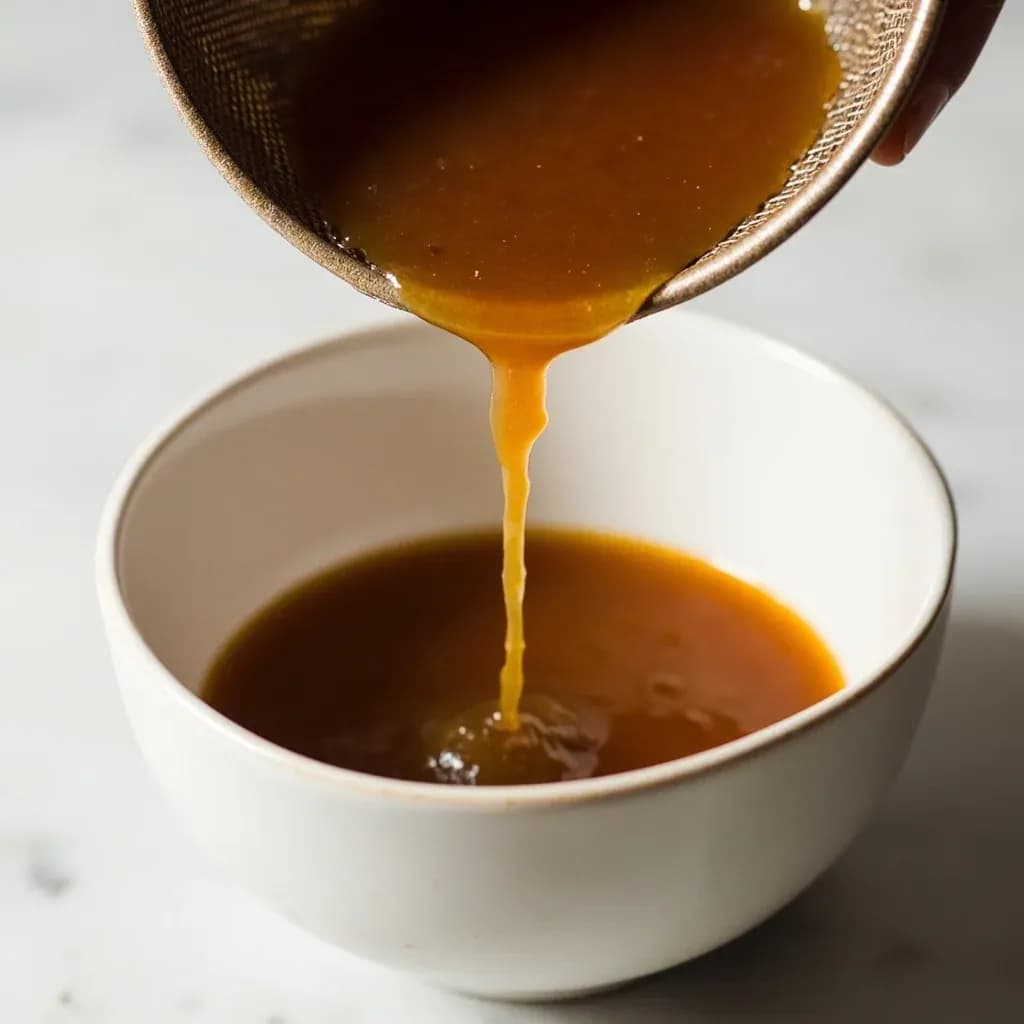
Pouring finished stock through a fine mesh or cloth to remove solids and fine sediment.
Straining passes a cooked broth, stock, or juice through a fine-mesh sieve, chinois, or cloth to leave behind bones, vegetables, and small particles. For a crystal-clear result the liquid is run through a jelly bag or layered cheesecloth and left to drip without pressing. It is a final clarifying step before chilling, reducing, or serving.
Straining broth is the final, often-underestimated step that turns a long-simmered stock into something a cook is actually proud to serve. The simmer itself pulls flavor, collagen, and tiny bits of bone, herb, and vegetable matter into the liquid, and much of that suspended material will read as grit on the tongue or cloud the visual appeal of a consommé, sauce, or clear soup. A proper strain is what separates a homely pan liquid from a clean, glossy broth with body and brightness.
The technique is forgiving in its basic form — pour through a mesh strainer and most cooks are technically done — but the small choices matter a great deal. Cloth versus mesh, single versus double pass, chilled settle-and-decant versus hot pour: each variable changes clarity, yield, and even flavor, because pressing the solids forces bitter compounds and emulsified fat back into the liquid. Knowing which level of strain a given dish calls for, and having the right tool for it, is what separates a useful home broth from a professional one.
Straining is not the same as clarifying. A strainer removes what is already there; for a truly crystalline consommé, the broth must additionally be cleared with an egg-white raft, which traps fine particles as it cooks. Strain first, clarify second, if clarity is the goal.
- Difficulty
- Easy
Types & varieties
Pouring through a colander or large-holed strainer to remove bones and large vegetable pieces only — the first pass in most stock work.
Using a fine-mesh sieve or chinois to catch small particles and broken-down solids; the standard finishing pass for everyday broth.
Lining a strainer with dampened cheesecloth (often double or quadruple ply) for a noticeably clearer result than mesh alone.
Passing the broth through a fine-mesh strainer and then a cheesecloth-lined strainer — the standard for professional kitchens.
Chilling the broth so fat solidifies on top and sediment sinks, allowing the clear middle layer to be poured off.
A final polish for crystal-clear consommé-style broths; very slow but very effective.
How to do it
- 1
Cool the broth slightly
Remove the pot from the heat and let it stand 15–30 minutes, or until the bubbling has fully stopped. Cooling allows fat to begin rising to the surface and reduces the risk of splashing during the pour.
- 2
Skim the surface
Use a wide, shallow ladle or a flat skimmer to lift off any visible fat or foam. For a fully defatted broth, chill the liquid until the fat solidifies, then peel the fat cap off in one piece.
- 3
Set up the strainer
Place a fine-mesh strainer or chinois over a clean pot, bowl, or heatproof container large enough to hold the full volume of liquid. If using cheesecloth, drape one or two layers inside the strainer and dampen it under cold running water first so it clings to the mesh.
- 4
Pour slowly and steadily
Tip the pot gently and let the broth run down the inside wall of the strainer rather than dropping from height. Avoid dumping the entire pot at once; work in batches if needed and never let solids reach the top of the strainer.
- 5
Do not press the solids
Once the liquid has drained through, leave the solids undisturbed. Pressing or stirring releases trapped sediment, emulsified fat, and bitter compounds and will noticeably cloud the broth.
- 6
Discard or repurpose the solids
Compost or discard the bones and exhausted herb stems. Reserve any vegetables (carrots, celery, onion) that still hold flavor and texture for sides, purées, or a second, lighter vegetable stock.
- 7
Optional second pass for clarity
For a restaurant-quality clear broth, line a clean strainer with fresh, dampened cheesecloth (double or quadruple ply) and pour the already-strained liquid through it again. For consommé-level clarity, finish with a paper towel or coffee filter set in a sieve.
- 8
Cool, store, or use
Cool the strained broth quickly — an ice bath works well — and refrigerate or freeze, or use it directly in a soup, sauce, braise, or grain dish.
Choosing the right cloth and mesh
The cloth or strainer you choose sets the ceiling on how clear your broth can become. Standard fine-mesh sieves, with perforations around 1/16 inch, catch bones, bay leaves, and most vegetable scraps but let fine sediment pass. A chinois — the conical, extra-fine strainer found in restaurant kitchens — does meaningfully better, and its deep cone holds a surprising amount of solids before backing up.
Cheesecloth is graded by ply, and the difference is real. Single-ply is loose weave meant for bundling herbs; it will not catch fine grit on its own. Double-ply is the everyday choice for stock work. Quadruple-ply is what kitchens reach for when a consommé or an aspic demands polish. In a pinch, a clean, lint-free cotton tea towel or even a paper coffee filter set inside a sieve will work, but expect the flow to slow to a drip.
- Fine-mesh sieve: everyday broths, soups, and grain dishes where slight cloudiness is acceptable.
- Chinois: sauces, glazes, and any stock destined for further reduction or presentation in a clear bowl.
- Double-ply cheesecloth: the default upgrade when a recipe asks for 'strained' broth without specifying.
- Quadruple-ply cheesecloth or muslin: consommé, aspic, and any clear preparation where the broth is the visual centerpiece.
- Coffee filter or paper towel: a last-resort polish for small quantities when nothing finer is on hand.
Common uses
Tips & pitfalls
- Never press or squeeze the solids in the strainer; this forces fine sediment, bitter compounds, and emulsified fat back into the broth.
- Work in batches if the volume is large — an overloaded strainer backs up and the last batches will pour through cloudy.
- Dampen cheesecloth before use so it clings to the strainer; dry cloth absorbs a surprising amount of liquid and slows flow.
- Strain into a wide, deep container rather than a narrow one to avoid splashing and to give fat room to rise evenly.
- For the clearest result, chill the strained broth overnight, lift off the solidified fat cap, and gently pour the clear middle layer off the sediment at the bottom.
- Rinse the strainer and cloth between batches to prevent buildup that slows flow and clouds later pours.
- A chinois is the professional's tool of choice; its deep cone holds more solids and its finer perforations catch what flat strainers miss.
- Save the skimmed fat — it is clean and flavorful cooking fat, well suited for sautéing vegetables or frying eggs.
Good to know
- Also called
- Straining stock, double-straining, fine-straining
- Typical equipment
- Fine-mesh strainer, chinois (China cap), cheesecloth, muslin, large bowl or pot
- Time required
- 5–20 minutes of active work, depending on volume and desired clarity
- Difficulty
- Easy; technique is forgiving but meaningfully affects final clarity and flavor
- When performed
- After simmering, once the stock has cooled enough to handle safely
- Yield impact
- Proper straining retains 85–95% of the cooking liquid; pressing solids reduces both yield and clarity
- Mesh sizes
- Standard fine-mesh is around 1/16 inch; chinois perforations are finer still
- Cloth options
- Cheesecloth (single, double, or quadruple ply), unbleached muslin, or a clean lint-free kitchen towel
- Storage after straining
- Refrigerate up to 4–5 days, or freeze up to 6 months; cool fully before storing
- Origin
- As old as stock-making itself; classical French cuisine formalized multi-stage straining for consommé and sauce bases
Also called
Straining Juice Through Jelly Bag · Straining Stock
Dishes that rely on it
Related

Whisk
Beat ingredients smooth and aerated with a looping wire motion

Sift
Pass dry ingredients through mesh to aerate and remove lumps

Strain
Pour through mesh to separate solids from liquid for a smooth result

Filter
Pass liquid through fine material to clarify out the smallest particles

Rice
Press cooked potatoes through small holes for fluffy, lump-free texture

Mash
Crush soft cooked food into a rustic, creamy purée

Grind
Crush food into a coarse to fine texture, from spices to meat

Grate
Shred food into fine bits against a sharp-toothed surface